
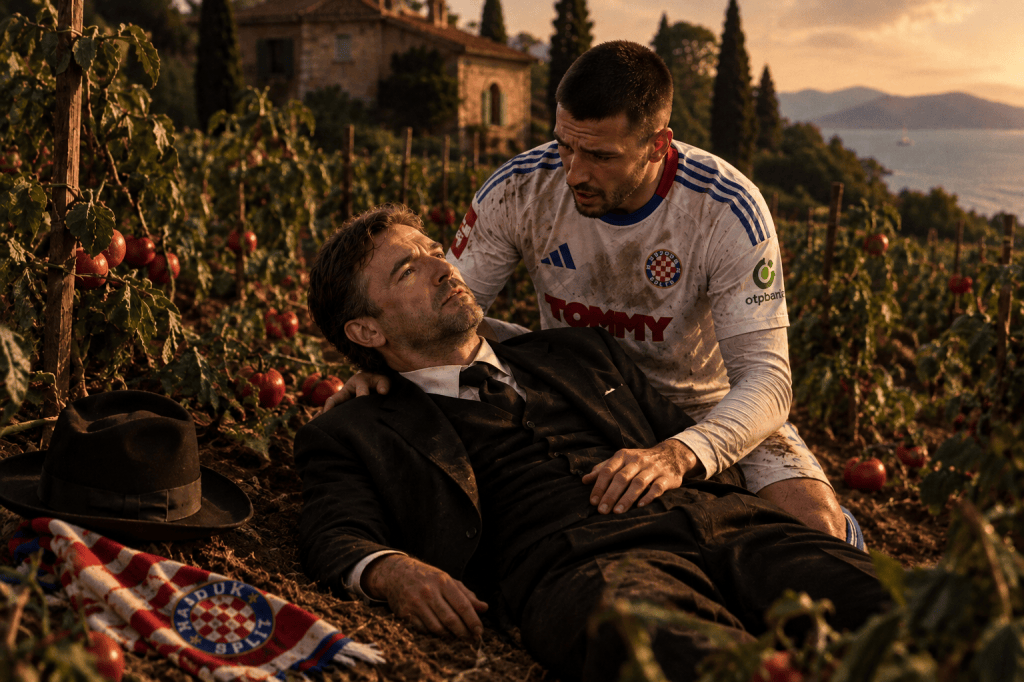
Every football genius comes with a manual. Some require a tactical briefing. Others require a full-time babysitter.
In the world of football, there are players who can do everything, players who can do almost everything, and players who can do one thing so extraordinarily well that everyone eventually agrees to stop asking them to do anything else.
Enter the footballing savant.
This is the player whose extraordinary ability makes the rest of his skill set look like it was assembled during a power cut. He can read the attacking phase three moves ahead, manipulate space, spot passing lanes invisible to ordinary mortals, and execute a technically exquisite pass — only to become a bewildered tourist the moment his team loses possession.
Unfortunately, football is an inconveniently comprehensive sport. It demands that players attack and defend, preferably during the same ninety minutes. This becomes particularly awkward when your player is a defender whose understanding of the attacking phase is light-years ahead of his defensive capabilities. A manager cannot simply admire his genius in possession while treating defending as an optional expansion pack.
Hajduk Split appears to have precisely this problem.
Their defensive structure has a Rain Man problem.
The reference is to Raymond Babbitt, the savant portrayed by Dustin Hoffman in Rain Man: a character with extraordinary abilities in specific areas who needs support navigating other aspects of everyday life. The footballing parallel is not about autism, but about the striking imbalance between exceptional ability and everything that ability cannot compensate for.
Hajduk’s very own Rain Man may possess remarkable spatial awareness, anticipation, technique, and an ability to recognise patterns before the opposition has even realised there is a question. With the ball at his feet, he looks like a footballing supercomputer.
Without it, the operating system crashes.
Positioning becomes a philosophical debate. Defensive responsibility turns into a matter of interpretation. Tracking a runner becomes an exciting opportunity to discover where the runner might eventually end up.
The paradox is delicious: a player capable of solving the most sophisticated attacking problems can become the solution to the opposition’s simplest attacking problems.
This does not necessarily make him a bad player. It makes him a specialist — an elite instrument designed for one particular function, like a Swiss watch that tells you the exact time but cannot survive being introduced to water.
The problem is not the instrument. The problem is asking it to put out a fire.
Hajduk’s other defenders must compensate, covering spaces that should already be occupied and tracking runners their teammate appears to regard as someone else’s responsibility. They are not merely defending the opposition; they are defending the opposition while simultaneously defending their teammate from the consequences of his own defensive performance.
At some point, this stops being a tactical system and starts resembling a government-funded support programme.
Against weaker opponents, the arrangement can work. Hajduk dominate possession, the opposition struggle to exploit the available space, and the savant gets to demonstrate why football analysts invented the phrase progressive actions.
Against better teams, the illusion evaporates. Good opponents do not need Pep Guardiola’s tactical genius to exploit an obvious weakness. They need a video analyst, a functioning pair of eyes, and access to Hajduk’s previous matches.
There is also a limit to how many times a centre-back can sprint across the defensive line to rescue a situation that should never have existed before wondering whether his contract includes hazard pay.
Which brings us to the Goodfather.
Gonzalo Garcia, the newly installed Don of the Hajduk dugout, faces the delicate task of managing not merely a footballer, but an entire tactical ecosystem built around one. The victory over Dinamo was glorious, naturally. It sent supporters into celebration, pundits into premature declarations of genius, and every tactical concern into temporary witness protection.
But beating Dinamo does not make a structural weakness disappear. It merely makes discussing it considerably less popular.
A derby victory is a result, not a defensive rehabilitation programme.
Garcia must resist the oldest temptation in football management: confusing a successful result with a successful solution. His Rain Man needs a system that protects his strengths without turning the rest of the defence into a permanent emergency response unit. Tactical adjustments, additional cover, clearly defined responsibilities — the details are Garcia’s problem. That, after all, is what managers are paid for.
Revolutionary, we know. Next, someone might suggest that defenders should be good at defending.
The danger is that the Rain Man’s brilliance becomes a form of managerial Stockholm syndrome. Every sublime pass excuses a defensive lapse. Every moment of attacking inspiration buys another ninety minutes of tactical indulgence. Eventually, Garcia stops coaching the player he has and starts coaching the player he hopes will materialise.
This is how good coaches lose their minds: not through one catastrophic defeat, but through a thousand tiny acts of justified optimism.
One more misplaced run. One more unmarked opponent at the back post. One more press conference about control, compactness, and the fine margins of elite football.
Soon, the post-match analysis resembles a defence lawyer explaining why his client cannot possibly be held responsible for anything that happened after the ball was lost.
And that is where the Goodfather’s real test begins. In the family business, loyalty matters. But loyalty without control is merely an expensive way to go broke. Garcia must decide whether he can accommodate his Rain Man without allowing every opponent to turn the player’s limitations into a tactical business model.
Because if he cannot, the ending writes itself.
One day, after another opponent has exposed Hajduk’s defensive arrangements, Garcia may find himself wandering through the tactical equivalent of a tomato field, chasing his little Rain Man while the season slips away and the rest of the family looks on in disbelief.
The attacking compilations will still be beautiful. The progressive passes will still be exquisite. The footballing romantics will still insist that genius must be given freedom.
And somewhere, an opposition winger will be running unmarked into the space that genius left behind.
The Goodfather may love his Rain Man. But if he cannot teach him to defend, he will end up sleeping with the fishes — while his Rain Man counts the cards.

