For a long time, I held a rather low opinion of Marko Livaja. I saw him as an immensely gifted footballer, but also as another example of what has often held Croatian football back—a player blessed with extraordinary talent, yet seemingly burdened by an oversized ego and too little self-reflection. To me, he embodied the recurring story of ability outweighing character.
Then he proved me wrong.
When sections of the public and influential figures around Naš Hajduk effectively withdrew their support, Livaja did not look for an easy exit. He did not chase a bigger contract abroad or seek refuge in a less demanding environment. He stayed.

That decision revealed something far more valuable than technical ability: pride, loyalty, and a genuine attachment to the club. It was at that moment that I changed my opinion of him. Not because he became a better footballer, but because he demonstrated the kind of character that cannot be measured by goals or assists.
That deserves respect.
Beating Pafos should not trigger euphoria.
Yes, Gonzalo Garcia is, without question, the most tactically gifted coach Hajduk has appointed in the last twenty years. His teams are structured, disciplined, and built around clear footballing principles. He consistently improves average players and accelerates the development of young talent better than most of his predecessors.
But let’s keep things in perspective.
Pafos are not a European football institution. They are a financially ambitious project, yet they possess neither the tradition, the historical weight, nor the footballing identity that defines genuinely great clubs. Regardless of Hajduk’s own struggles, defeating Pafos should never be regarded as an extraordinary achievement.
It should be the expectation.
The moment a club begins celebrating routine accomplishments as historic successes is the moment it quietly accepts mediocrity as its new standard.
That is the real danger.
Garcia deserved the whistles from the stands.
Not because he lacks tactical intelligence—quite the opposite.
He earned them because he represents a managerial philosophy in which the coach risks becoming more important than the dressing room itself. It is a philosophy that builds authority through distance rather than trust.
Great coaches do more than organise teams. They publicly protect their players when circumstances demand it. When leaders such as Livaja, Šarlija, Krovinović, or Guillamón feel that their manager is unwilling to stand behind them, the message extends far beyond those individuals: today you matter, tomorrow you may simply become expendable.
That culture may create discipline.
It rarely creates absolute commitment.
Respect cannot be demanded.
It has to be earned.
Garcia is an exceptional tactician, but that is also where his greatest challenge lies. Tactical brilliance wins matches; leadership wins dressing rooms. If he truly wants elite players to embrace his philosophy completely, he must recognise that great footballers do not follow ideas alone—they follow people they genuinely trust.
Ironically, Garcia may have contributed more than anyone to Livaja’s personal growth. He has created an environment in which Livaja can no longer rely solely on his status or personality. He has been forced to embrace the collective ahead of himself.
To Livaja’s immense credit, he has done exactly that.
Perhaps that is his greatest victory yet.
Then there is Šego.
One beautifully struck free kick cannot erase a catalogue of missed opportunities that a forward at this level simply has to convert.
Strikers are not ultimately judged by how much they run or how aggressively they press opponents.
They are judged by goals.
Hajduk cannot aspire to become a serious European club if effort is allowed to compensate for efficiency.
At a truly great club, effort is merely the minimum requirement.
End product is the standard.

Šego must therefore accept the hardest truth in professional football: talent, work rate, and determination only matter when they consistently appear on the scoreboard.
Hajduk’s greatest problem today is neither the quality of its coach nor the quality of its players.
Its greatest problem is the steady erosion of standards.
Routine victories are celebrated as extraordinary triumphs. Missed chances are excused because someone “worked hard.” Emotional narratives increasingly replace objective performance.
That is not how great football clubs operate.
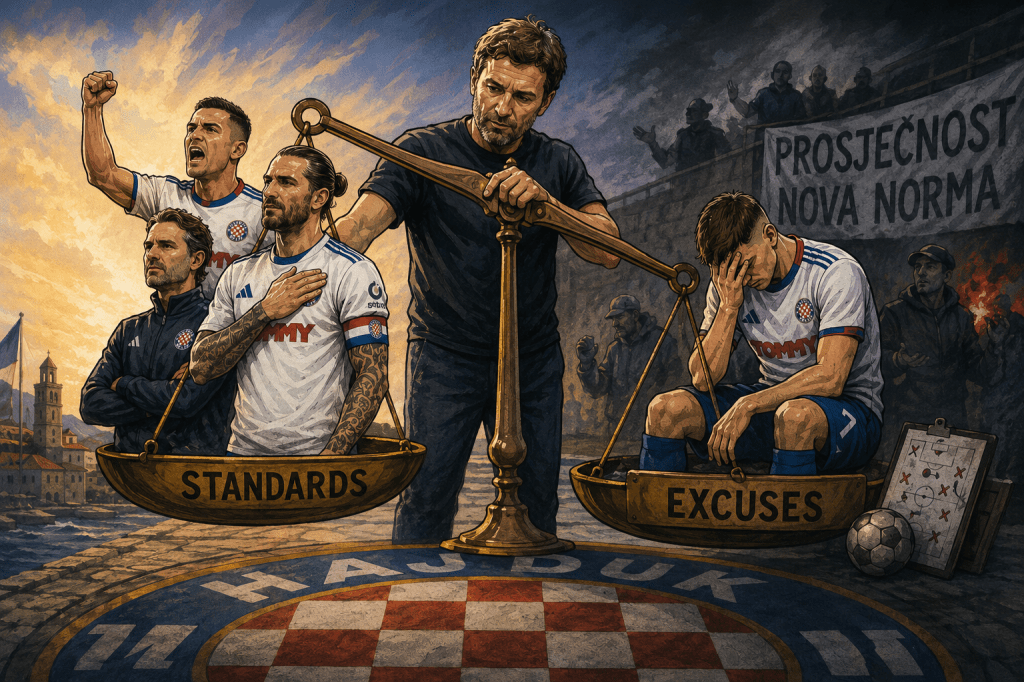
Great clubs are built on standards, not excuses.
And Hajduk will only become truly great again when it stops celebrating what should always have been expected.