The question is not whether Spain deserved to become world champions in 2026—they unquestionably did. The real question is how they achieved such complete dominance, controlling every match while conceding just one goal throughout the tournament.
The answer lies in a remarkable paradox.
Spain had the tournament’s outstanding goalkeeper without him leading the save statistics. Their centre-backs were the best without recording the most tackles or clearances. Their full-backs dictated games without topping the crossing charts, their wingers rarely relied on spectacular dribbles, and their forwards were neither the leading scorers nor assist providers.
How is that possible?
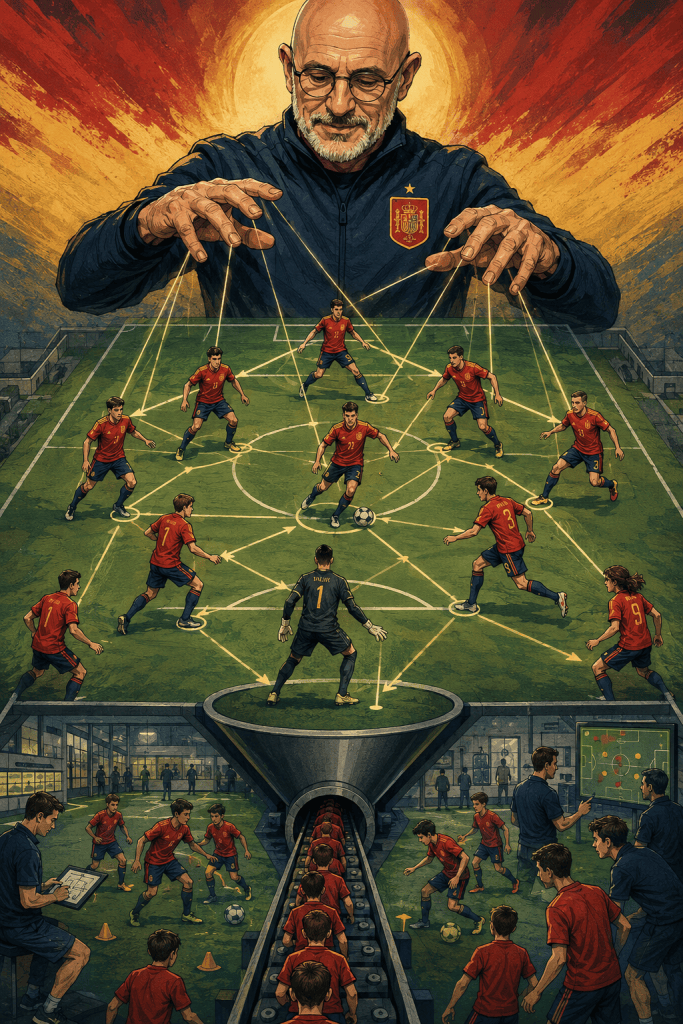
Because Spain did not rely on individuals. They relied on a system.
Every player was technically and tactically prepared to solve complex situations instinctively within a collective structure. Every movement created space, every pass generated a new angle, and every player understood not only his own role but also the responsibilities of those around him. Individual quality existed, but it always served the collective.
This identity was not built during a handful of international breaks. It is the product of more than two decades of strategic planning.
Spanish football educates players from childhood through a shared methodology that extends from academy football to the U17, U19 and U21 national teams before reaching the senior side. Positional play, spatial awareness, body orientation, passing geometry and decision-making are taught long before players become professionals.
Spain did not always look like this. Before Pep Guardiola’s Barcelona helped redefine positional football, the national team was known internationally as La Furia—competitive, passionate and intense, yet rarely dominant. Everything changed when positional and possession football evolved from a tactical preference into a national football philosophy.
The honours reflect that evolution: European champions in 2008, 2012 and 2024. World champions in 2010 and 2026.
Yet the trophies tell only part of the story.
Throughout the 2026 World Cup, Spain averaged close to 60 per cent possession and finished with the highest expected goals (xG) and the most chances created. Crucially, possession was never the objective—it was the defensive strategy. By monopolising the ball, Spain denied opponents the opportunity to attack. Their defenders spent much of the tournament outside their own penalty area, while the goalkeeper functioned as an additional outfield player, allowing Spain to compress the field and eliminate danger before it could even emerge.
It is one of football’s most sophisticated defensive concepts: the safest way to defend is to ensure the opponent rarely has the ball.
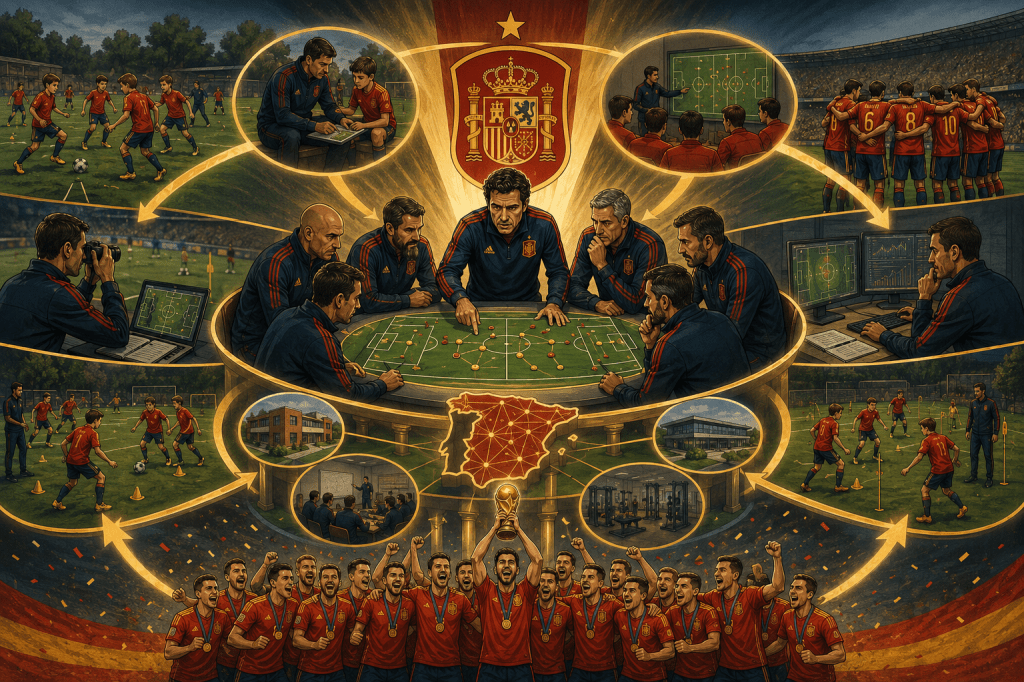
Such precision cannot be created solely at senior level. It requires an entire football ecosystem—coaches teaching identical principles across generations, training designed around spatial interpretation, positional superiority, body orientation, receiving patterns, passing angles and decision-making, all reinforced through a common football language understood by every talented youngster before reaching the elite game.
Above all, it demands patience and consistency.
Spain has spent more than twenty years constructing this identity. During that period, they collected more than fifteen UEFA European Championship titles across the U17, U19 and U21 age groups, with even England’s outstanding youth system unable to match that sustained production.
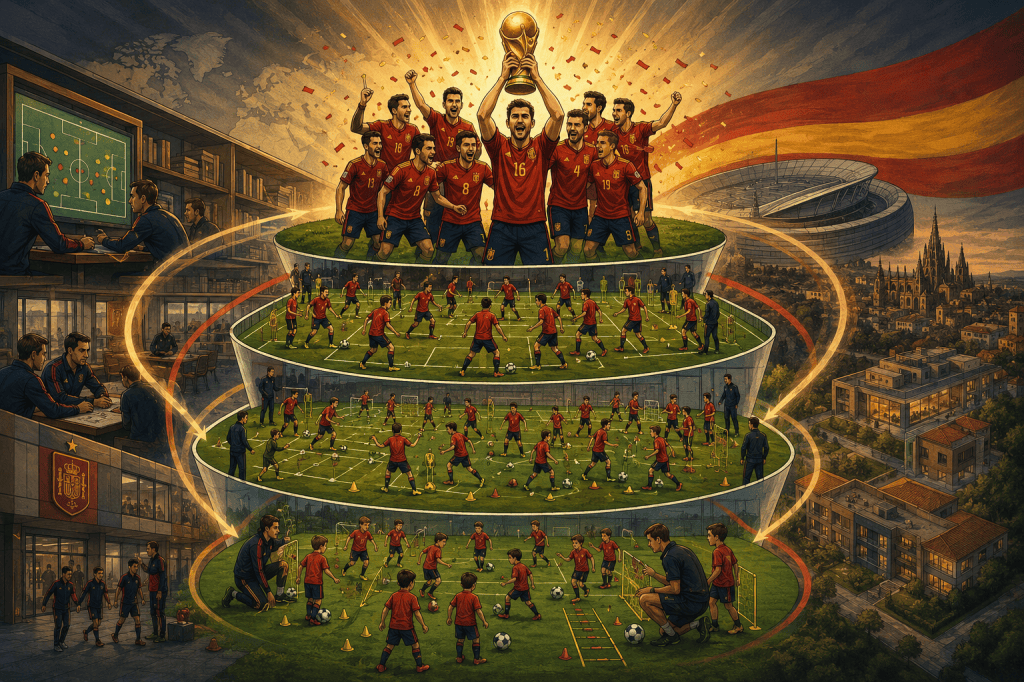
Those youth trophies were never the objective. They were simply indicators that the production process was functioning exactly as intended.
The 2026 FIFA World Cup confirmed what the most successful football nations have long understood: talent may decide moments, but systems decide eras.
Spain did not become world champions because they assembled the tournament’s greatest collection of individuals.
They became world champions because they built the world’s most coherent football ecosystem—one in which every academy, every youth national team and every coach contributes to the same football identity.
In the end, it was not only La Roja that lifted the FIFA World Cup.
It was the triumph of an idea.
An idea that had been refined for more than two decades.
An idea that proved, once again, that the greatest team is not always the one with the greatest players.
Sometimes, the greatest team is the one with the greatest system.