

This World Cup final is likely to be decided in one area above all others: the midfield. It promises to be a battle between Spain’s relentless pursuit of control and Argentina’s intensity without the ball—a clash of two similar footballing philosophies that could ultimately define the biggest game in world football.

Spain will almost certainly look to impose their positional game and dominate possession through the structures that have defined them throughout the tournament. Their double pivot is unlikely to remain static during the build-up phase. Rodri will frequently drop into deeper areas, positioning himself close to the full-backs or even between the centre-backs, while Fabián Ruiz and Dani Olmo are expected to receive from higher positions, creating progressive passing angles through the central corridors.
One of the biggest tactical questions concerns Argentina’s midfield structure, particularly in the defensive phase. How high will Lionel Scaloni’s side choose to defend? Will they commit to an aggressive high block or retreat into a more compact mid-block?
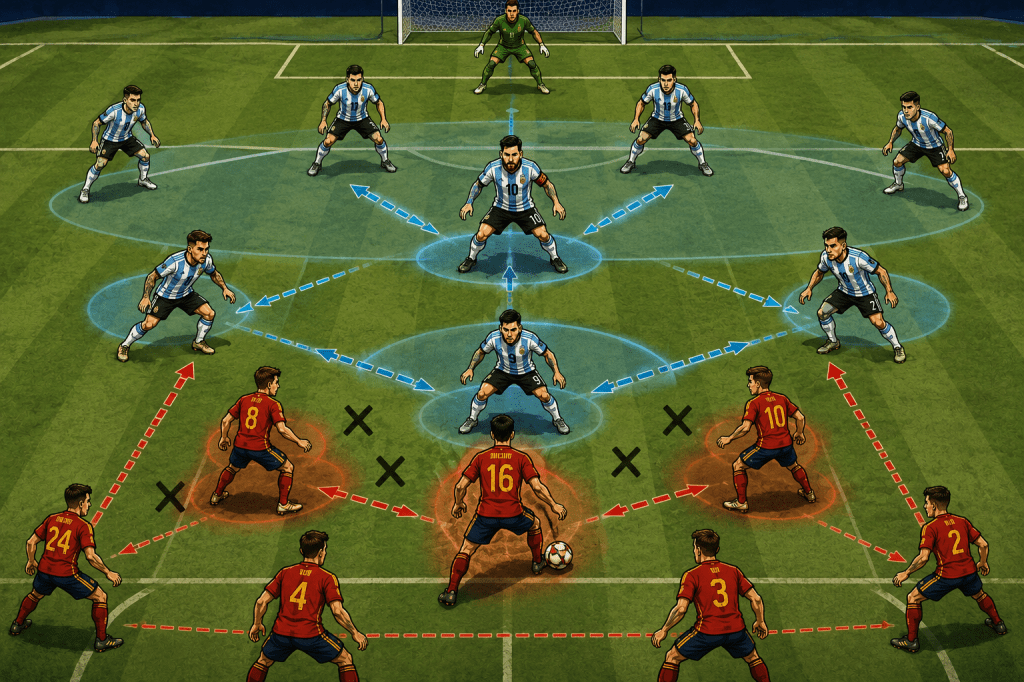
If Argentina opt for a high, zonal press, they will likely mirror Spain’s midfield structure. Rather than pressing Spain’s centre-backs aggressively, I expect Lionel Messi and Julián Álvarez to prioritise screening passing lanes into midfield, deliberately allowing Spain’s defensive line to initiate the build-up. The objective will be simple: isolate Spain’s midfielders from the first phase of possession. Once the ball reaches Rodri, Ruiz or Olmo, Argentina are likely to attack the receiver with maximum intensity, disrupting Spain’s rhythm through fierce duels and, when necessary, tactical fouls.
That pressure could force Spain into a more direct approach than they would normally prefer. Long balls towards Mikel Oyarzabal may become a recurring feature, making his partnership with Dani Olmo crucial in the battle for second balls. Cristian Romero is expected to mark Oyarzabal tightly, setting up what could become one of the most physical individual duels of the final.
On the opposite flank, Lamine Yamal will undoubtedly look to threaten with runs in behind. However, Nicolás Tagliafico—supported by Lisandro Martínez—should be far better equipped to contain those movements than France managed in the semi-final.
Spain’s full-backs may ultimately become one of the clearest indicators of how the game is unfolding. Their ability to advance into attacking positions will depend almost entirely on Spain’s control of possession. If Argentina succeed in disrupting Spain’s dominance on the ball and forcing quicker circulation under pressure, Spain’s full-backs will be pinned deeper, limiting one of Luis de la Fuente’s most important attacking mechanisms. That alone could become one of Argentina’s greatest tactical victories.
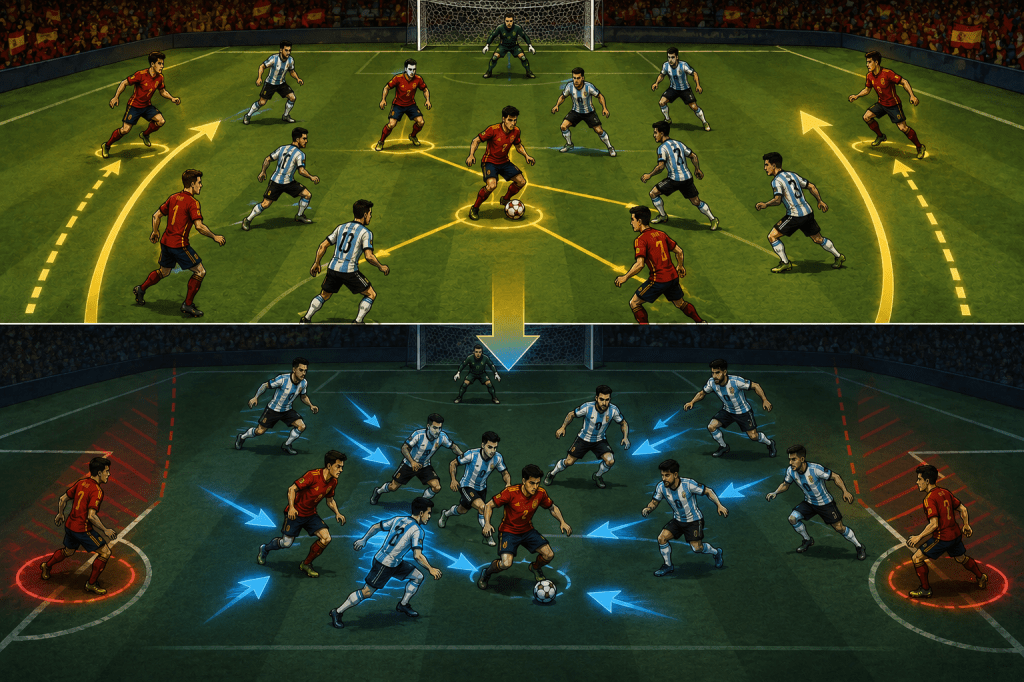
At the other end of the pitch, Spain may face their biggest problems immediately after losing possession in midfield. Argentina have repeatedly demonstrated throughout the tournament how devastating they can be in transition, particularly during extended transition phases. Their ability to attack before the opposition has fully reorganised—with explosive vertical attacks, early low deliveries and dangerous aerial crosses—has become one of their defining strengths. Expect Argentina to defend aggressively through the centre before attacking with speed, precision and ruthless verticality once possession is regained.
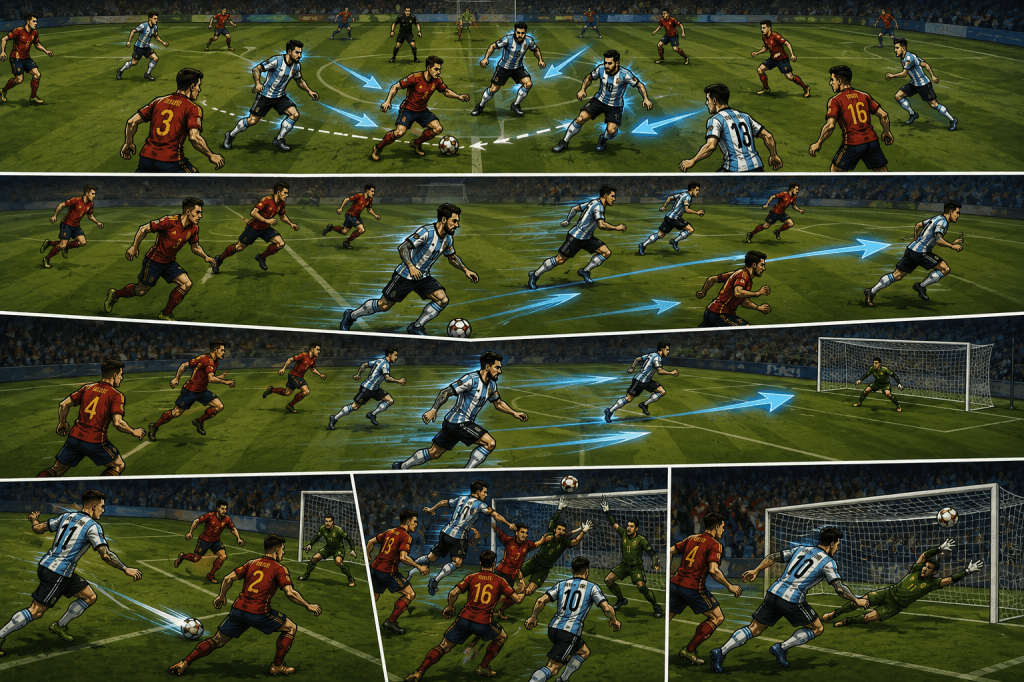
Ultimately, this final may not be decided by moments of individual brilliance alone, but by which side succeeds in imposing its rhythm in midfield. Can Spain transform possession into territorial dominance, or will Argentina’s aggression, relentless pressing and devastating transitions dismantle Spain’s structure?
The World Cup trophy may well be lifted by the team that wins football’s most important battlefield: the midfield.

