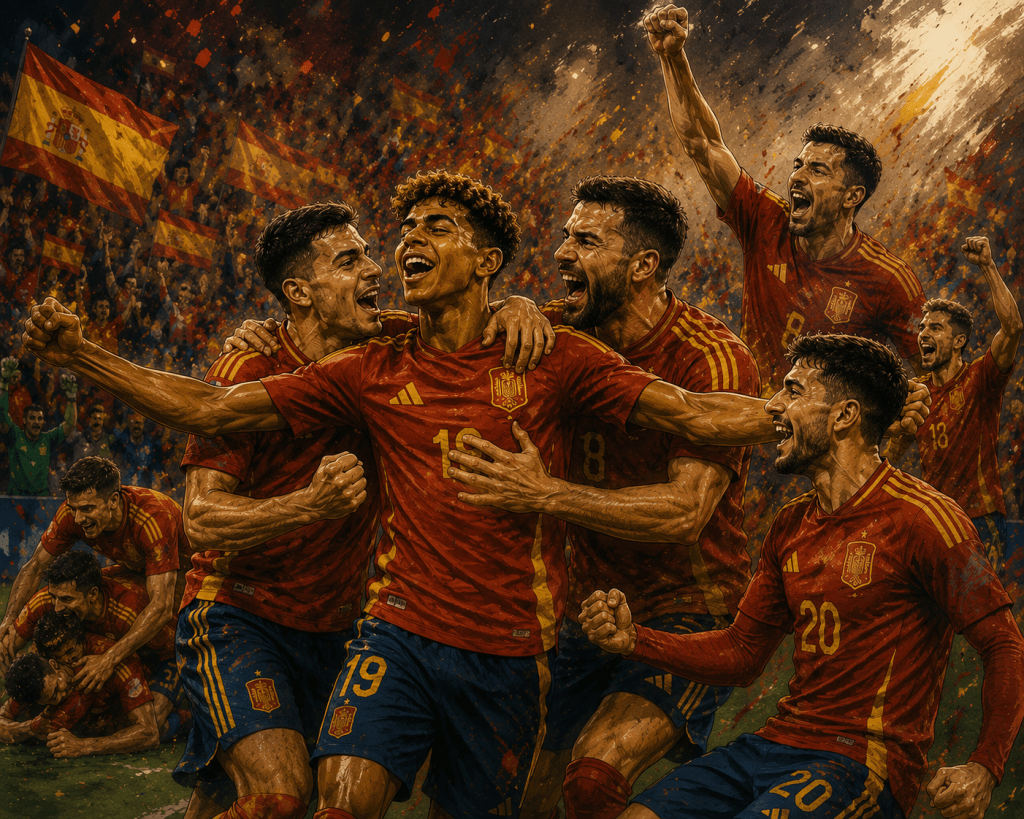

Football often rewards preparation, but World Cup semi-finals are decided by something more difficult to quantify: the ability to solve problems as they emerge. International football offers little time for tactical corrections. Managers cannot spend weeks refining solutions on the training ground. They have one opportunity to read the game correctly, and another to react when the original plan begins to fail.
Against Spain, Didier Deschamps failed on both counts.
Luis de la Fuente, meanwhile, produced a coaching performance that bordered on tactical perfection.
From the opening whistle, Spain looked like a team executing a carefully rehearsed script. Their structure remained recognisably Spanish—patient in possession, aggressive without the ball—but several subtle adjustments completely changed the dynamics of the contest. Rather than attempting to dominate France everywhere, De la Fuente identified one structural weakness and relentlessly attacked it until the entire French defensive system collapsed.
That weakness was Lucas Digne.
Rather than distributing attacks evenly, Spain repeatedly channelled possession towards their right side, isolating Lamine Yamal against the French left-back. It quickly became the defining tactical duel of the match.
Yamal won it emphatically.
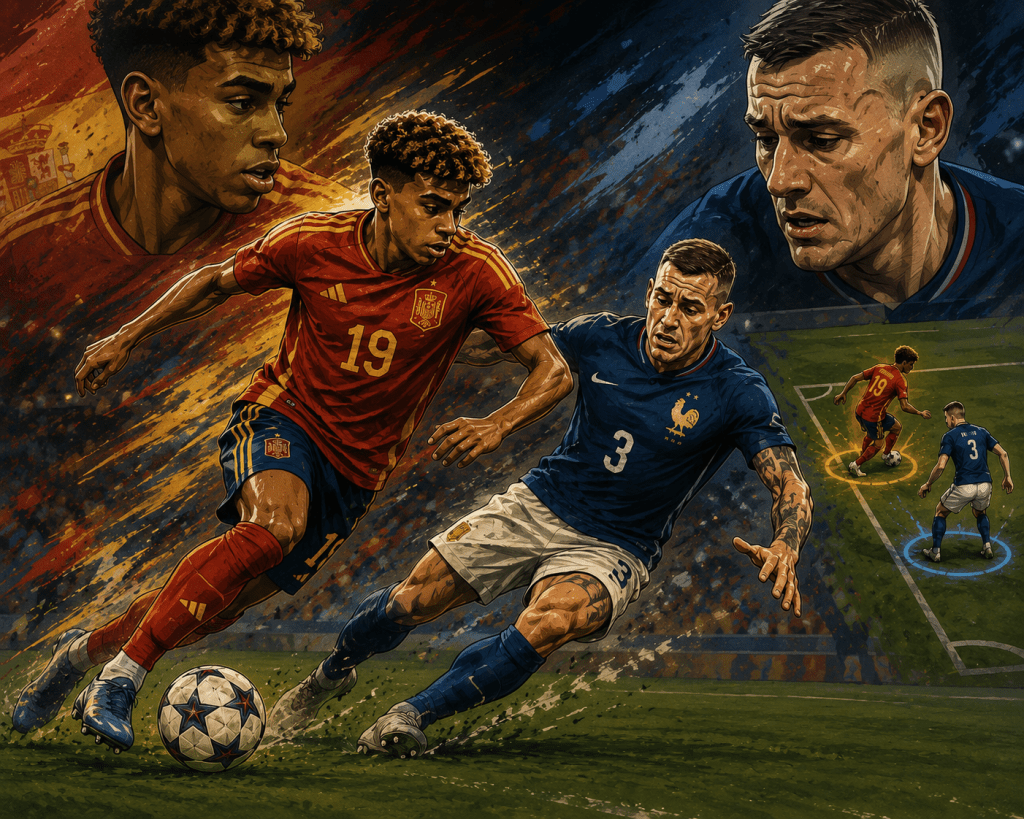
Every time Spain succeeded in switching play, Digne was forced into situations he simply could not control. Yamal’s acceleration, close control and decision-making repeatedly eliminated him, forcing France’s defensive block to shift excessively towards one side. As defenders moved across to provide cover, new spaces opened for Pedro Porro’s overlapping runs and for Spain’s midfielders arriving from deeper positions.
The opening goal felt less like an isolated action and more like the inevitable consequence of sustained tactical pressure.
What made De la Fuente’s strategy particularly impressive was its persistence. Spain never abandoned the plan because France never demonstrated they had found an answer.
That is where the match became a coaching contest rather than merely a football match.
One of the greatest challenges facing any international manager is recognising when an individual battle has become structurally damaging for the team. Deschamps never truly addressed the problem.
Despite Digne enduring an increasingly difficult evening, France’s coaching staff resisted making an immediate adjustment. Whether through tactical protection, positional reshaping or substitution, nothing fundamentally changed after halftime. By the time Theo Hernández eventually entered the match in the 72nd minute, Spain had already established complete territorial control and the damage was irreversible.
Even France’s substitutions illustrated a lack of tactical coherence.
Replacing Bradley Barcola with Désiré Doué failed to restore balance. Within minutes of entering the pitch, Doué failed to track his defensive assignment during the sequence leading to Spain’s second goal. Moments earlier, Digne himself had contributed with an unsuccessful clearance that allowed Spain to recycle possession and sustain another wave of pressure.
Instead of solving France’s problems, the substitutions merely exposed new ones.
Yet De la Fuente’s tactical superiority extended well beyond exploiting a favourable one-versus-one matchup.
Spain’s greatest defensive achievement came without the ball.
France entered the match hoping to attack through quick vertical transitions, using the pace of their forwards to punish Spain’s aggressive defensive line. De la Fuente anticipated exactly that. Rather than retreating into a conservative block, Spain systematically denied France access to the passes that initiate counter-attacks.
Rodri and Spain’s midfield compressed central passing lanes, while the front line immediately pressed the first receiver after possession changed hands. The objective was not simply to recover the ball quickly, but to prevent France from ever finding the first progressive pass.
Without supply, even elite forwards become isolated.
Whenever France did manage to break Spain’s first defensive line, Unai Simón acted almost as an additional sweeper, repeatedly leaving his penalty area to intercept through balls before French attackers could exploit the space behind Spain’s high defensive line. It was a calculated risk, executed with remarkable confidence and timing.
Spain therefore neutralised France’s greatest weapon before it could become dangerous.
The defensive line deserves equal recognition.
Marc Cucurella produced another outstanding performance, combining aggressive pressing with intelligent positioning and composure in possession. Alongside him, Spain’s back four maintained excellent distances throughout the match, stepping forward together to compress space while rarely allowing France opportunities to attack between the lines.
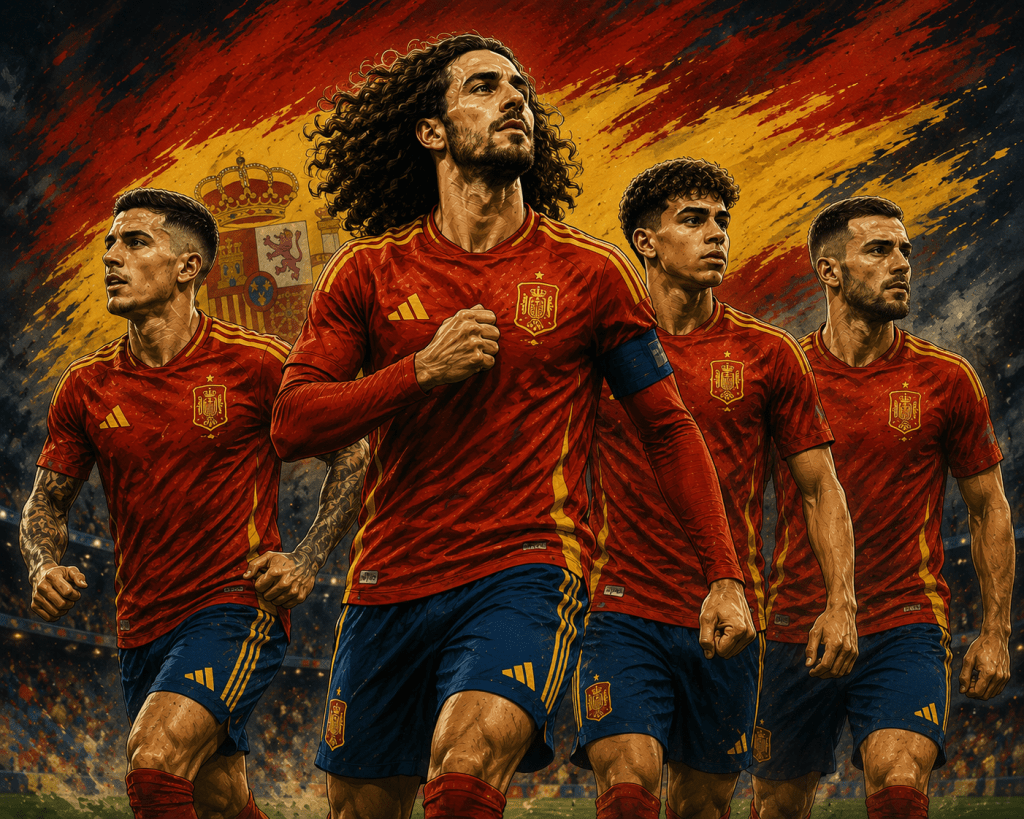
Collectively, it was one of Spain’s most complete defensive displays under De la Fuente.
Perhaps the most revealing aspect of the evening was psychological rather than tactical.
France had enjoyed a relatively comfortable route through much of the tournament and rarely found themselves chasing games against an opponent capable of controlling both possession and space simultaneously. Once Spain established control, France appeared increasingly uncomfortable playing outside their preferred script. As the game became more chaotic, Spain became calmer. As France searched for solutions, Spain simply continued executing the ones they had prepared before kick-off.
That contrast ultimately reflected the two managers.
De la Fuente anticipated France’s problems before they appeared.
Deschamps reacted only after they had already decided the match.
At the highest level, elite coaching is rarely about inventing extraordinary tactical systems. It is about recognising where games will be won before the first whistle and adapting faster than your opponent once the unexpected happens.
In this World Cup semi-final, Luis de la Fuente accomplished both.
Spain did not simply defeat France 2–0.
Their manager won the tactical battle long before the final whistle, delivering a coaching masterclass that secured La Roja’s place in the World Cup final.