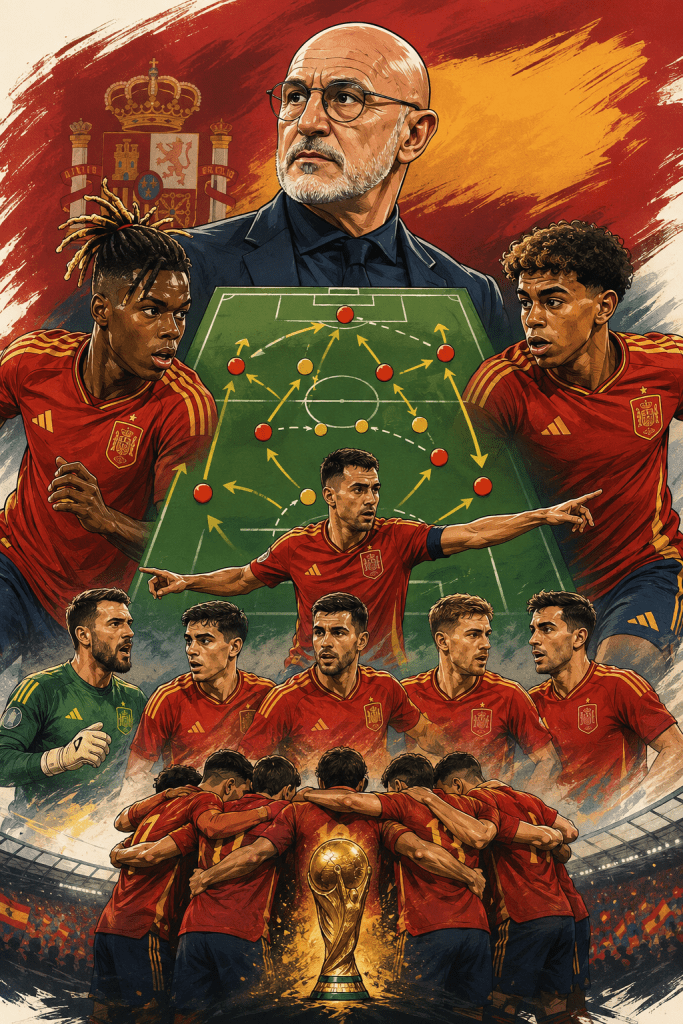
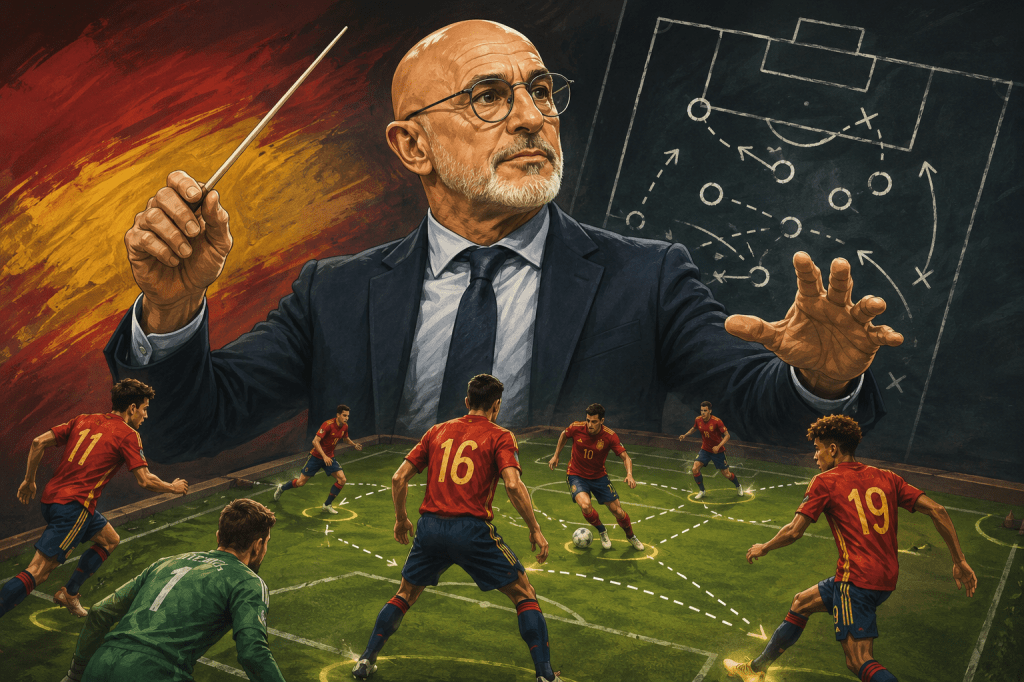
Luis de la Fuente – The Architect of a New Spain
When the Spanish Football Federation appointed Luis de la Fuente as head coach following the 2022 FIFA World Cup in Qatar, the decision was met with a degree of scepticism. He did not arrive with the profile of an elite club manager, nor with Champions League trophies or major domestic titles on his résumé. Instead, he was a coach who had spent almost his entire managerial career within Spain’s national team structure, developing successive generations of young players. In hindsight, that proved to be his greatest qualification.
De la Fuente led Spain’s Under-19 and Under-21 sides to European titles and guided the Olympic team to a silver medal in Tokyo. Yet his greatest achievement was not measured in silverware but in continuity. By the time he took over the senior national team, he already knew the core of the squad inside out. Rodri, Pedri, Fabián Ruiz, Unai Simón, Mikel Oyarzabal, Martín Zubimendi and many others were not players he needed to evaluate; they were footballers whose development he had overseen for years. In international football, where preparation time is measured in days rather than months, that familiarity represents a decisive competitive advantage.
From a tactical perspective, De la Fuente has not abandoned the principles that defined Spanish football over the past two decades; he has modernised them. Possession remains central to Spain’s identity, but it is no longer an end in itself. Instead of circulating the ball endlessly, his side uses possession to manipulate defensive structures, create space and attack vertically. Technical excellence remains the foundation, but it is now complemented by greater intensity, athleticism and directness.
One of the most significant transformations has come through the wide areas. Nico Williams and Lamine Yamal embody this new Spain. Rather than merely supporting positional play, they provide genuine one-versus-one superiority, stretching defensive blocks and forcing opponents into uncomfortable decisions. Width has once again become an attacking weapon rather than simply a positional reference.
Perhaps De la Fuente’s greatest contribution, however, lies beyond tactics. Unlike managers who impose authority through charisma or confrontation, he has built a culture based on trust, continuity and collective responsibility. His Spain appears emotionally balanced, united and fully committed to a common identity. That stability has been just as important as any tactical innovation in restoring Spain among the world’s elite.
Tactical Analysis: Spain at the 2026 FIFA World Cup
Through the opening stages of the 2026 World Cup, Spain have arguably offered the tournament’s clearest expression of modern positional football. Their nominal 4-3-3 is merely a starting point. In possession, it frequently evolves into a 3-2-5 or 2-3-5, with constant positional rotations creating numerical superiority between the lines.
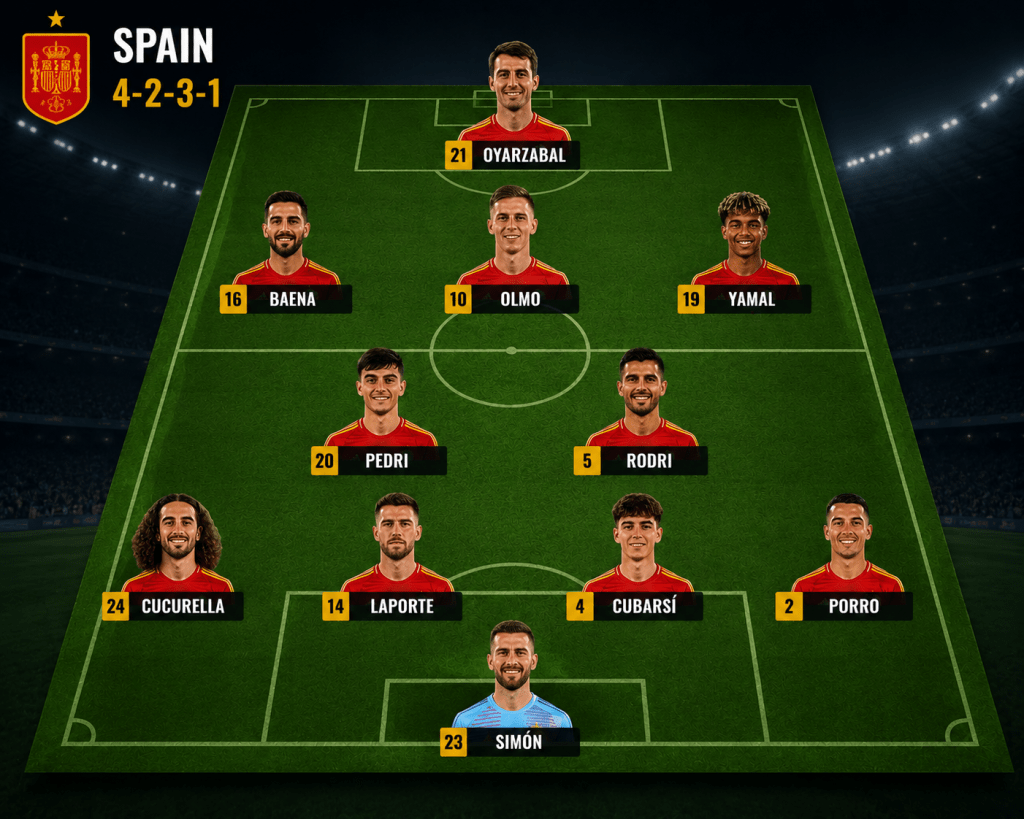
Build-up begins with Unai Simón, who functions as far more than a goalkeeper. His composure in possession allows Spain to invite pressure before exploiting the spaces it creates. Rodri regularly drops alongside or between the centre-backs, forming the first platform of progression, while Pedri occupies advanced pockets between midfield and defence. Together, they dictate the rhythm of Spain’s attacks: Rodri controlling the tempo from deep, Pedri accelerating play through intelligent movement and exceptional spatial awareness.
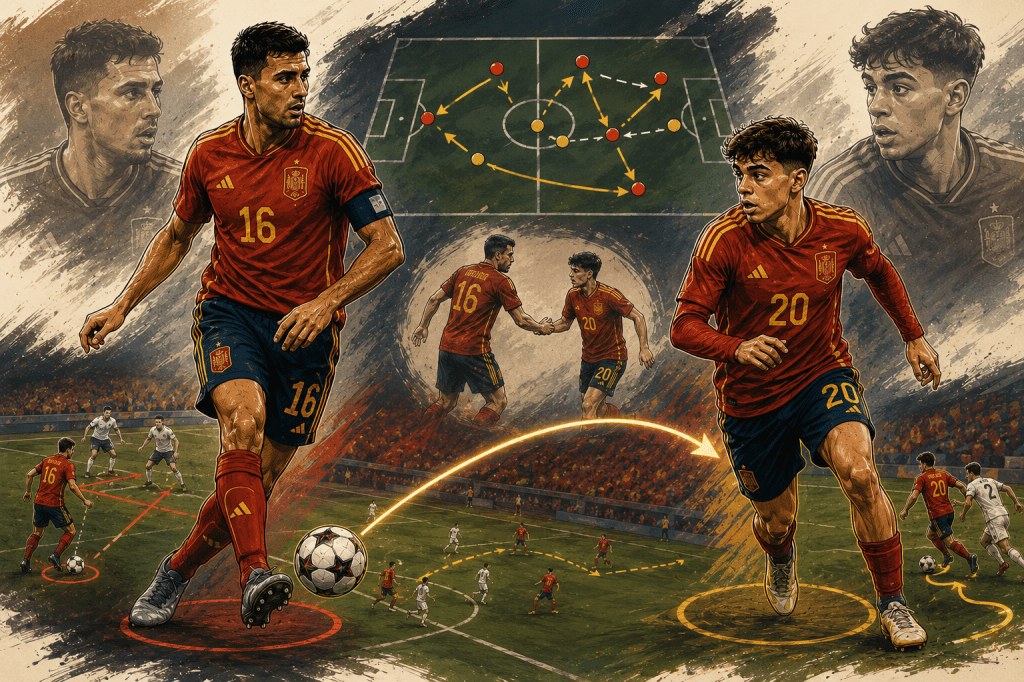
The team’s greatest individual weapon remains Lamine Yamal. His ability to isolate defenders and eliminate opponents in one-versus-one situations gives Spain an attacking dimension that previous generations rarely possessed. When opponents commit two defenders to Yamal, spaces immediately appear for Pedri or Fabián Ruiz. When they fail to do so, Yamal is capable of deciding matches through individual brilliance.
Unlike Spain’s golden generation between 2008 and 2012, this team does not seek absolute control through endless circulation. Their possession is more vertical, their attacks more direct, relying on diagonal passes, quick switches of play and cut-backs rather than prolonged dominance around the penalty area. Possession has become a means of controlling space rather than simply controlling the ball.
Defensively, Spain have been among the tournament’s most organised sides. Their aggressive high press, coordinated pressing triggers and immediate counter-press after losing possession enable them to spend long periods camped inside the opposition half. If the initial press is bypassed, they quickly reorganise into a remarkably compact mid-block, closing central passing lanes and denying opponents time and space between the lines.
Yet this model is not without flaws.
Spain still lack an elite penalty-box striker capable of consistently converting territorial dominance into goals. Mikel Oyarzabal contributes intelligently to build-up play and positional rotations, but he is not a traditional No. 9 who guarantees clinical finishing.
That issue has become increasingly apparent during this World Cup. Spain have created a high volume of chances but have lacked efficiency in front of goal. Lamine Yamal, despite remaining the team’s primary creative outlet, has not reached his usual level of individual form in the final third. More broadly, the attacking unit as a whole appears to be experiencing a dip in finishing confidence. Nico Williams’ return from injury has also coincided with a period in which he has struggled to make his usual impact in the attacking third, slightly reducing Spain’s effectiveness on the left flank.
Dani Olmo has provided valuable verticality with his late runs from midfield and ability to attack central spaces, adding another dimension to Spain’s offensive structure. However, even his contribution has not fully solved their problems in front of goal. If Spain are to lift the World Cup, improving their efficiency in decisive moments will almost certainly be their biggest tactical challenge.
Beyond that, the system remains heavily dependent on Rodri’s control of the game and Yamal’s ability to destabilise defensive structures. Neutralising either player significantly reduces Spain’s attacking fluency, while their aggressive defensive line inevitably leaves space behind the centre-backs against opponents capable of exploiting transitions.
Even so, the defining strength of this Spain lies in its collective identity. Every player understands his tactical role, communication within the team is outstanding, and emotional composure allows them to remain faithful to their principles regardless of the scoreline. It is this blend of technical quality, tactical organisation and psychological resilience that makes Spain arguably the tournament’s most complete side.
Can Spain Win the World Cup?
The most interesting question surrounding this Spanish team is not whether it is better than the side that won two European Championships and the 2010 World Cup.
It is not.
The golden generation led by Xavi Hernández, Andrés Iniesta, Sergio Busquets and Iker Casillas remains the benchmark for collective control in international football. Their ability to dominate matches through possession, manipulating space, tempo and the emotional rhythm of games, may never be replicated.
Football in 2026, however, demands different qualities.
This Spain may lack a player capable of controlling matches quite like Xavi, and its defensive line cannot yet match the experience once provided by Puyol, Piqué and Sergio Ramos. Yet De la Fuente’s team possesses something its predecessors arguably did not: greater tactical versatility.
This is a team capable of winning in multiple ways. It can dominate possession, overwhelm opponents with coordinated pressing, create superiority through Yamal’s individual brilliance or patiently dismantle organised defensive blocks through positional play. That flexibility makes Spain exceptionally well suited to the demands of modern tournament football.
Their biggest threats remain nations such as France or Brazil, whose pace and individual quality in transition can expose Spain’s aggressive defensive structure. Squad depth is another concern, particularly if Rodri or Pedri were unavailable, as neither has a true like-for-like replacement.
Nevertheless, few teams combine as many elements of the modern game as Spain currently do. Technical excellence, positional intelligence, physical intensity, coordinated pressing and collective stability coexist within a single tactical framework.
If Vicente del Bosque’s Spain represented the pinnacle of classical positional football, Luis de la Fuente’s side represents its evolution. It has not abandoned Spain’s footballing identity; it has adapted it to the realities of contemporary football.
That is precisely why Spain enter the decisive stages of the 2026 World Cup not merely as one of the favourites, but as perhaps the most tactically complete team left in the competition—and one with every reason to believe that another world title is within reach.