

“Football is simple, but it is difficult to play simply.” — Johan Cruyff
For decades, England has entered major tournaments carrying a familiar burden: extraordinary talent accompanied by extraordinary expectations. Each generation arrives with the belief that it could finally end the long wait for international success, supported by players of undeniable quality and a nation convinced that the next opportunity will be different. Yet, when the decisive moments arrive, England often appears less like a cohesive football team and more like a collection of outstanding individuals searching for solutions in isolation.
Thomas Tuchel was not appointed to find better footballers; England already possesses those. His challenge is far greater: to transform a group of elite players into a modern tournament team capable of competing with the most tactically advanced nations in the world.
This distinction is fundamental.
Modern international football is no longer decided solely by moments of individual brilliance. The margins between victory and elimination have become increasingly tactical, and the best teams succeed because every aspect of their game is connected. Their build-up creates the foundation for their attacking play, their defensive organisation determines the quality of their transitions, and their set pieces evolve into carefully designed opportunities rather than moments of chance. Structure has become the bedrock upon which elite teams build their success.
Few coaches understand this reality more deeply than Thomas Tuchel.
Beyond Selection: Building a Team, Not a Collection of Names
One of Tuchel’s greatest challenges has not come from opponents on the pitch but from the expectations surrounding the players left out of the squad.
The decision to exclude certain established names from the roster immediately sparked debate among supporters and media. In England, where individual reputation often carries significant weight, leaving out a recognised star can quickly be framed as a controversial decision rather than a tactical choice. Questions inevitably follow: Why was this player selected over that one? Why leave experienced players at home? Why ignore a player who has performed at the highest level for club and country?
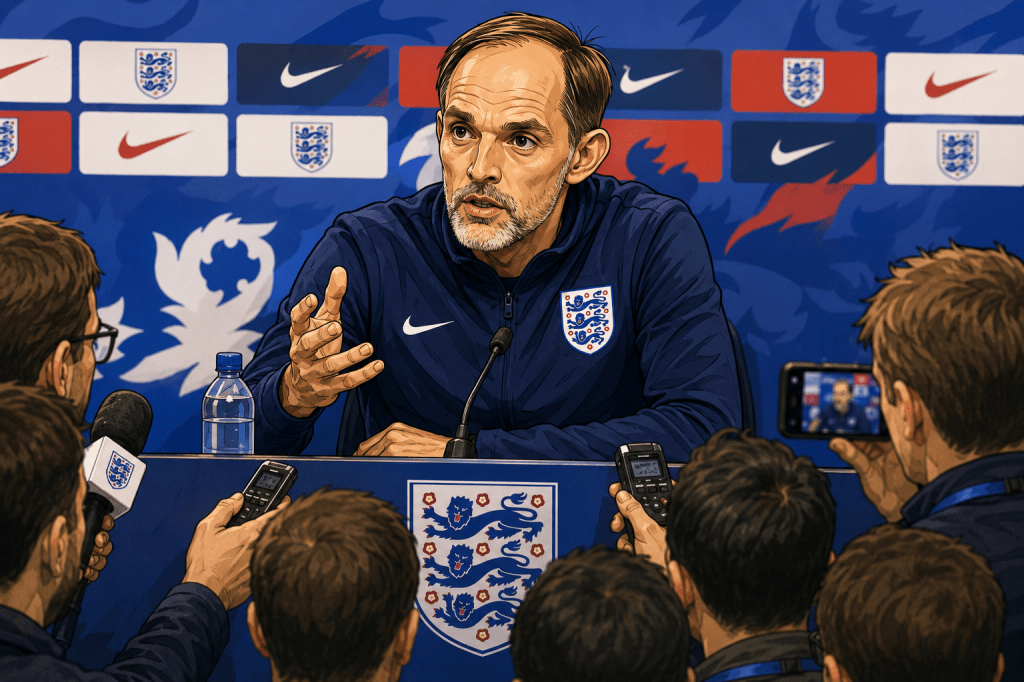
Tuchel’s answer rests on a principle that has defined successful tournament teams throughout history: a national side cannot simply be built by collecting the best individuals available; it must be constructed around players who enhance the collective identity.
International football is particularly sensitive to this issue. Unlike clubs, where managers can reshape squads over months and years, national teams have limited time together. Every player must understand his role, accept responsibility and contribute to a shared purpose. A squad filled with exceptional talent can become weaker if individuals prioritise personal status, playing time or reputation over the needs of the team.
This does not mean selecting the most obedient players or ignoring quality. It means recognising that chemistry, balance and mentality are tactical qualities in their own right.
Tuchel’s challenge, therefore, was not only to create the right formation but also to foster the right environment. A player who feels entitled to start, becomes dissatisfied when substituted or is frustrated by a reduced role can affect the atmosphere of the entire group. At the highest level, where outcomes are decided by confidence and collective belief, internal harmony becomes a competitive edge.
The greatest tournament teams are rarely defined solely by the number of stars they possess. They are defined by how those stars function together.
Tuchel’s selection decisions embodied that philosophy: England was not searching for the most famous names; they were searching for the right team.
Beyond Formations: The Evolution of a Tactical Thinker
To judge Thomas Tuchel simply by the formations he uses is to miss the essence of his football.
Throughout his managerial career at Mainz, Borussia Dortmund, Paris Saint-Germain, Chelsea and Bayern Munich, his teams have constantly evolved. Defensive structures have shifted, midfield combinations have changed and attacking roles have been reinvented depending on the qualities of the players available. Yet beneath those adjustments remains the same central principle: football is ultimately a game about controlling space.
Tuchel’s new England is not built around endless versatility. It is built around structure and security. Positions are more fixed, and the tactical message has been simplified for the players.
He coaches relationships between players and the spaces they occupy. Every movement exists to create an advantage, whether through numerical superiority, positional rotations or the manipulation of an opponent’s defensive shape. Possession is valuable because it provides control, while pressing matters because it creates opportunities to attack before the opposition can recover its structure.
His greatest achievement has not been the invention of a new formation. It has been the removal of unnecessary chaos from the game.
That philosophy has now become the foundation of England’s identity.
Rebuilding England’s Identity
The greatest challenge for any international manager is time. Unlike club coaches, national team managers rarely have the opportunity to develop complex tactical systems through daily training. Preparation periods are short, players arrive from different footballing environments and simplicity often becomes a necessity.
England entered the 2026 FIFA World Cup with more than a collection of tactical ideas. They arrived with a clear footballing language. Players understandd not only their individual responsibilities but also how their movements influenced those around them.
On paper, England operate in a 4-2-3-1 system. During possession, Declan Rice and Elliot Anderson become the central reference points around which the team balanced itself.
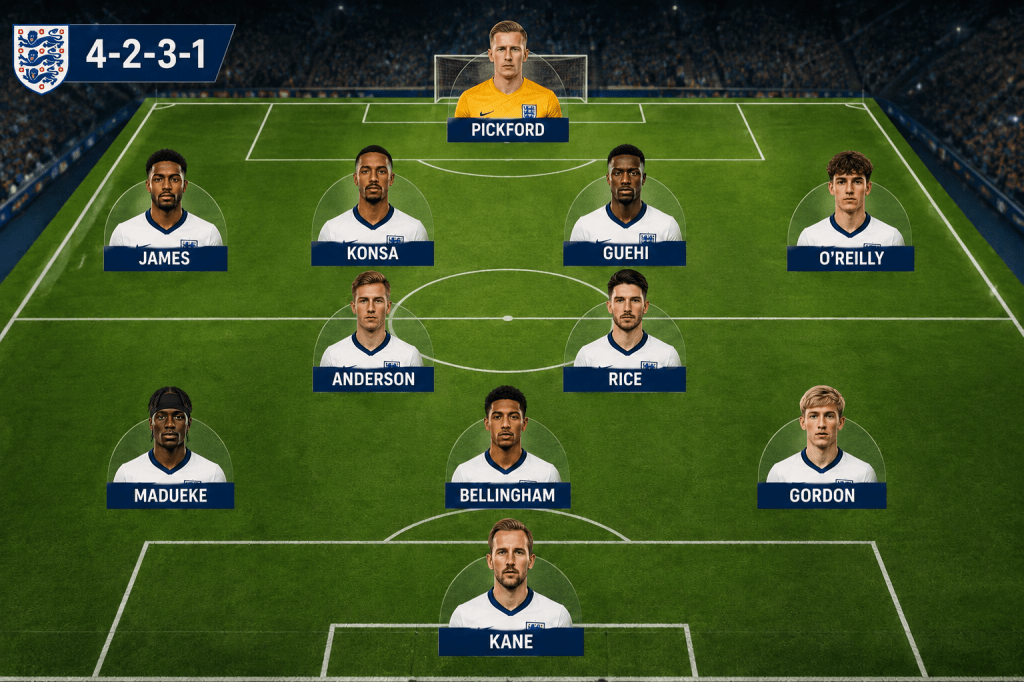
Every player understand not only where to move, but why that movement matter. After a long time, England’s playing style look simple enough for players to execute naturally while still being effective at the highest level.
England no longer controll possession simply for the sake of having the ball. Their circulation has purpose without unnecessary complications. They attempt to draw opponents out of position before attacking the spaces created behind them.
Full-backs no longer make excessive underlapping movements or act like additional midfielders. Their roles are simplified: they play more like traditional full-backs, providing width and balance.
Jude Bellingham became the essential connection between midfield and attack, capable of receiving under pressure, carrying the ball through defensive lines and changing the rhythm of matches through his decision-making.
Harry Kane’s role became equally significant. Rather than remaining permanently between centre-backs, he repeatedly dropped deeper to influence the game, forcing defenders into difficult choices and creating space for teammates to exploit. His movement was not a retreat from danger; it was a mechanism for creating it.
England’s attacking identity is therefore built less on individual improvisation and more on collective understanding. Even their use of crosses reflect this philosophy. Early deliveries, cut-backs and far-post movements are not hopeful attempts into crowded penalty areas, but carefully constructed methods designed to exploit defensive reactions.
Tuchel simplified things. He placed players in their natural positions and simplified the game as much as possible.
Winning Without the Ball
One of the most common misunderstandings of modern football is that elite defending is defined only by aggressive pressing.
Tuchel’s approach is less complicated; it is simplified.
The objective is not simply to recover possession as quickly as possible. The objective is to recover possession in the areas where it can create the greatest threat.
England therefore avoid becoming a team driven purely by intensity. Their defensive success come from controlling space before applying pressure. Central areas remain protected, passing lanes are carefully managed and pressing is triggered only when circumstances are favourable: a poor touch, a backwards pass or an opponent forced towards the touchline.
When immediate recovery is impossible, England show another quality often overlooked in tournament football: patience. They can retreat into a compact defensive block without losing organisation or emotional control.
This is not passive defending. This is intelligent defending.
Their reaction immediately after losing possession demonstrate the same principles. Rather than chasing the ball collectively and opening spaces behind them, England prioritise delaying the opponent’s progress while maintaining their defensive structure. Rice protect central areas, nearby players restricted passing options and the team remained connected.
Tournament football is often decided by emotional discipline as much as technical ability.
Tuchel’s England possess both.
Kane and Bellingham: A Defining Partnership
Every great international team is built around relationships between exceptional players. The greatest sides in tournament history have rarely been defined only by individual brilliance; they have been shaped by partnerships that allow talent to become something greater than the sum of its parts.
Manchester United had Yorke and Cole. Brazil had Romário and Bebeto. Milan had Shevchenko and Inzaghi. For this England team, that defining connection belongs to Harry Kane and Jude Bellingham.
What makes their partnership so valuable is not simply the quality they possess individually, but the way their contrasting qualities fit together within Tuchel’s structure.

Kane has evolved far beyond the traditional role of a centre-forward. His intelligence allows him to influence matches from deeper positions, drawing defenders away from their natural zones and creating spaces that other players can attack. His movement is not about leaving the penalty area; it is about reshaping the defensive structure around him.
Bellingham is the player who understands those moments better than anyone. His greatest quality is not only his technical ability or physical power, but his awareness of timing. He recognises when Kane’s movement has created an opening and arrives into those spaces with extraordinary precision.
While Kane manipulates the defensive line, Bellingham attacks the consequences of that manipulation. One changes the shape of the game; the other exploits the space that appears.
Their relationship reflects the wider philosophy of Tuchel’s England. Neither player is required to dominate matches alone because the system allows their strengths to constantly reinforce one another.
Kane provides control, intelligence and connection between the lines. Bellingham provides acceleration, penetration and unpredictability.
Together, they give England something every elite tournament team requires: the ability to control a match while still possessing the capacity to decide it.
Their influence extends beyond attacking moments. Both players contribute to England’s defensive organisation, pressing structure and leadership. They understand not only how to create chances, but how to shape the emotional rhythm of a game.
In that sense, their partnership represents more than a connection between two stars. It represents the meeting point between Tuchel’s tactical principles and England’s greatest individual qualities.
Turning Set Pieces into a Tactical Weapon
In modern football, set pieces are no longer moments of opportunity; they are carefully designed attacking phases. England’s approach to corners at the 2026 World Cup represents this evolution perfectly. Rather than treating corners as simple crosses into the penalty area, Thomas Tuchel’s side has transformed them into structured attacking situations where every movement has a clear purpose. England’s reputation from previous tournaments, especially their exceptional set-piece record in 2018, has continued to influence their identity.
The strength of England’s corners does not come only from the quality of delivery. It comes from the organisation around that delivery. Players are assigned specific roles: some attack the first zone, others create blocks, while others position themselves to exploit the second phase. The objective is not simply to win the first header, but to manipulate defensive reactions and create favourable finishing situations.
Declan Rice, Bukayo Saka and other technically gifted players provide England with elite delivery options, allowing them to vary their approach depending on the opponent. Some corners are aimed aggressively towards dominant aerial players, while others are designed to create space through movement and deception.

The presence of players such as Harry Kane, Jude Bellingham and powerful centre-backs gives England a unique combination of intelligence, timing and physical dominance. Kane’s ability to attack space, occupy defenders and create uncertainty makes him valuable even when he is not the direct target. Bellingham’s movement adds another layer, as he can arrive late into dangerous areas and exploit defensive hesitation.
What separates elite set-piece teams from ordinary ones is not only execution, but repeatability. England’s corners are built on patterns that players understand, allowing them to remain dangerous regardless of the opponent. This reflects Tuchel’s wider philosophy: reduce unnecessary chaos, create clear responsibilities and maximise the strengths of individual players within a collective structure.
At the highest level of tournament football, margins decide matches. A single corner can change the entire direction of a knockout game. England’s ability to turn dead-ball situations into controlled attacking opportunities gives them an additional weapon that many opponents cannot easily neutralise.
Their corner routines are not a replacement for open-play quality. They are an extension of it — another example of a team that understands exactly how it wants to win.
Scientific Preparation and Recovery: Tuchel’s Strategic Approach to Ready England for the World Cup, Highlighted by the Mexico City Game
In the lead-up to the World Cup, Tuchel’s innovative methods played a crucial role in preparing England for success. By embracing a scientific approach to preparation and recovery, he maximized the team’s performance. The experiences and challenges faced during the Mexico Challenge provided valuable insights that shaped the team’s strategy, ultimately setting the stage for a strong World Cup showing.

The match against Mexico represented a different type of World Cup challenge for England. Beyond tactical preparation, Thomas Tuchel and his staff had to solve a physical and physiological problem: how to maintain performance in extreme environmental conditions while ensuring that players could recover quickly enough for the next demanding fixture against Norway.
Playing in high temperatures and at altitude places additional stress on the human body. Reduced oxygen availability, increased dehydration, and faster energy depletion can affect decision-making, sprint capacity, and recovery between high-intensity actions. Tuchel’s approach was built around reducing these risks through scientific monitoring and individualised preparation rather than relying on traditional training methods.
England’s preparation included detailed analysis of each player’s physical condition through GPS tracking, workload measurements, and recovery data. The coaching staff could identify how much intensity each player could safely handle during training and adjust sessions accordingly. Instead of trying to increase fitness levels during the tournament, the priority was maintaining performance, protecting players from fatigue, and arriving at kick-off with maximum physical readiness.
Adaptation to heat was another important part of the preparation process. Training schedules were adjusted to help players become comfortable with the demands of the climate, while hydration strategies, nutrition plans, and cooling methods were integrated into the daily routine. The aim was not only to prevent physical decline during the match but also to accelerate recovery afterwards. Players’ fluid balance, muscle condition, and sleep quality were closely monitored because even small reductions in recovery can have a major impact during a World Cup knockout stage.
Against Mexico, this scientific preparation allowed England to manage the rhythm of the match more effectively. The team was able to maintain intensity during key moments while avoiding unnecessary energy loss in difficult conditions. Tuchel’s tactical plan was supported by physical preparation: players understood when to press, when to control possession, and when to reduce the tempo in order to conserve energy.
The most important test of the system came after the match. A short recovery window before facing Norway required a precise regeneration programme. Instead of traditional high-volume training, England focused on active recovery, mobility work, physiotherapy, nutrition, and personalised recovery sessions. The players who carried the highest physical load received specific treatment, while others completed controlled tactical work to maintain sharpness.
This connection between science and football management reflects one of Tuchel’s biggest strengths as a coach. His methods are based on combining tactical ideas with measurable information about the human body. Data does not replace football knowledge, but it helps create better decisions about preparation, intensity, and player availability.
England’s ability to overcome Mexico and then recover quickly enough to defeat Norway showed the importance of tournament management. In modern international football, success is not determined only by formations and individual quality. It is also created through the invisible work of sports scientists, analysts, medical staff, and coaches who prepare players to perform when physical limits are tested.
The Final Step
Can England finally end six decades of waiting?
For much of the modern era, that question has been driven by emotion. Every new generation of players carried the weight of history, every tournament brought renewed belief and every disappointment reinforced the feeling that England were somehow falling short of their potential.
The country was never short of talent. The challenge was always finding a structure capable of transforming that talent into something consistent.
That is what makes this England different.
Previous teams often entered major tournaments believing that individual brilliance could provide the answer when matches became difficult. Under Thomas Tuchel, the approach has changed completely. Individual quality remains central, but it now exists within a framework designed to maximise it. The system does not restrict England’s best players; it creates the conditions in which they can influence matches more effectively.
That philosophy extends beyond tactics.
Modern tournament football is not decided only by formations, pressing structures or attacking patterns. It is also decided by preparation, recovery and the ability to maintain performance under extreme physical demands. Tuchel’s England have embraced a more scientific approach, using data, workload monitoring and individual recovery strategies to ensure that players are not only tactically prepared, but physically capable of delivering when the pressure is greatest.
In difficult World Cup conditions, where heat, fatigue and limited recovery time can influence decision-making and intensity, small details become decisive. Training loads are carefully managed, recovery is personalised, and every aspect of preparation is designed to preserve performance throughout the tournament. Science does not replace football instinct, but it allows better decisions to be made about when players should push, when they should recover and how they can arrive at the most important moments at their best.
This reflects a wider change in England’s mentality. Success is no longer viewed as something created only on match day. It is built through every detail: squad selection, tactical preparation, physical conditioning, recovery and the environment created around the team.
The challenge ahead remains extraordinary. Tournament football offers no guarantees, and England will face opponents with their own elite qualities. Argentina possess unmatched competitive resilience. France continue to combine physical dominance with extraordinary attacking depth. Spain remain one of the most advanced positional teams in world football.
But the significance of this England side lies not in the absence of obstacles. It lies in their readiness to confront them.
For decades, England hoped that exceptional individuals could overcome collective limitations.
Under Tuchel, the equation has been reversed.
The collective structure now creates the environment in which exceptional individuals can decide matches.
Whether that will be enough to deliver the World Cup remains unknown. Football will always contain uncertainty, moments of chaos and margins too small to predict.
Yet England arrive at this tournament with something they have rarely possessed in previous generations: not only belief, but a clear understanding of how they want to win.
They are no longer simply a team with extraordinary potential.
They are a team with an identity.
And in modern tournament football, identity is often built through the combination of talent, organisation and preparation — the final step between competing for history and creating it.

 Diamond Football Tactics