
From Unlikely Appointment to Football’s Quiet Mastermind
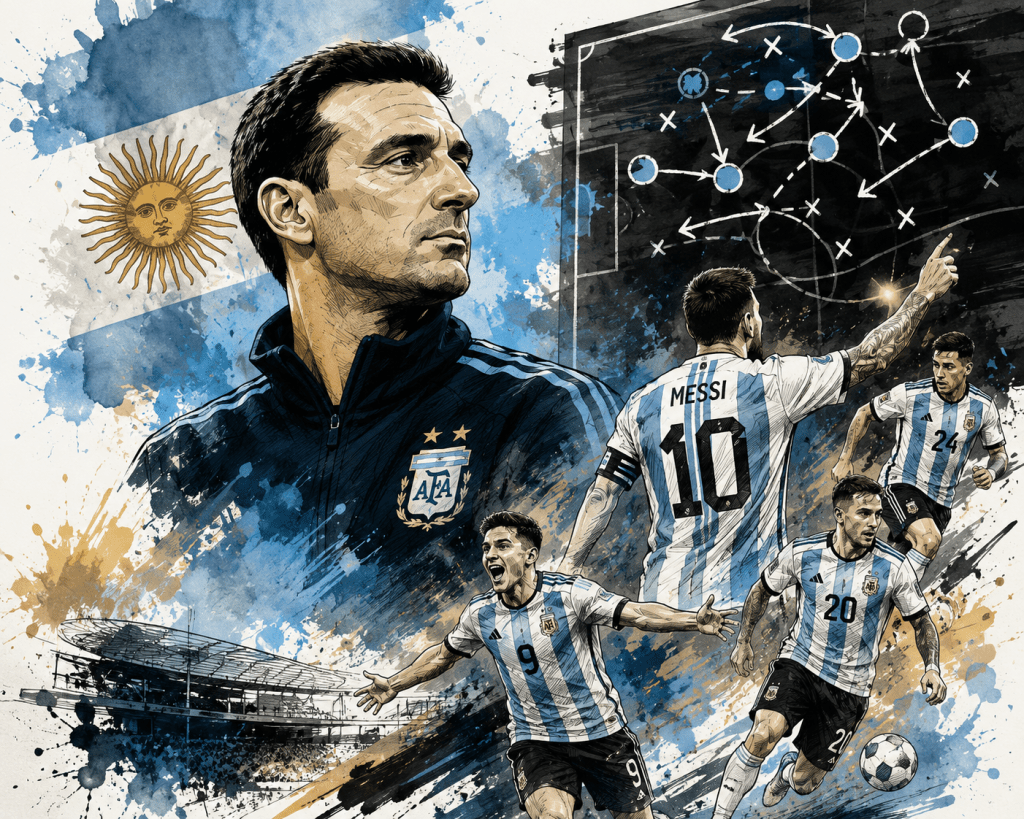
When Lionel Scaloni accepted the Argentina job in 2018, few believed he was anything more than a temporary solution. With no senior managerial experience and following the chaos of Argentina’s disappointing 2018 FIFA World Cup campaign, his appointment was widely viewed as an act of necessity rather than conviction. Eight years later, that perception has been completely transformed.
Scaloni has become one of international football’s defining coaches—not because he introduced a revolutionary tactical system, but because he redefined what elite international management can look like. His Argentina is built on flexibility rather than ideology, collective intelligence rather than individual dependency, and emotional stability rather than relentless pressure. Having guided the Albiceleste to the Copa América title in 2021, the FIFA World Cup in 2022, another Copa América triumph in 2024 and now another outstanding campaign at the 2026 World Cup, Scaloni has quietly assembled one of the most tactically complete national teams of the modern era.
His philosophy is deeply rooted in his own playing career. Never a superstar himself, Scaloni learned football through intelligence, versatility and tactical discipline. Years spent in Argentina, Spain and Italy exposed him to three contrasting football cultures—Argentine competitiveness, Spanish positional play and Italian defensive organisation. Rather than adopting one football school, he blended elements of each into a coaching philosophy that values adaptability above all else. Today, Argentina no longer plays according to a fixed formation; it plays according to a fixed set of principles.
A Team Defined by Principles Rather Than Systems
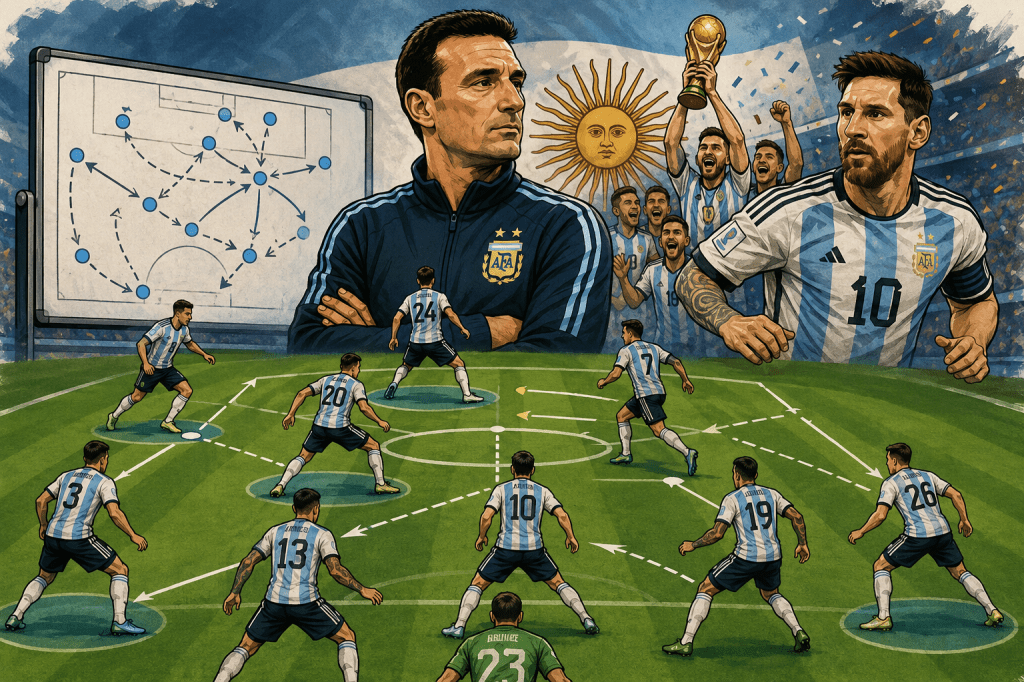
One of the biggest misconceptions about Scaloni is the belief that his success is rooted in a specific tactical system. In reality, formations serve merely as starting points. Throughout the 2026 World Cup, Argentina has seamlessly alternated between a 4-3-1-2 diamond, a 4-2-3-1, and phases resembling a 4-3-3, often changing shape multiple times during the same match while maintaining structural balance. In the defensive phase, the team assumes a solid 4-4-2 shape.
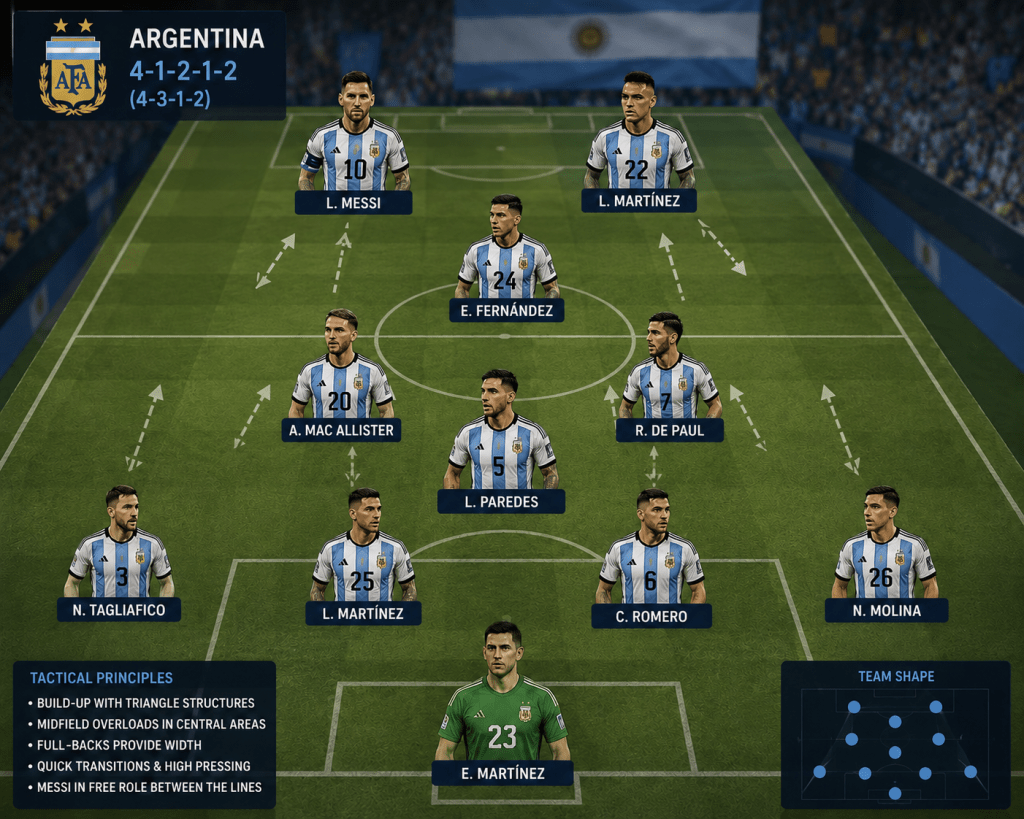
The constant remains numerical superiority in central areas. Scaloni’s midfield rotations consistently overload the centre of the pitch, allowing Argentina to dominate possession while maintaining excellent defensive security during transitions. Width is rarely provided by traditional wingers; instead, Nahuel Molina and Nicolás Tagliafico stretch the field from full-back positions, freeing the midfield trio to occupy the half-spaces and central corridors.
Equally important is how Scaloni has slightly redefined Lionel Messi’s role within the team due to his age and the physical demands placed on him. Previous Argentine squads often revolved more around their captain, assigning him the responsibility of both creating and finishing plays, which required him to be heavily involved in the buildup phases of attacking play. Scaloni has changed this dynamic.
Instead of constructing the entire team around Messi in every phase of the game—though he remains a crucial player and a key component in Argentina’s status as World Cup contenders—Scaloni has developed a comprehensive tactical framework that allows Messi to thrive more naturally.
In this new setup, Rodrigo De Paul brings relentless defensive intensity, while Alexis Mac Allister consistently finds space between the lines. Enzo Fernández orchestrates play from deeper positions, and either Julián Álvarez or Lautaro Martínez takes advantage of the spaces behind opposing defenses. Together, these players share the physical demands more effectively than before, which means Messi doesn’t have to engage extensively in defensive phases. This allows him to focus on making a significant impact in the final third, where he is most dangerous, with fewer responsibilities in the defensive half of the pitch.
Positional Play with Vertical Intent
Argentina’s attacking structure begins with composure. Emiliano Martínez actively participates in the build-up alongside Cristian Romero and Lisandro Martínez, while one central midfielder frequently drops between the centre-backs to create a numerical advantage against the opponent’s first line of pressure. The objective is not possession for possession’s sake, but controlled progression through the thirds.
Once established in midfield, Argentina become considerably more fluid. Third-man combinations, constant positional rotations and quick exchanges allow them to manipulate defensive blocks before accelerating vertically. Messi naturally drifts between the lines, Julián Álvarez stretches the back line with intelligent runs in behind, while Alexis Mac Allister frequently arrives late into attacking positions to create numerical superiority around the penalty area.
Without possession, Scaloni demonstrates the same tactical flexibility. Argentina alternate between an organised mid-block and aggressive high pressing depending entirely on the opponent. Rather than applying a rigid pressing philosophy, Scaloni adjusts his defensive behaviour according to the context of each match. Against technically superior opponents, Argentina remain compact before exploiting transitions. Against teams less comfortable in possession, they press aggressively from the front, forcing mistakes close to goal.
This pragmatic approach explains why Argentina have become one of the tournament’s most efficient attacking teams. Their ability to create chances through multiple attacking mechanisms has made them exceptionally difficult to defend. Although not among the tallest teams in the competition, they have become one of its most dangerous aerial sides, ranking second only to England in headed shots on target with 18. The quality of Messi’s and Lautaro Martínez’s inswinging deliveries—combined with the perfectly timed movements of Romero, Álvarez and the advancing midfielders—has transformed crossing situations into another highly effective attacking weapon rather than a last resort.
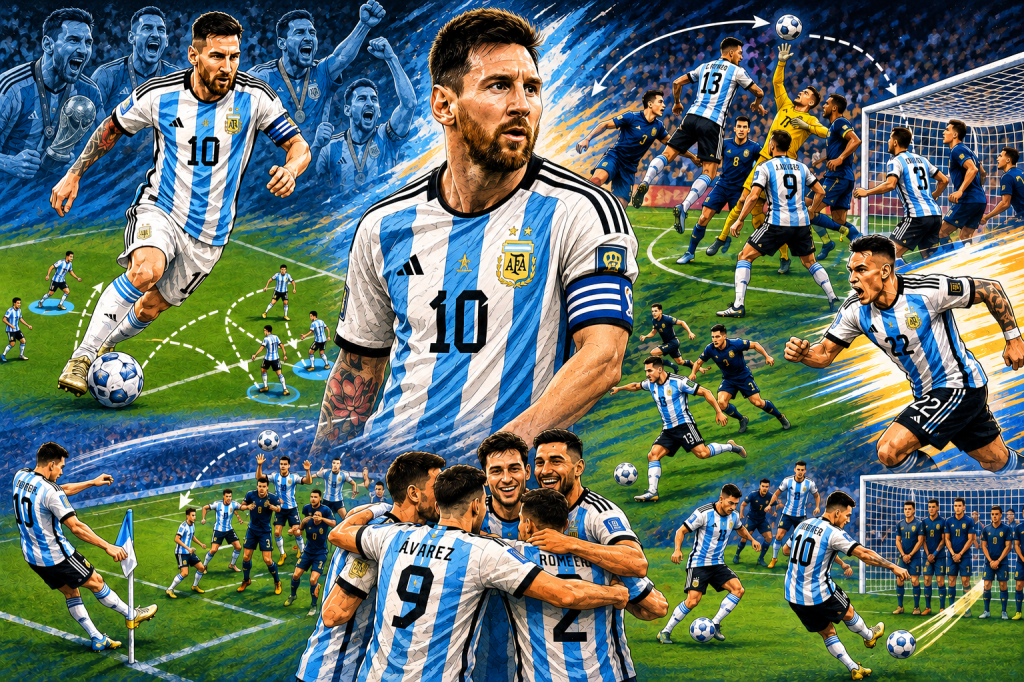
The statistical profile of Scaloni’s side perfectly reflects this tactical versatility. Argentina currently lead the tournament in expected goals (13.9), have scored a competition-high 17 goals and feature the widest distribution of goalscorers among all remaining teams. Messi has contributed eight goals, Lautaro Martínez two, while six additional players have also found the net. More importantly, those goals have originated from virtually every attacking scenario imaginable: positional attacks, counter-attacks, corners, direct free kicks, penalties and aerial situations. Rather than relying on one predictable pattern, Argentina have demonstrated an exceptional ability to exploit whatever weakness the opposition presents.
Adaptability as the Ultimate Competitive Advantage
Like every elite side, Argentina possess identifiable weaknesses. Their aggressive counter-press occasionally leaves significant spaces behind the advanced full-backs, particularly when opponents bypass the initial pressing wave. Several teams have generated promising transition opportunities by attacking these wide channels before Argentina can recover their defensive structure.
Yet those moments remain exceptions rather than defining characteristics. Overall, Argentina continue to display remarkable tactical maturity. Their set-piece organisation combines sophisticated blocking schemes with Messi’s outstanding delivery, while defensively they blend zonal marking with selective man-orientation depending on the opponent’s aerial threats. Every phase of play reflects the same underlying philosophy: organisation without rigidity, structure without predictability.
Ultimately, Argentina’s greatest strength is neither their possession game nor their pressing intensity. It is their ability to adapt. Scaloni has built a national team capable of changing rhythm, shape and strategic emphasis within the same match without ever compromising its collective identity. His players understand principles instead of memorising positions, allowing them to interpret space rather than simply occupy it.
In an era increasingly dominated by coaches promoting rigid football ideologies, Lionel Scaloni has demonstrated that adaptability itself can become a tactical identity. His Argentina do not seek to play the same football every game; they seek to solve every game differently while remaining faithful to the same collective principles.
That may ultimately become Scaloni’s defining legacy. More than trophies or tactical innovations, he has created a football culture built upon humility, trust, positional intelligence and collective responsibility. As Argentina once again compete for football’s biggest prize, it becomes increasingly difficult to argue that any international coach has mastered the balance between tactical sophistication and practical adaptability more completely than Lionel Scaloni.
 Diamond Football Tactics