
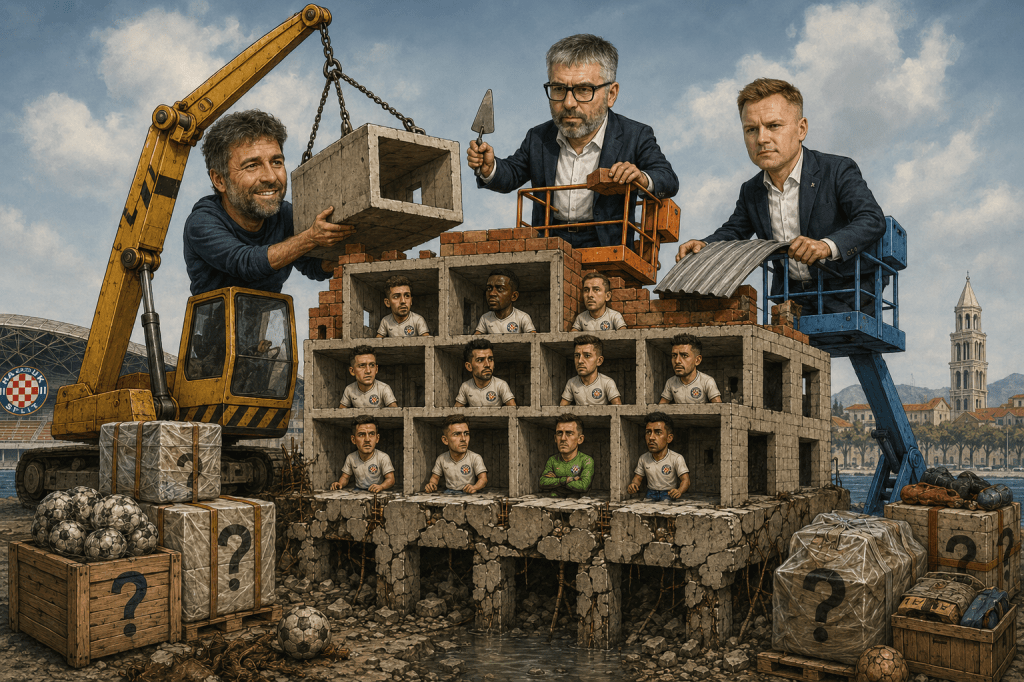
Hajduk is in the middle of a rebuild. New signings have arrived, long-standing weaknesses suddenly seem less obvious, and after one convincing performance, everything feels brighter. The financial report presented at the club assembly? Forgotten. The Livaja drama? Archived somewhere deep in the collective subconscious. It’s good to be a Hajduk supporter again—or at least until reality catches up.
The 2–0 victory over Žilina was more convincing than the scoreline suggests. Hajduk could—and probably should—have won by a larger margin. More importantly, the match already revealed recognizable tactical patterns from Gonzalo Garcia’s playbook. The structure looked familiar, but the personnel and some of the roles were new.
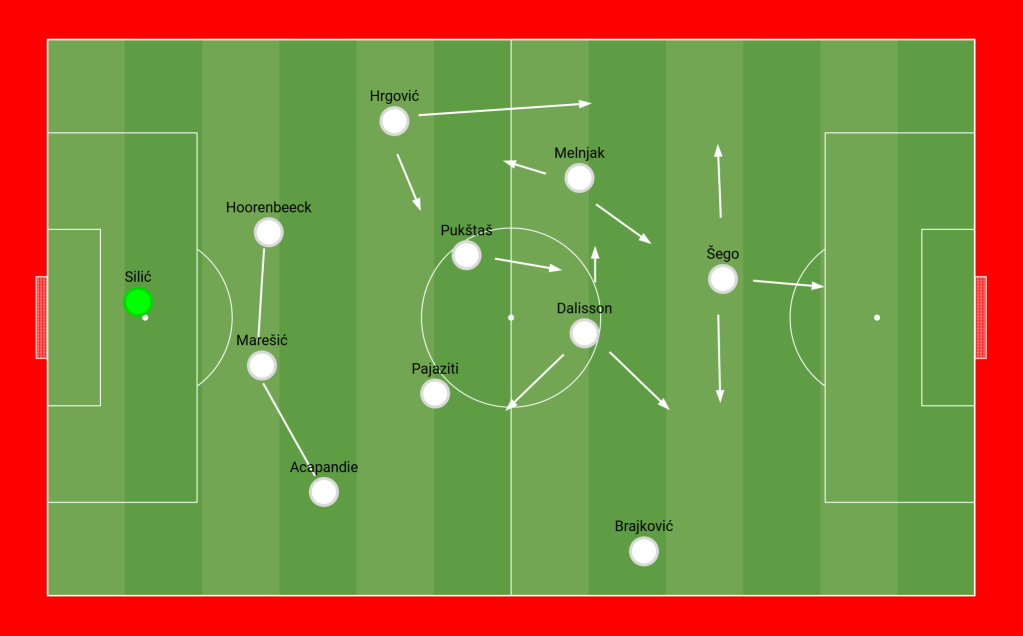
Garcia appears committed to his preferred 4-2-3-1, which transforms into a 3-2-2-3 during possession. Acapandi stayed deep alongside Marešić and Van Hoorenbeeck to form the three-man build-up, while the rest of the team occupied higher positions between the lines.
The real discussion, however, begins in central midfield.
Pajaziti and Pukštaš operated as the double pivot. It worked against Žilina, but whether it can work consistently throughout the season is another question entirely. Pukštaš simply is not a natural number six. This is not about quality—it is about profile. His instincts constantly pull him forward, toward the half-spaces and attacking zones. During several attacking rotations, he drifted wide or advanced higher up the pitch, while Dalisson and Hrgović temporarily occupied central areas to preserve the team’s structure. Against an opponent like Žilina, those movements are manageable. Against stronger opposition, they could become an open invitation for counterattacks.
The attacking patterns in the final third were already encouraging. Brajković, Šego, and Dalisson displayed intelligent movement, created overloads, and combined well in tight spaces. The caveat is that Žilina often looked two steps behind every sequence, making it difficult to determine whether Hajduk’s fluidity was exceptional or simply made to look exceptional by passive defending.
Dalisson stood out with his constant movement and ability to manipulate space. He already seems comfortable interpreting Garcia’s positional principles. Šego also had a positive outing, particularly without the ball, pressing aggressively and creating space for teammates. His finishing, however, remains a concern. He missed chances that statistically belong in the “harder to miss than to score” category. If he improves his composure in front of goal, his overall contribution could become extremely valuable.
Perhaps the biggest surprise was Melnjak on the left wing. The experiment itself is not new—Karoglan tried it before—but within Garcia’s positional system, it makes considerably more sense. Melnjak offers defensive discipline, intelligent pressing, and excellent timing when attacking the penalty area. While Hajduk continues its reconstruction, he looks capable of filling that role effectively.
Then there is the other side of the equation.
Žilina were underwhelming. They defended in a 5-4-1 after nominally lining up in a 3-4-2-1, but their organization was poor throughout. Their pressing was virtually nonexistent, their defensive structure collapsed under minimal pressure, and their finishing resembled that of an under-15 side discovering the concept of expected goals for the first time. Unless they improve dramatically, the second leg is unlikely to become a tactical contest—it will simply be another test of Hajduk’s efficiency.
Which naturally leads to the bigger question.
Was Hajduk genuinely dominant despite fielding Pukštaš and Pajaziti as the double pivot, or was Žilina simply too weak to expose the structural weaknesses that better opponents inevitably will?
That answer cannot be found after one qualifying match.
Football supporters possess a remarkable talent for selective memory. One convincing victory can erase months of concerns overnight. Suddenly, every signing looks inspired, every tactical idea feels revolutionary, and every unresolved issue quietly disappears beneath the excitement.
The reality, however, is usually less forgiving.
Questions surrounding squad depth and player profiles will emerge sooner rather than later. Most of Hajduk’s newcomers are entering a completely different footballing environment, where adapting is about far more than tactics. Understanding the league, the expectations, and the unique pressure that comes with wearing Hajduk’s shirt takes time. Time is exactly what football rarely allows.
Once the domestic season begins, Hajduk will have to compete on multiple fronts. At its current stage of reconstruction, the squad still lacks the depth required to sustain Garcia’s demanding style over a long campaign. Rotation will become inevitable, and with it, inconsistencies. The team is clearly a work in progress—and work in progress usually comes with a price. The only question is whether that price will be paid in dropped points.
To build a successful football team, you first need solid foundations. That is precisely where Hajduk’s biggest challenge still lies. A modern tactical structure, exciting new arrivals, and fresh ideas can make the building look impressive, but no architect can ignore unstable foundations forever.
There is probably no better feeling in capitalism than unboxing something brand new. The packaging is flawless, the marketing promises perfection, and for a brief moment you genuinely believe you’ve made the best purchase of your life. Only later do you discover that the charger isn’t included.
Hajduk currently feels a lot like that unopened box. The new arrivals bring hope. Garcia’s ideas are beginning to take shape. The optimism is understandable—and even necessary.
But football is not won by packaging.
It is won by foundations.
And the only mistake would be confusing hope with proof.

