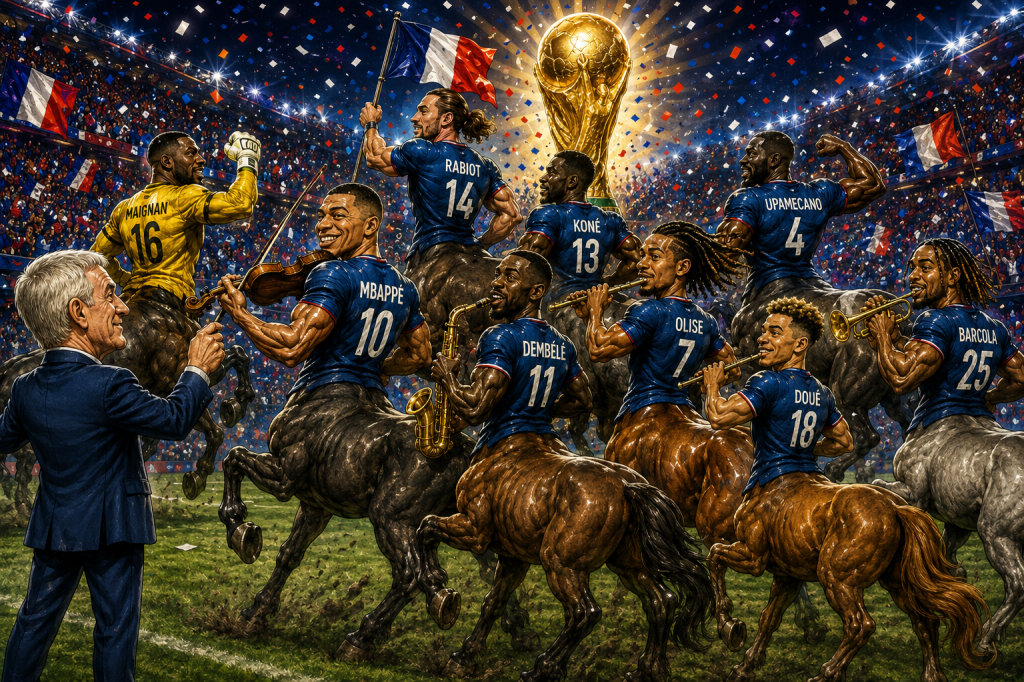

The Greatest Dynasties in Football History
International football is not defined solely by trophies. While every World Cup champion enters the record books, only a select few achieve something greater: dynasties that redefine the game itself. These teams do more than simply win tournaments; they shape the tactical evolution of football, inspire generations of coaches and players, and set the standards by which all future champions are measured.
Uruguay introduced collective excellence to the world before the World Cup truly found its place. Italy established the foundations of tactical discipline. Hungary revolutionized attacking movement. Brazil turned football into an art form. The Netherlands transformed positional thinking with Total Football. Germany embodied consistency, Spain perfected positional play, and Argentina demonstrated that emotional unity and tactical balance could elevate greatness to immortality.
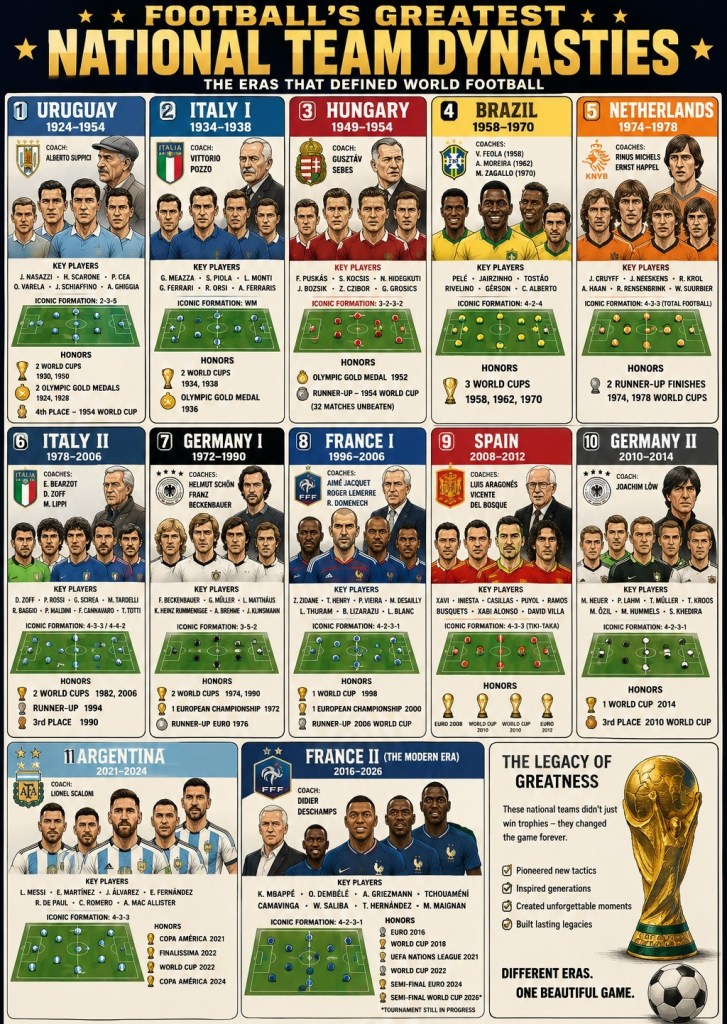
Each dynasty reflects the demands of its era. Some excelled through technical brilliance, while others relied on revolutionary tactics or uncompromising discipline. Only a few rare teams managed to combine all three elements. Modern France comfortably belongs among these elite groups. For nearly a decade, Les Bleus have remained consistent contenders, overcoming injuries, retirements, and generational changes. They have achieved something that few champions ever manage: constant evolution without sacrificing their identity. This remarkable achievement bears the unmistakable signature of one man: Didier Deschamps.
Building a Football Empire
Didier Deschamps did not just build another successful national team; he created a football empire. His philosophy does not revolve around a single superstar or a rigid tactical system but centers on the belief that the collective must always triumph over individual brilliance. While many coaches aim for aesthetic perfection, Deschamps strives for competitive perfection. He understands that international tournaments reward adaptability rather than strict ideology. His France team has demonstrated the ability to dominate possession, defend deeply, or swiftly counterattack, depending on what the situation demands.
Perhaps his greatest achievement has been cultural rather than tactical. Managing a dressing room filled with global superstars requires an authority that few coaches possess. Deschamps consistently transforms individual ambition into collective responsibility. Reputation never guarantees selection, and no player has ever been bigger than the team. This culture allowed France to navigate the departures of players like Lloris, Varane, Pogba, Giroud, and Griezmann without decline. Instead, new talents such as Mbappé, Dembélé, Olise, Barcola, Doué, Camavinga, Tchouaméni, Saliba, and Zaïre-Eméry naturally emerged as the next generation. This proves that Deschamps’ greatest legacy lies not in a trophy cabinet but in a system capable of continuous renewal.
The Evolution of French Football
The current French team represents the most comprehensive evolution of Deschamps’ philosophy. The familiar defensive discipline remains but is now complemented by an attacking freedom that was rarely associated with his earlier teams. France forms a highly compact defensive structure without possession, but once they recover the ball, their objective shifts instantly: they attack vertically, exploit space, and reach the penalty area before their opponents can reorganize. Rather than dominating possession for its own sake, France focuses on dominating pivotal moments.
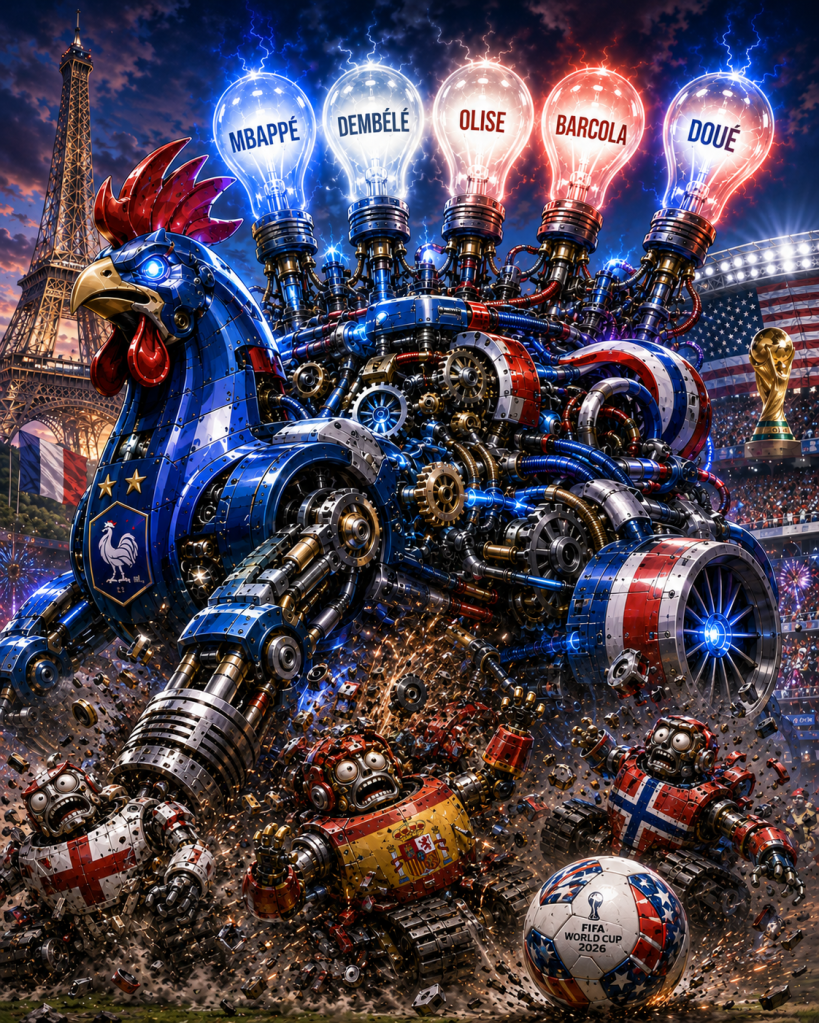
The front line exemplifies this transformation. Mbappé, Dembélé, Olise, and Barcola—along with Doué increasingly joining their ranks—regularly exchange positions, isolate defenders, and stretch defensive lines across the entire width of the pitch. Behind this attacking freedom, however, lies exceptional positional discipline. The midfield guards against transitions, full-backs choose their moments wisely, and defensive organization remains consistent. Deschamps has achieved perhaps football’s most challenging balance: maximizing creativity in attack without compromising defensive stability, which makes France one of the most entertaining teams to watch while also being extremely difficult to break down.
Why France Is the Favorite
France’s status as the tournament favorite goes beyond the brilliance of Kylian Mbappé. The defining strength of this generation lies in its extraordinary depth combined with tactical flexibility. Every position is occupied by players capable of performing at the highest international level, allowing coach Didier Deschamps to rotate the squad without significantly weakening the team. Few nations can introduce substitutes of Dembélé’s, Doué’s, Barcola’s, or Olise’s quality while maintaining the same tactical intensity.
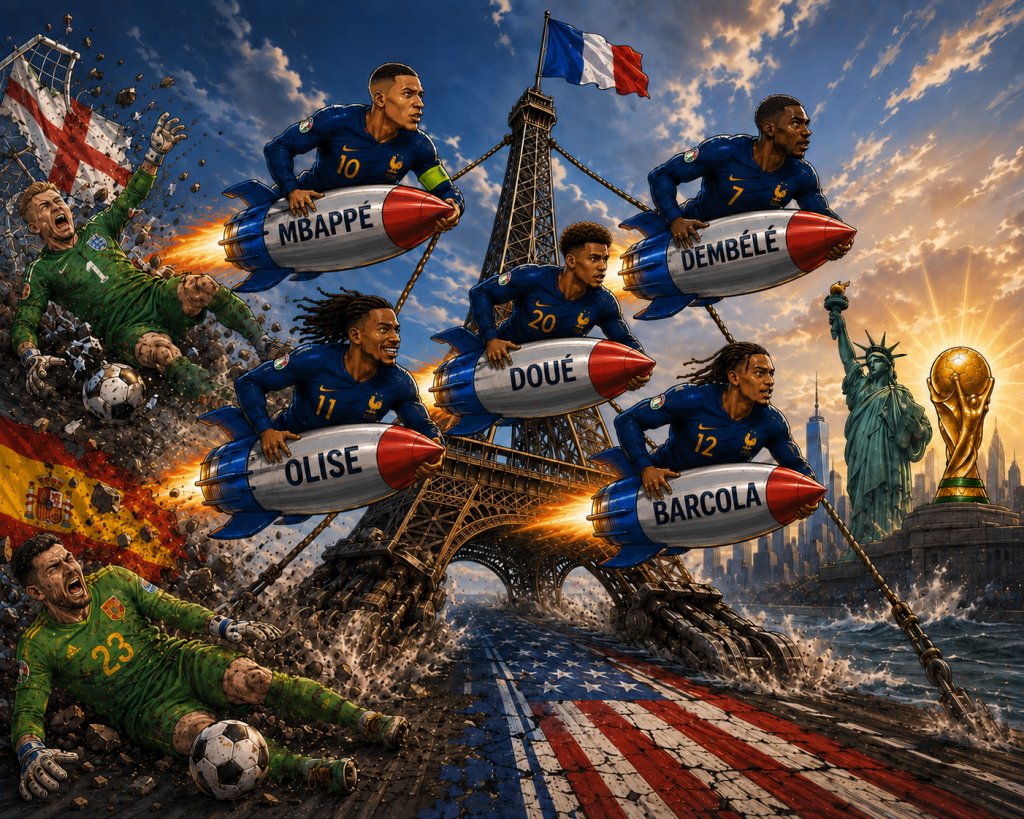
Unlike previous generations that relied on Giroud as a target man and Griezmann as the focal point of France’s attack, Deschamps has opted for a different approach. With a team full of exceptional players possessing great motor skills and speed, he decided to exploit this unique advantage, which sets his squad apart from others. He has evolved and adapted his strategy.
He boasts five exceptionally gifted attacking players. There may have never been so much offensive talent in one squad. Dembélé, Olise, Mbappé, Doué, and Barcola possess extraordinary one-on-one skills, as well as precision and creativity at high speeds. No defense can effectively counter this blend of skills in both positional play and transitions.
Deschamps faces the extremely difficult task of structuring the team to support these four attackers within a seemingly shapeless 4-2-3-1 formation while managing their egos, especially for those who remain on the bench. He has chosen to grant his four attacking talents absolute freedom, completely shifting his previous playing philosophy. All four players interchange positions freely, collaborating in tight spaces, creating numerical overloads, and generating space for one another to exploit their individual qualities in one-on-one or one-on-two situations during positional play. If opponents make the mistake of playing with an extremely wide build-up or, worse, pushing their defenders up the pitch, Mbappé, Dembélé, Olise, Barcola, or Doué, when regaining their positions in transitions, become relentless and perhaps the deadliest force football has ever seen. They are indefensible once they ignite their engines.
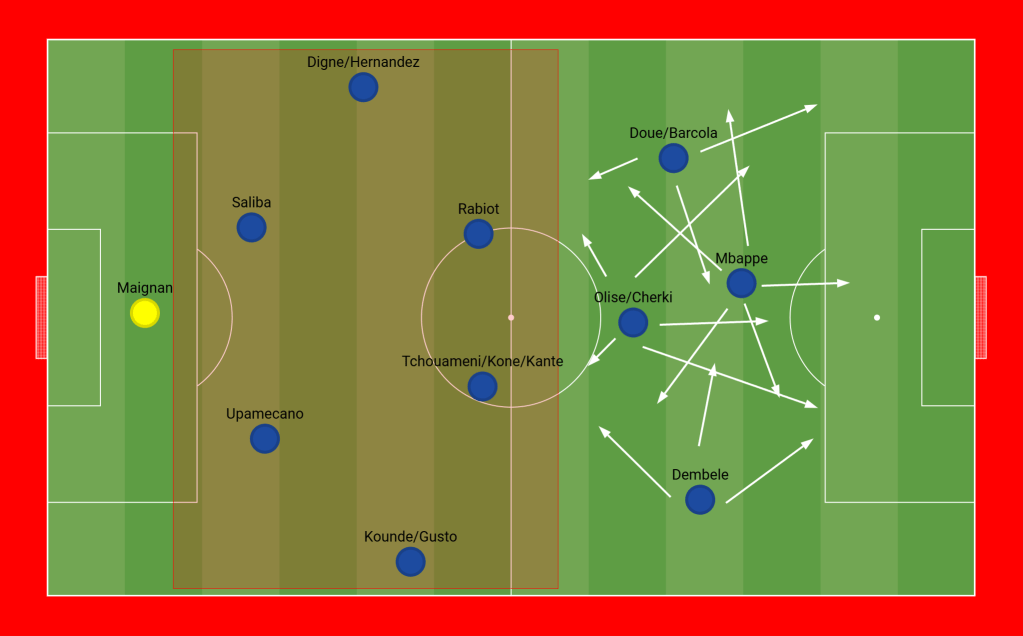
For this strategy to work, Didier had to balance the team, which he did effectively. Four players provide the necessary stability: Upamecano and Saliba in central defense, and Rabiot with either Kone, Tchouaméni, or Kanté in midfield. These four are sufficient to cover for the attackers and absorb every opposing team’s attack thus far in the tournament.
Deschamps also needs to manage the egos of players on the bench, such as Cherki, Hernandez, Tchouaméni, Kanté, Konaté, and others, who are not getting the minutes they are accustomed to at their clubs and are all great players. France could probably field another competitive team with its bench players alone. Balancing these egos is precisely what Deschamps excels at. He is providing his key players the space they need without interfering with the egos of the others, boosting everyone’s confidence to succeed.

Modern tournaments are rarely decided by starting elevens alone; they are won by squads capable of solving various tactical problems over seven demanding matches, adapting to injuries, suspensions, and different styles of opposition. This is where France distinguishes itself from rivals. It possesses elite quality, tactical versatility, physical power, defensive security, and arguably the deepest pool of attacking talent in international football. The result is a team that often appears inevitable rather than merely superior.
The Legacy of Didier Deschamps
Every great dynasty eventually fades into history, but the most remarkable ones leave behind something more enduring than just medals. Uruguay instilled belief in football, Italy brought organization, Hungary introduced innovation, Brazil embodied beauty, the Netherlands showcased Total Football, Spain demonstrated positional mastery, Germany represented consistency, and Argentina exemplified emotional resilience. Each of these nations transformed the game in its own way, creating a lasting legacy in football’s collective memory.
Didier Deschamps may ultimately be remembered for something equally significant. He has shown that the greatest competitive advantage in modern international football is not just one tactical system, one extraordinary generation, or one transcendent superstar, but rather the ability to continuously evolve without losing one’s identity. Throughout this process, he instilled the self-confidence his players needed, and his charisma complemented rather than conflicted with their egos. This is why he has succeeded—his France team has remained among the world’s elite for so long, and why his contributions deserve to be recognized alongside the greatest dynasties the game has ever produced, possibly making it the best one yet. He did not simply build another champion; he created an institution by adapting and evolving.