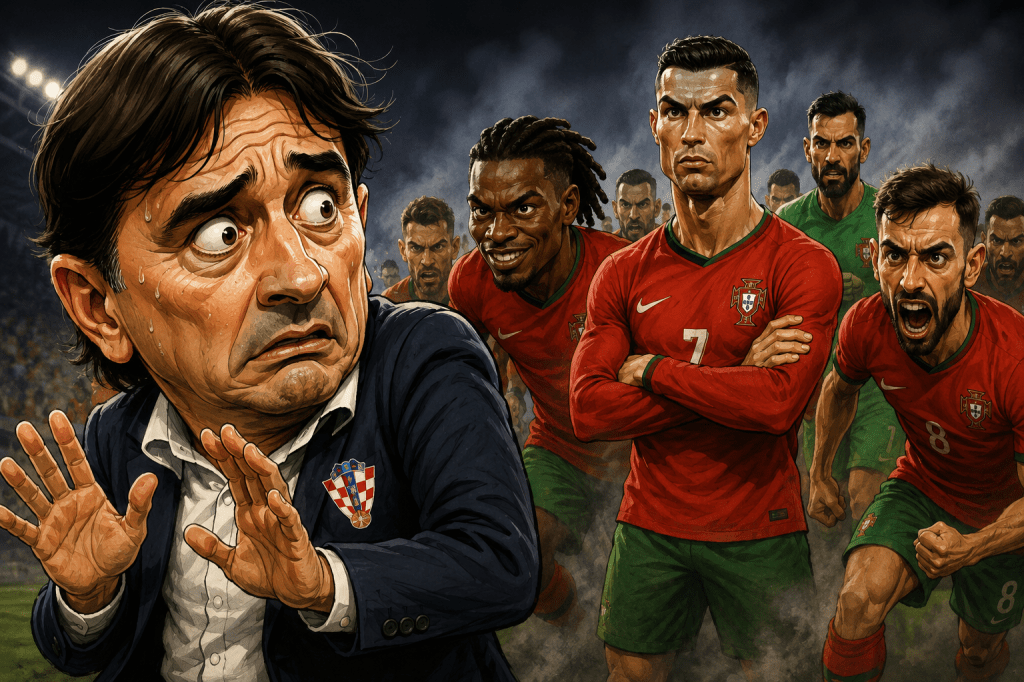
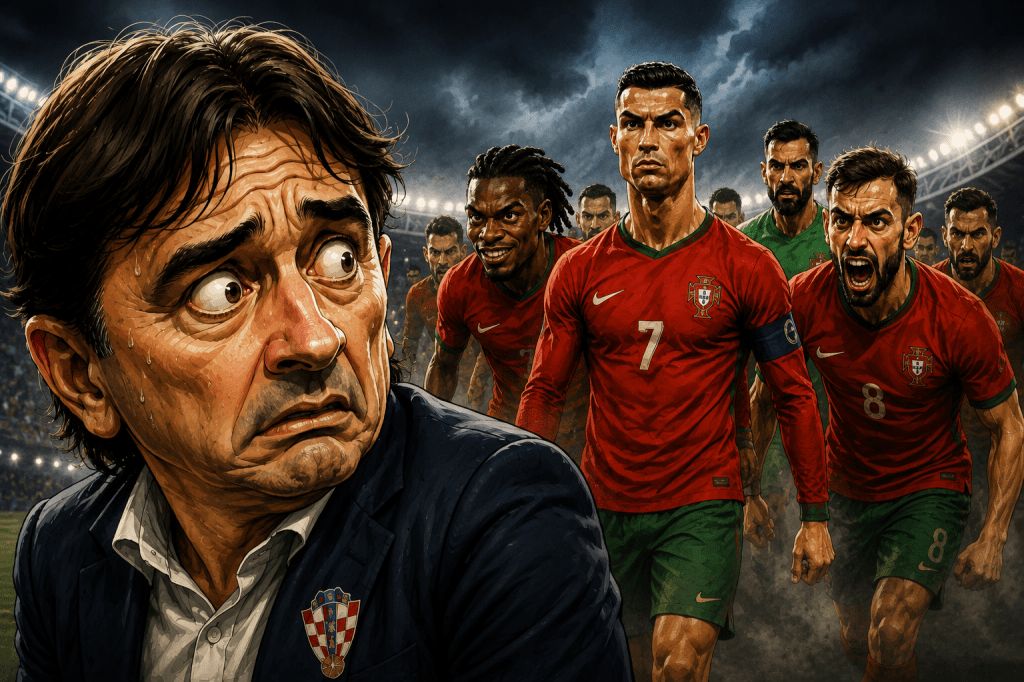
Ten matches against Portugal have resulted in seven losses for Croatia until tonight. After this match, the Croats will have even bigger complexes regarding Portuguese football. Portuguese journalists discussed their victorious mentality against Croatia, emphasizing it as their primary reason for optimism in the Round of 16 of the 2026 World Cup. However, despite their self-confidence, Croatia’s fear was evident, affecting every aspect of their game tactics.
In a pre-match interview, Croatia’s coach Dalić mentioned their scouting of Portugal and noted that he and his staff had identified certain patterns in Portugal’s midfield and finishing. They highlighted Vitinha as a crucial player, pointing out how he influences Portugal’s game flow and how Portugal’s rotations could create opportunities for their fullbacks to advance into the attacking third.
On the other hand, Dalić and his staff failed to recognize the opportunity for Croatia to exploit Leão and Cristiano Ronaldo’s tendency to contribute little defensively. With both players in the starting eleven, Portugal often encounters significant challenges in terms of pressing and maintaining a low defensive block. This should create gaps for Croatia to take advantage of in their game plan, but the Croatian coaching staff did not recognize this possibility.
Portugal’s Rotations
Portugal entered the match as clear leaders, showcasing themselves as the favorites on the field. It raises the question: Did Portugal control the first half due to their quality, or did Croatia deliberately drop back, allowing Portugal to dominate possession? As the game progressed into the second half, it became obvious that Croatia held too much respect—perhaps even fear—of Portugal. However, with stars like Modrić, Kovačić, and Perišić on their side, they should have shown more confidence.
Portugal took control of the game, utilizing a buildup structure from their defensive third that featured a 3+2 formation. Vitinha and Neves positioned themselves in front of Dias, Veiga, and Mendes. As they progressed the ball upfield, both Cancelo and Mendes operated as wide or inverted fullbacks, connecting with Leão on one side and Neto on the other. Croatia had prepared a response to these movements, but it was not as successful as they had hoped, which will be elaborated on later. Vitinha and Neves frequently interchanged positions, dropping back between Dias and Veiga to orchestrate the play from deep.
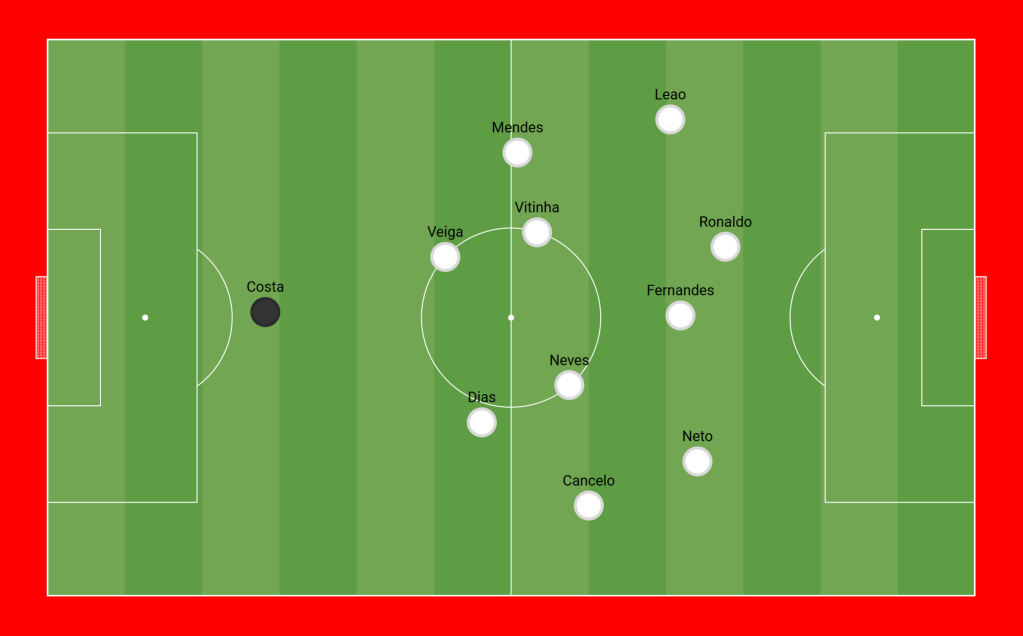
Ronaldo made a notable effort to contribute to the game’s creation, even more so than Fernandes. However, this approach may not have been as effective as it initially seemed, as he often found himself outside the box and unable to finish crosses. When Portugal lost possession, they pressed high up the pitch. Fernandes and Ronaldo targeted the Croatian center-backs, while Neves and Vitinha man-marked Modrić and Kovačić. Given that the PSG midfield duo has strong defensive capabilities, the rest of the Portugal team could afford to take more risks in their pressing strategy. This allowed Portugal to effectively press high and limit Croatia’s opportunities for counterattacks. Fernandes capitalized on the spaces between the Croatian full-backs and center-backs, making several intriguing runs in those areas and creating key passes.
Croatia’s Low Block and Inability to Counterattack
Croatia began the match with a 4-2-3-1 formation on paper, which remained consistent during their offensive play. Luka Modrić and Mateo Kovačić operated in pivot midfield roles, while Luka Sučić and Nikola Vlašić occasionally interchanged positions on the right mezzala/wing during Croatia’s possession in the first half.
However, during the defensive phase, the team transitioned to a hybrid system that incorporated elements of a 4-4-2, 4-1-4-1, and 5-4-1 formation. In this setup, Modrić dropped deeper into the defensive line to mark Bruno Fernandes. This strategy allowed Ivan Perišić and Josip Stanišić to press the opposing ball carrier on the flanks, while Vlašić and Baturina remained compact in the center to help maintain a solid defensive line. Unfortunately, this tactic proved ineffective, as Portugal frequently delivered crosses from wide areas, which the strategy was meant to minimize.

Croatia rarely, if at all, pressed Portugal’s buildup, which reflects poor judgment from the Croatian coaching staff, likely stemming from an excess of respect and fear towards Portugal. By not applying pressure on Portugal’s midfielders, Croatia allowed them to maintain possession control throughout the first half. The inverted wingers did help protect spaces against Portugal’s rotations but simultaneously hindered Croatia’s ability to launch counterattacks.
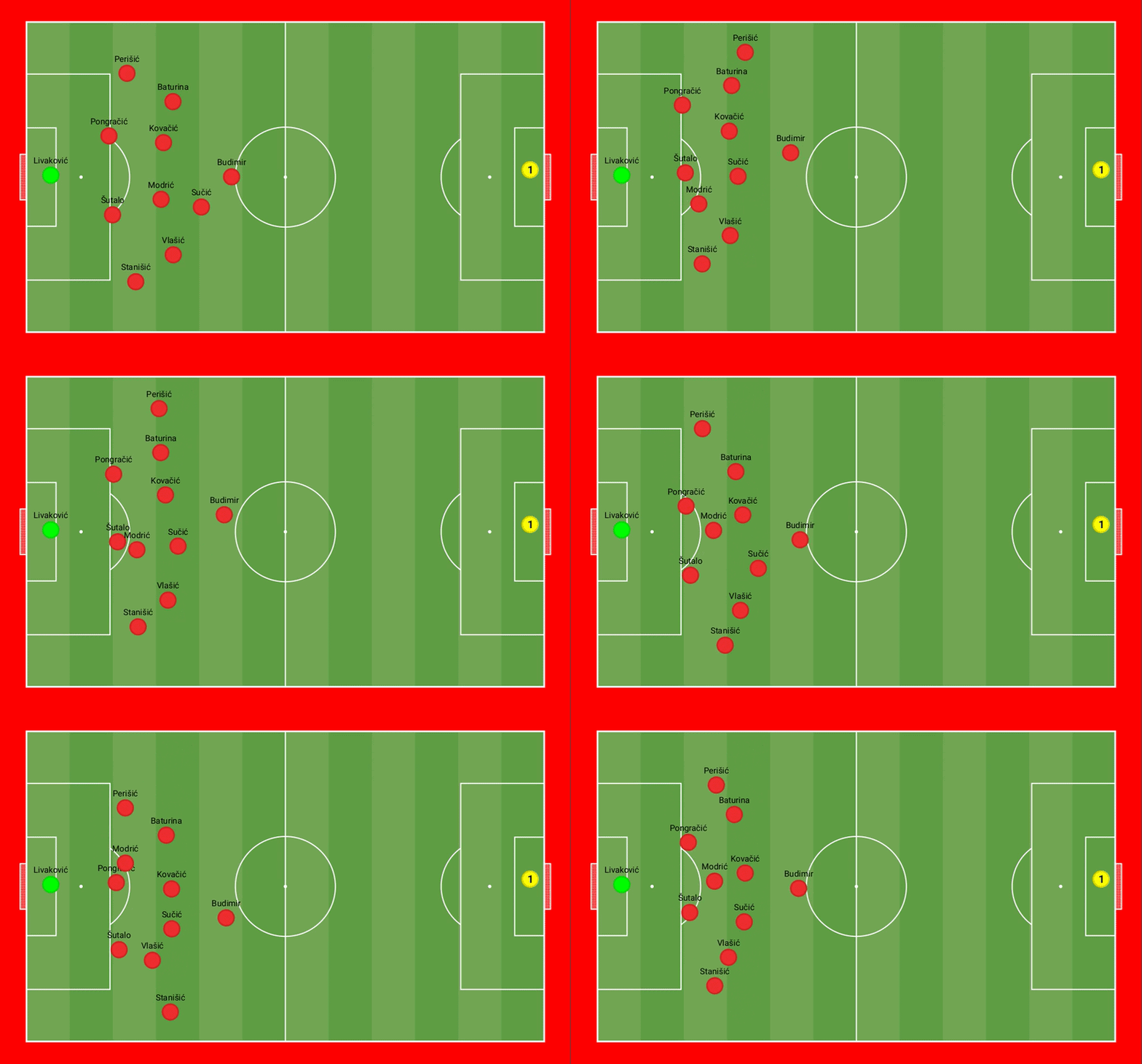
When in possession, Croatia attempted to build up play, but once Neves and Vitinha effectively blocked Modrić and Kovačić, the Croatian players seemed to give up on developing possession control. Instead, they resorted to a few direct attacks. Additionally, Budimir was often isolated, and the defensive positioning in front of Croatia’s low block limited his ability to contribute to counterattacks.
Despite Croatia’s efforts, Portugal consistently posed a threat to their goal, particularly through crosses originating from areas that Croatia tried to address by having fullbacks press out and utilizing inverted wingers.
Dalić’s tactical assumption that Croatia would be capable of counterattacking was misguided. It was erroneous because Portugal pushed up the pitch with their fullbacks, compelling Croatia’s wingers to drop deep to follow them. This situation denied Croatia any opportunity to develop counterattacks when the chance arose.
Furthermore, the dynamics of the game led to numerous corner kicks for Portugal, which became a significant challenge for Croatia and its coaching staff, who struggled to devise an adequate structure to defend set pieces.
Croatia’s Second Half
In the second half, after emerging from the dressing room, Croatia clearly altered their playing style. Coach Dalić gave his players more freedom on the field. Matanović replaced Budimir and made an immediate impact. While in possession, Kovačić and Sučić began to effectively carry the ball through the opposition’s defensive lines, breaking past Neto’s and Vitinha’s press to deliver the ball into the final third.
With Vitinha and Neves man-marking Croatia’s midfield, once they penetrated the first line of press— and even the Portuguese midfield— Croatia often found themselves in a 4 vs. 4 counterattack situation. Portugal struggled with their defensive transitions and tracking back. In the second half, Croatia resembled a new team, as players made deep runs ahead of the ball, particularly Sučić. This dynamic play allowed for the development of attacks in the final third.
Croatia became more direct, especially thanks to Kovačić’s inspiration, seizing the momentum of the game for a solid ten minutes during which they scored and took the lead.
As Croatia applied pressure on Portugal’s midfield while in possession, Portugal started to lose control of the game.
Martinez’s Reaction
Martinez quickly responded by substituting four players. The most notable change was Bruno Silva replacing Vitinha, shifting the formation to something resembling a 4-1-3-2. The momentum changed immediately, proving to be a great reaction from Martinez. After this substitution, Portugal leveled up their momentum, and the game saw dangerous attacks from both sides, with Portugal regaining control.
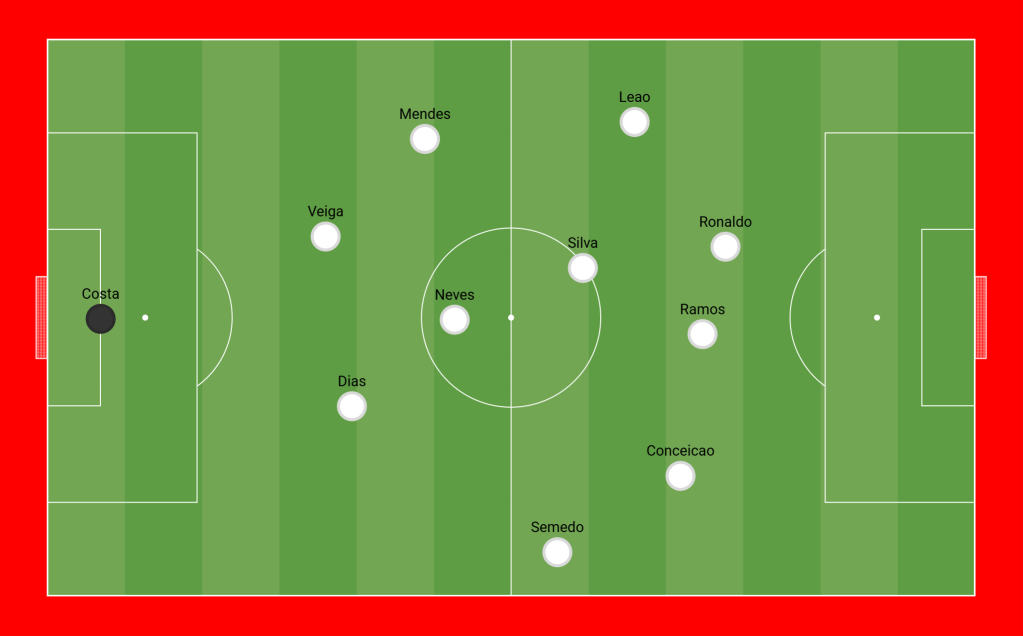
Croatia’s Poor Corner Kick Defense
For the fourth game in the tournament, Croatia displayed catastrophic defensive set-piece defending. They conceded a penalty that resulted from a corner kick. It was obviously a mismatch: Vlašić was covering Veiga, as he had in previous corners, and it had not been successful before. This time, Croatia was left without any luck. Ronaldo scored the equalizer from the penalty spot.
Dalić brought in Pašalić for Baturina, but it remains unclear whether this was a reaction to Portugal’s change of shape or simply a move to refresh the team.
A Wild Game
Until the end, the game remained open. Croatia had its momentum thanks to the impressive performances from Kovačić and Sučić, who developed many direct attacks. Croatia created three great chances: Pašalić missed a header from close range, Kovačić hit the woodwork from outside the box, and Matanović executed some great dribbling, coming close to scoring but being denied by Costa, who had a fantastic match.
On the other hand, Portugal continued to attack from wide positions, particularly exploiting Leão and his crosses.
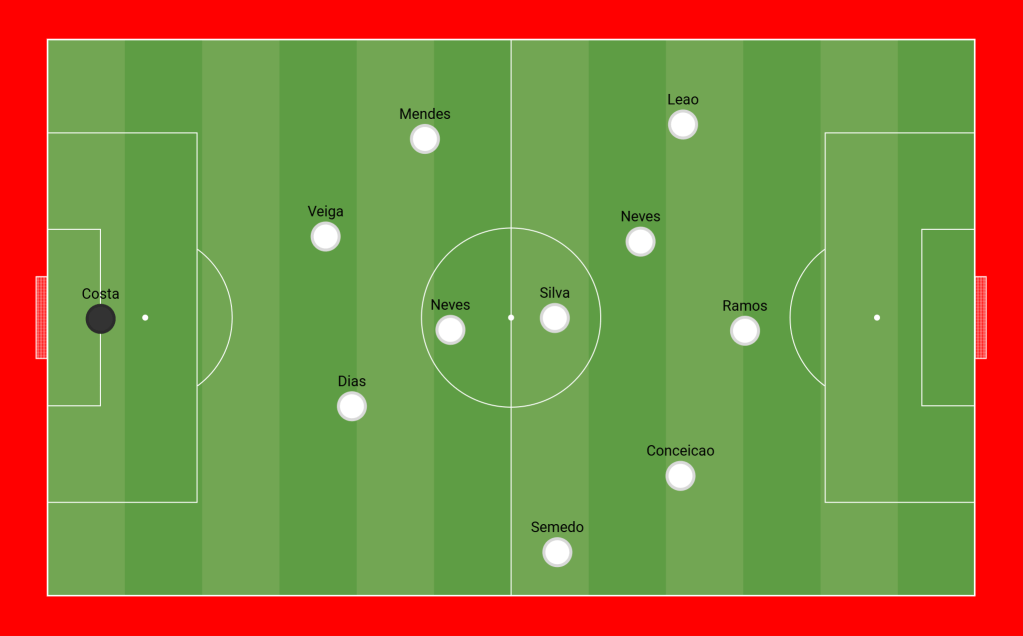
Dalić’s Fear
At the end of the match, Dalić decided to substitute Vlašić and introduce Gvardiol as a left full-back, pushing Perišić into a winger position. It was clear that he was worried about conceding, opting to replace an offensive player with a defender. Unfortunately, this decision backfired. Gvardiol, along with Pongračić, made a mistake when Leão delivered a cross for Ramos, who, despite being surrounded by three Croatian defenders, scored without much interruption.
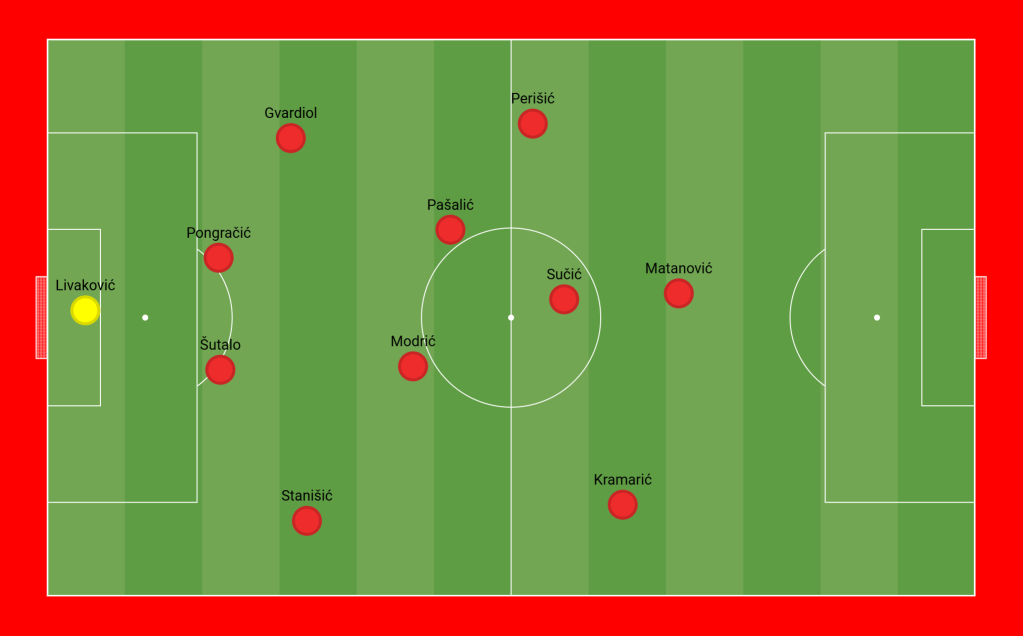
Croatia did put in the effort to score and even seemed to have succeeded (demonstrating that Dalić’s fear was unfounded), but the goal was disallowed due to offside.
Conclusion
It was an exciting tactical duel in which Martinez emerged victorious. He made a bold move by substituting Vitinha, allowing Bernardo Silva to take control of the midfield, and he showed trust in Leão, who rewarded him with a brilliant assist for Ramos, a substitution that was also his idea.
On the other hand, Dalić demonstrated the dangers of allowing excessive emotion and fear of losing to overshadow essential tactical reasoning. Players like Ronaldo and Leão are less involved in the defensive phase, which should have been scouted and integrated into Croatia’s tactical plan. Due to his fear of losing, Dalić relinquished possession and failed to exploit Portugal’s greatest weakness. In the second half, when his players displayed more courage, this became evident. Croatia’s 15 minutes of dominance were not enough to secure a victory. Although Portugal had a stronger team on paper, it wasn’t their quality that defeated Croatia; rather, Croatia was hindered by Dalić’s fear and apprehension in facing Portugal. This match illustrates how excessive emotion can cloud tactical judgment.
The Croatian complex over Portugal continues. After tonight’s match, Croatia holds a record of eight losses, two draws, and only one victory in eleven games against Portugal.