
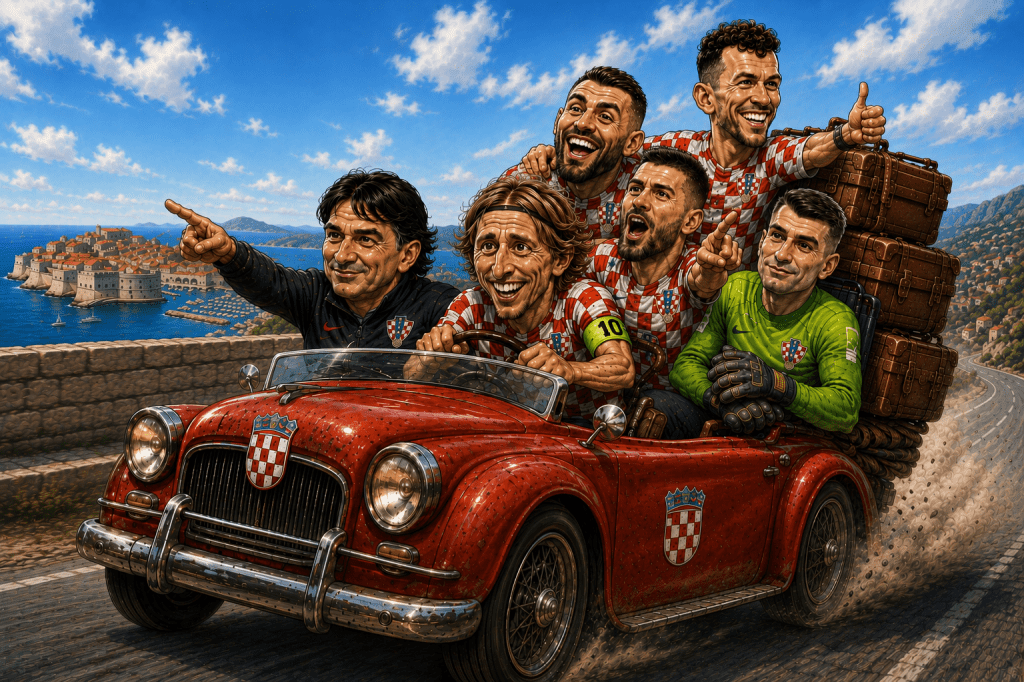
Today at 22:00, Croatia will face England in their opening match of the 2026 World Cup at AT&T Stadium in Arlington, USA. The team has been subconsciously escorted out of the country without great expectations. People are thankful for everything the team has accomplished so far, realizing that the best times of this generation may be behind them and that the end of one of the greatest collectives in Croatian sport history is near. However, it is not over yet; we will have to wait for their final dance.
Zlatko Dalić has assembled an intriguing group of footballers, including veterans like Modrić, Kovačić, Perišić, Kramarić, and Livaković, alongside some fresh talents. As is often the case with the Croatian national team, there is a noticeable lack of speed on the pitch. However, a new generation of talented central defenders has emerged, prompting Dalić to make some tactical adjustments. In recent matches, he has employed two formations: 3-4-2-1 and 4-2-3-1.
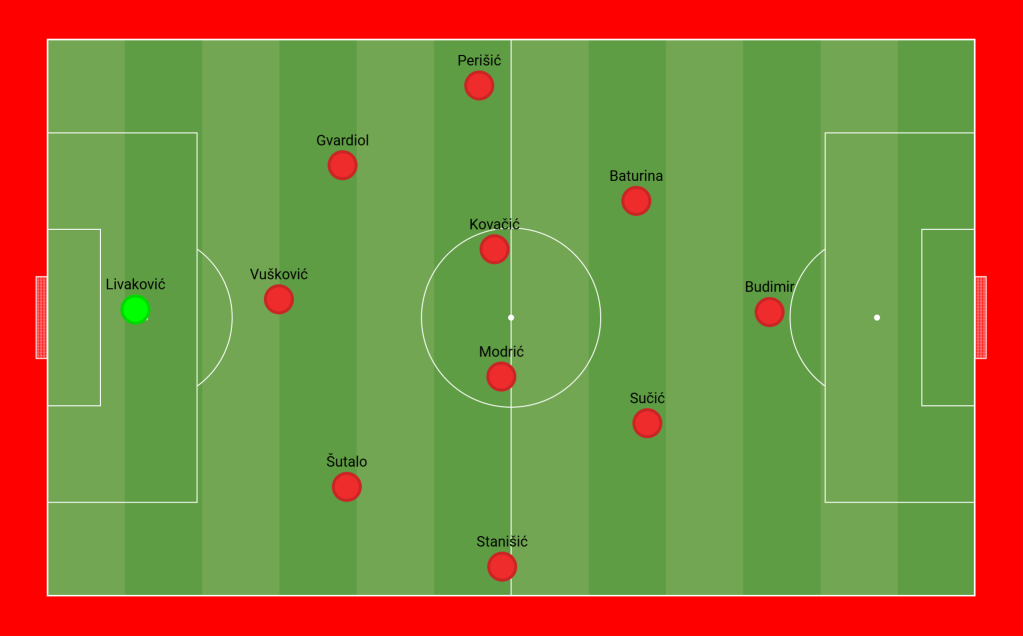
3-4-2-1
Dalić chose the 3-4-2-1 formation because he identified issues with defensive transitions in the team. A formation with three central defenders simplifies defensive duties during negative transitions. Another reason for switching to this system is the emergence of Vušković. The Hajduk Split youngster is a great prospect for the future; he has already transferred to Tottenham and played last season on loan in Hamburg. It’s an understatement to say that he had an excellent season, boasting one of the best defensive records in the Bundesliga. Along with him, Gvardiol and Šutalo should form the defensive trio. On the bench, Dalić has solid defensive alternatives such as Čaleta Car, Pongračić, and Erlić, giving him a good selection at the defensive position.
Lacking offensive speed, Dalić had to make adaptations to compensate. He decided to use four midfielders (two defensive and two offensive). He needed two wingbacks, and Perišić, who played that position superbly a few seasons ago at Inter Milan, is one great solution (he revitalized his career at PSV by the way). On the other side, Stanišić, who had a fantastic season with Bayern Munich, will fill the other wingback position.
It’s evident that the two central midfielders will be Modrić and Kovačić, who are expected to dictate the game’s rhythm from deep and control possession. However, there are some issues regarding geometry in defensive transitions. Croatia has a significant deficit of defensive midfielders in these positions, although Modrić played as one in Milan for the entire season (they utilized a 3-5-2 formation, so he acted as a regista). Croatia has faced difficulties in this area of the pitch, which has often been a trademark for the team. Dalić has some alternatives like Luka Sučić, Jakić, and Moro, but they are not at the same level—rarely anyone is. It’s perhaps a pity that Dalić did not introduce Josip Mišić, one of Croatia’s great midfielders and Dinamo Zagreb captain. He might be the only one capable of dictating the game from deep, close to Modrić’s level. However, his adaptation should have taken place long ago; if it is a mistake, it was made earlier, and now it would be unrealistic to expect a new player to step into this position and assume control instantly at the World Cup.
In the attacking midfield role, Dalić experimented with Petar Sučić and Martin Baturina, both of whom had very good seasons at Inter Milan and Como. As the tournament begins, he will likely use only one of them, potentially combining with Kramarić or starting with all three. Baturina offers a more creative profile with a great final pass and the ability to create space in tight areas through dribbling, while Petar Sučić is a more aggressive runner who can provide reactive pressing/counter-pressing and is a strong presence in and around the box when crosses are delivered. It’s worth noting that Croatia has great alternatives in these positions, especially with Vlašić and Mario Pašalić, who could also be starters if necessary. Additionally, there is Fruk, a player from the Croatian league, who could contribute from the bench if needed.
In the central attacking positions, Croatia has Ante Budimir, a typical number nine who provides a strong presence in the box and works hard defensively. However, he is limited in speed and ball control, making his status as a guaranteed starter questionable. Kramarić is an all-around and very creative central attacker, but he might be more effective in an offensive midfield position rather than as a central forward. There are also Petar Musa and Ivan Matanović, both of whom are very good attackers at the club level but may struggle to make an impact on this stage. This is a position where the Croatian team faces its biggest challenges.
Resting Defense Problems
The midfield has long been Croatia’s trademark and focal point. Midfielders who are highly creative, possess excellent match reading skills, and control game tempo through positioning and passing have made a significant difference in Croatia’s gameplay. They know when to speed up the game, slow things down, and anesthetize opponents with regressive possession when necessary. On the defensive side, great awareness, positioning, and physical capacity enable them to perform even the most difficult defensive duties effectively. However, Modrić is now 40 years old and likely cannot maintain the same level of performance for 90 minutes throughout the tournament. Additionally, Kovačić is returning from a severe injury, creating challenges for the Croatian team.
In recent friendly matches against Belgium and Slovenia, Croatia struggled defensively in central areas after losing possession. Both Modrić and Kovačić were often out of position, as their roles in game creation and finishing drew them away from their defensive duties. This left the three central defenders to cover the full width of the pitch and a space of more than 50 meters behind them, creating vulnerabilities for counterattacks.
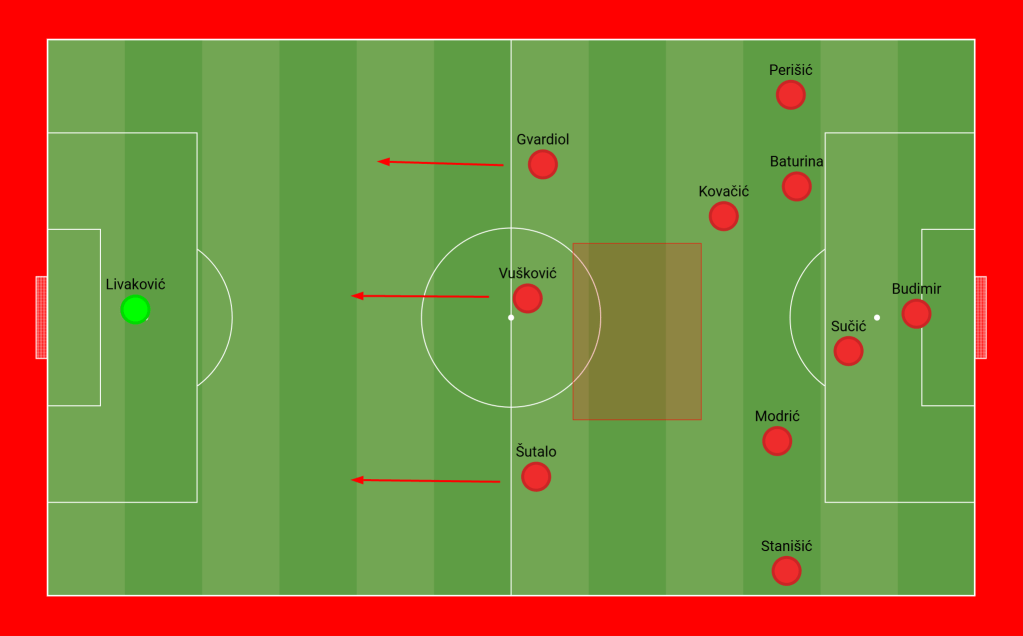
One potential solution for coach Dalić might be to reshape the offensive geometry into a 3-5-2 formation, allowing Modrić to take on a deeper playmaking role (similar to what he has done at Milan this season) and relieving him of the responsibilities in the final third. However, this would require compensating for Modrić’s contributions in terms of assists and goals, which are crucial for the Croatian national team.
Regardless, Dalić must find a way to address this significant issue with defensive transitions, especially since nearly all World Cup teams, unlike Croatia, possess quickness in their offensive lines and can exploit such weaknesses. It’s evident that Dalić is aware of this risk, which may be why he has opted for a three-man defense.
Scoring Goals
Since Mandžukić’s retirement, Croatia has struggled to find a world-class central forward. While there are talented strikers in the squad, they have not yet reached the elite level necessary to rely on. Kramarić is an option and can perform at a world-class level, but he is not a traditional number nine. As a result, other players will need to step up their game.
In a 3-4-2-1 formation, midfielders and wing-backs will need to work harder to impact the box and contribute to scoring goals. Although this strategy may expose Croatia to counterattacks, it is a risk that must be taken to secure victories.
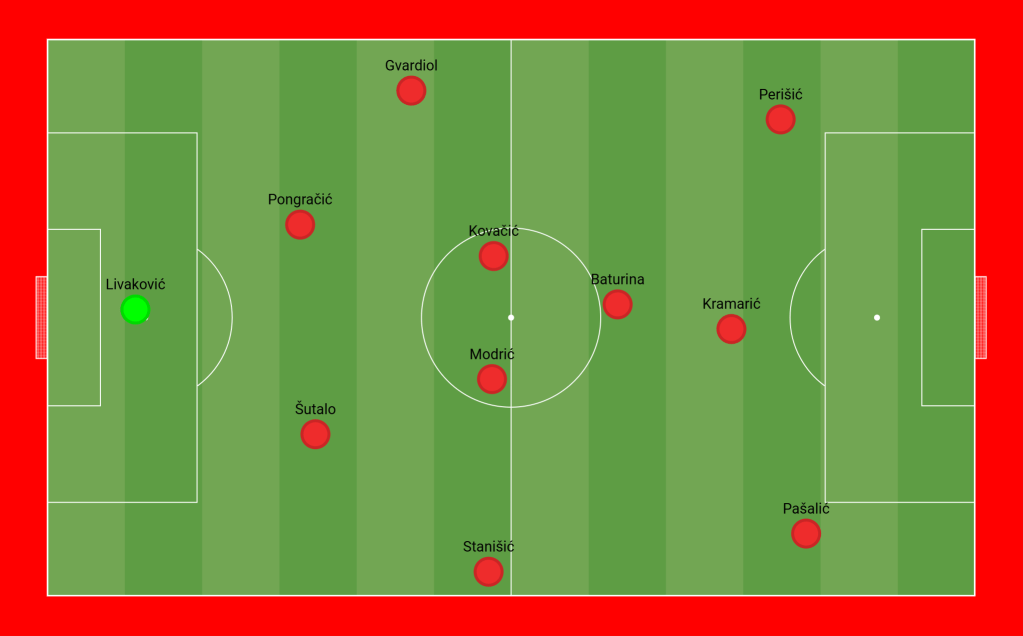
4-2-3-1
Dalić achieved success with Croatia using this system but, due to a lack of quickness and real wingers, will likely reserve it for less challenging matches. In this setup, he could utilize Stanišić and Guardiol as full-backs, Šutalo and Pongračić as central defenders, Kovačić and Modrić in midfield, Baturina as an attacking midfielder, Perišić and, Marco Pašalić (an interesting left-footed player with speed and a great inside shot) on wingers and Kramarić as the central striker.
Conclusion
Dalić will need to make further adaptations to ensure his system works effectively. His decision to change the team’s shape is commendable and reflects his coaching creativity. However, it may not be enough, and he will need to develop additional innovations during the tournament to overcome Croatia’s team deficits.
The Croatian national team has a good chance of progressing through the group phase. Although their best years may be behind them, they have not yet made their final statement. This might be the last major competition for Kramarić, Perišić, and Modrić, but they still have the potential to create significant challenges for larger teams in the knockout phase. After all, they remain one of the World Cup’s perennial underdogs.

