
The game occurred in an almost packed Opus Arena, with many away fans.
As mention in match preview , game was tactical competition between two creative coaches, and it can be divided in few phases.
Hajduk’s coach Karoglan, as expected and is well known for that quality, prepared the match tactically and used Zekić’s Osijek formation (three at the back) deficits very well. Zekić’s reaction at halftime was great, making three subs and significant formation and playing style changes, but unfortunately for him, it didn’t pay off in the match result.
Although the coaches thought about many details and scouted each other’s game, individual errors decided the match.
In this kind of match, the final result often defines a successful or unsuccessful game plan. When you look at the match from a tactical perspective and which game plan helped on the team’s path to victory or defeat, then the tiny margin is in between. A lot of times, players’ individual quality or individual error decides the match result, and it is, more than it is not, out of the coach’s influence; that is also the main beauty of the game because it probably should belong more to the actual playing artists and tactics should help them express their creative potential, either in defence or in attack. After all, great players are why we’ll fall in love with the game. It looks like industry, hard-working football is taking over even creative Croatian mentality, but that is the theme for other situations.
So, let’s begin with match analysis!
OSIJEK-HAJDUK 0-1
The match can be divided in two halves and six phases:
First half:
- Starting game plans and fighting for game plan dominance (Hajduk 4123 buildup fluidity vs Osijek’s 3421 middle block)
- Hajduk’s high defensive line, attacking dynamics, and wing overlaps vs Osijek 5311 low block resistance
- Osijek 541 shape adaptation after constant wing leakage
Second half:
- Osijek’s substitutions, formation and playing style change vs Hajduk’s low block adaptation and resistance
- Hajduk’s substitutions, formation and shape change (4312)
- Osijek’s all in
FIRST HALF
Starting game plans, and fight for game plan dominance (Hajduk 4123 buildup fluidity vs Osijek’s 3421 middle block)
Immediately, from the kick-off of both game plans were obvious. Osijek lined up in 3421 formations middle block, both offensive midfielders (Jugović and Omerović) staying narrow, waiting for Hajduk’s back pas to defenders and goalkeeper to pop out in the press. In the attacking phase, it was evident that Zekić decided that Osijek should play long on Mierez, so Jugović and Omerović were narrow to give support on bounced second balls and quick transitions afterward. Although Osijek’s pattern was evident, Hajduk’s high play fluidity, press resistance, and solid second ball recovery from Žaper, Šarlija, and Uremović made that plan ineffective.
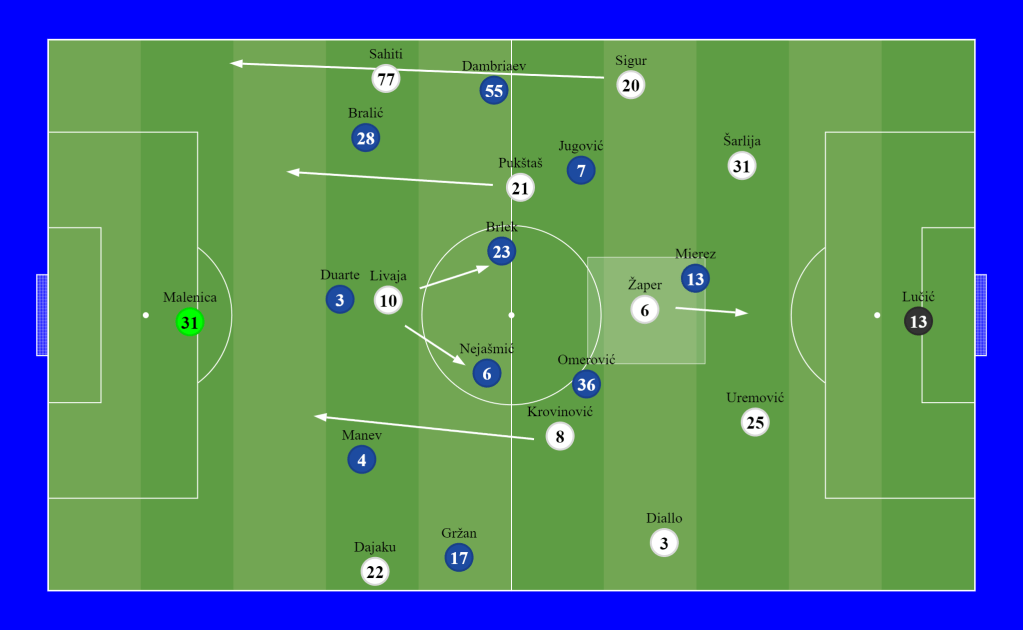
On the other side, Karoglan decided Hajduk would play a highly fluid passing game, deciding for 4123, a very stretched formation, with classical wingers in their positions, so he could exploit the width of the pitch and Zekić’s three-at-the-back formation and making space for his midfield trio (Žaper, Krovinović, and Pukštaš) to dictate the game tempo. Interestingly, Livaja was playing a lot like a false nine, participating in midfield overloads and pulling Osijek’s central defenders (especially Manev) from the defensive line so both midfield eights (Krovinović and Pukštaš) could exploit pockets and gaps.
After ten minutes, Hajduk had great buildup fluidity, which ended up with a few very good ball transfers to the attacking third and even one excellent transition chance (Pukštaš, after overlapping and receving pass on the third player from Sahiti, made an incredibly high speed running key pass for Livaja) it was obvious that Osijek will not be able to cope with Hajduk’s game plan with middle block and 3421 shapes.
Hajduk’s high defensive line, attacking dynamics, and wing overlaps vs Osijek 5311 low block resistance
To not receive transition goals after buildup and to compensate for positions on their flanks, Osijek lowered the defensive line, changing their system into something that looked a lot like 5311.
Hajduk exploited even this adaptation, bringing the defensive line up the field, with midfielders quickly passing the ball and changing sides. That allowed Hajduk’s fullbacks to overlap, especially Sigur, with many crossings in the box. Fortunately for Osijek, Hajduk’s lack of inbox finishing capacity (evident from the beginning of the season) left Osijek’s goalkeeper, Malenica, without the need for big saves, and the result was 0-0.
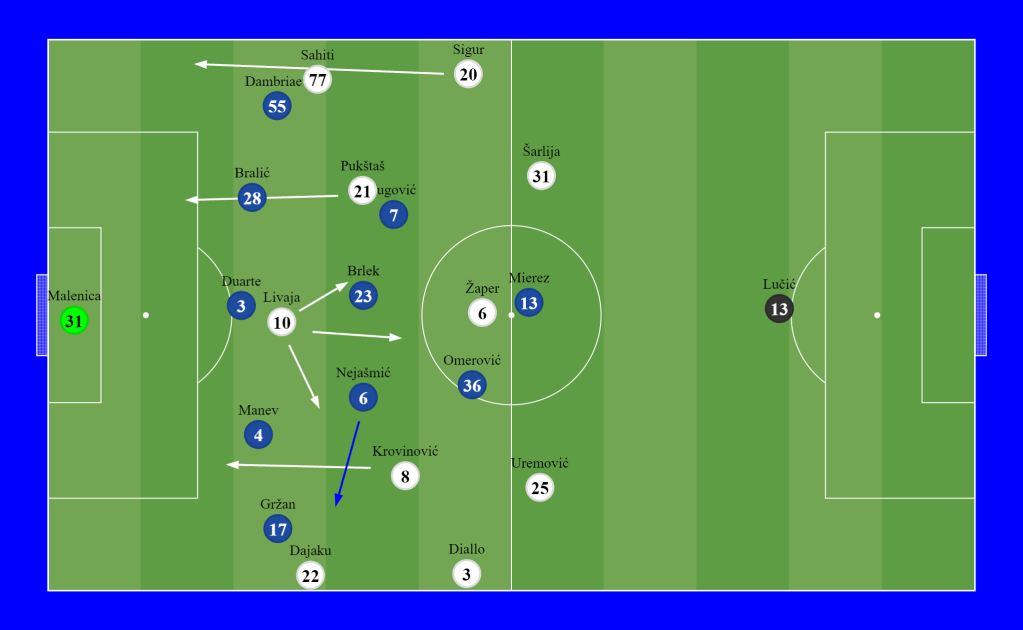
It is evident that Osijek’s midfield was struggling; Nejašmić and Jugović had a lot of running to help Osijek wingbacks in 2v1 situations, so another formation adaptation needed to be done.
Osijek 541 shape adaptation after constant wing leakage
Osijek needed change to close the man deficit on the flanks. Zekić made another adjustment, changing formation in 541, so both Jugović and Omerović could help cover wide arias in the defensive phase.
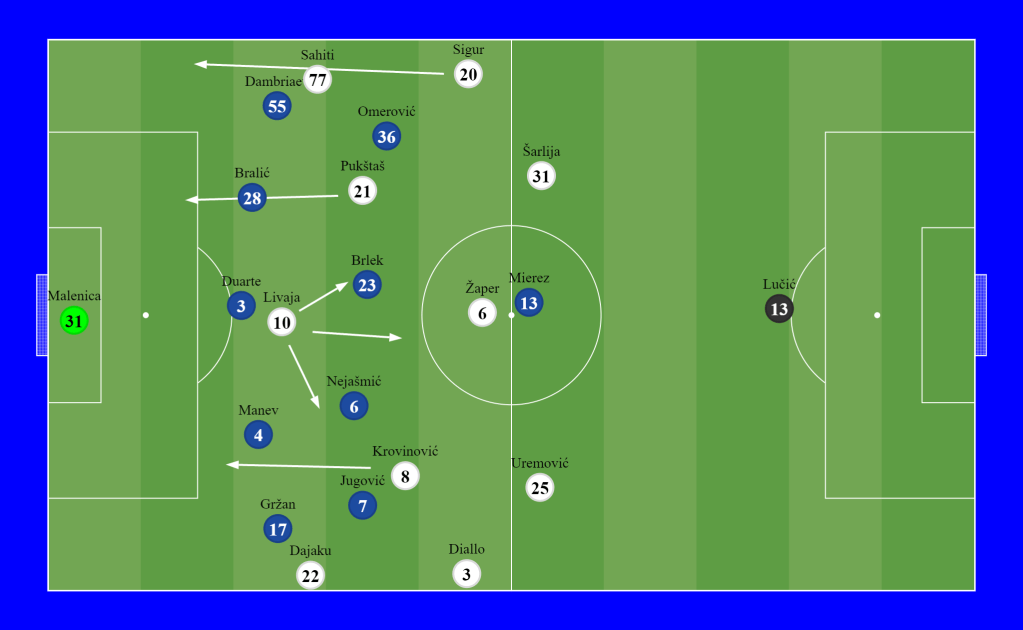
Although it looked very confusing (sometimes Omerović defended the right side, sometimes left, changing sides with Jugović), it looked like Osijek got away with an awful halftime presentation without a scratch. But then Jugović gave a wrong back pass directly in the legs of Sahiti, exactly when Duarte wanted to play a one-two with him, leaving Osijek’s defence wide open. Sahiti gave Livaja a tremendous final pass, and Livaja took an excellent angle to beat Malenica 1vs1.
Hajduk took the lead and went on the break 1-0 up, at the end of the day, not because of the game plan but because of individual error.
SECOND HALF
Osijek’s substitutions, formation and playing style change vs Hajduk’s low block adaptation and resistance
It was expected that Zekić would change the game plan. And he did; right after halftime, he made three substitutions. Bringing in an offensive midfield trio (Caktaš, Pušić, and Bukvić), Osijek changed formation in 4231.
Hajduk reacted by lowering their lines and zonal defending, with occasional “trips” on the opponents’ half of the pitch. After ten minutes of the second half, it was evident that Hajduk’s midfield was losing a battle and could not retain possession. It was most apparent in Krovinović, so to keep him in the game longer, Karoglan sacrificed winger Dajaku and substituted him with right fullback Moufi. So Moufi went to right fullback position, Sigur went to left midfield eight positions, and “tired” Krovinović went on “vacation” to left winger position, doing absolutely nothing for his team, as always in the second half, but now at a less dangerous place.
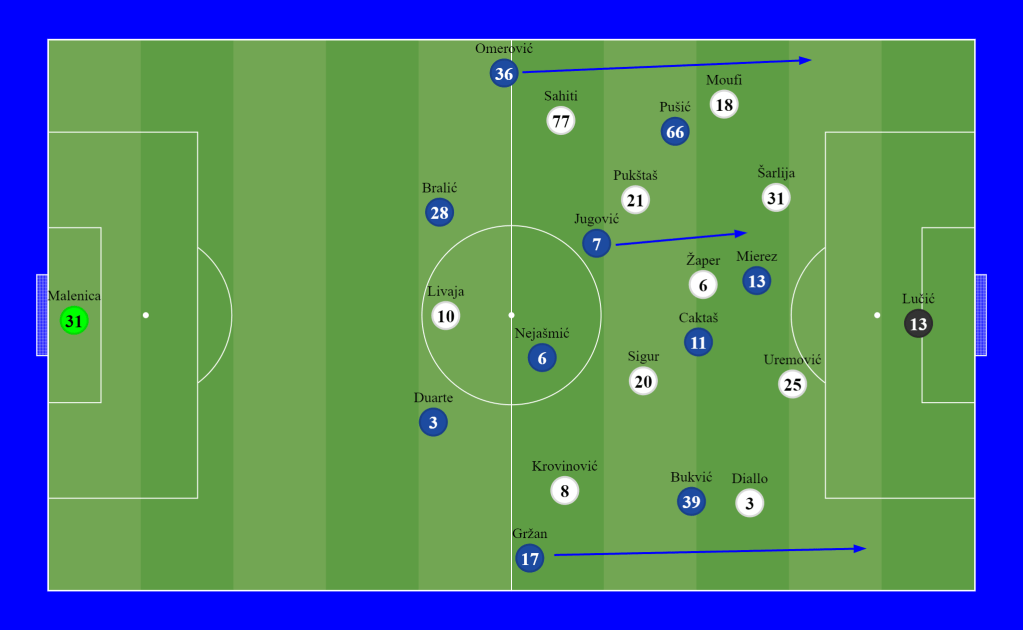
Osijek’s substitutions and formation change made an immediate impact on game dynamics. Osijek took possessions and initiative, applying high press and creating chances mainly through crosses and set pieces. But they still couldn’t score, although they came in many cases, especially Jugović and Mierez; there was always someone from Hajduk’s defence to make the shot difficult or to block it.
Hajduk’s substitutions, formation and shape change (4312)
After 70 minutes, it is evident that Osijek was almost there and that if it continued, Osijek would score shortly. So Karoglan decided to do two substitutions and a formation change.
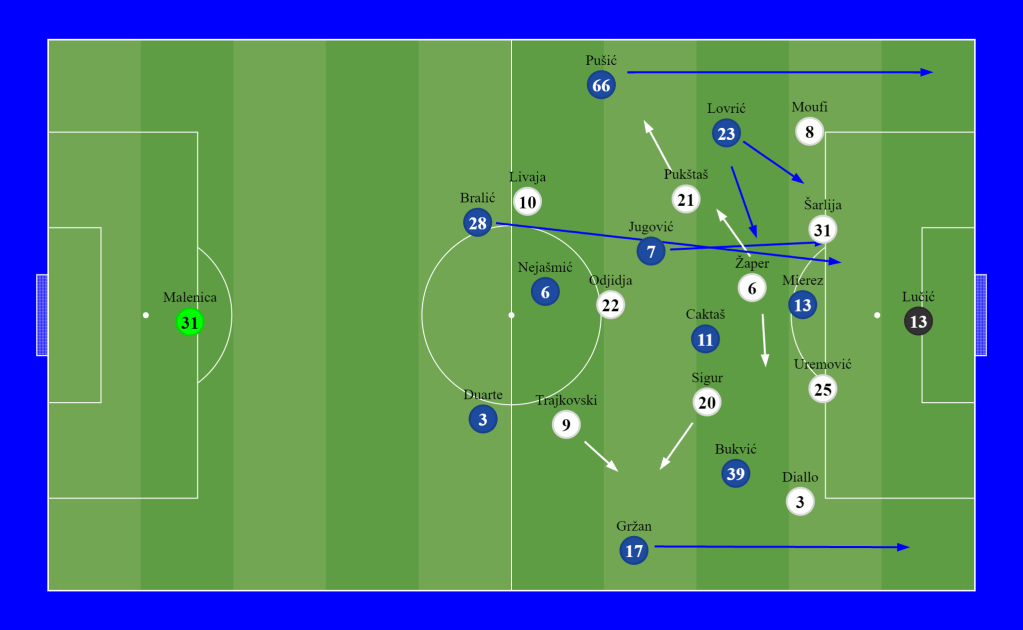
“Tierd” Krovinović was substituted with Odjidja and Sahiti with Trajkovski. Hajduk took 4312 shapes on the field. It gave them momentum for around ten minutes. Hajduk stabilized by gaining a numerical advantage in the center of the pitch, taking some positions, and performing a few attacks on the finishing third, but without permanent impact. After ten minutes, Osijek adapted to Hajduk’s new formation and exploited 4312 flank numerical disadvantages and player profile deficit.
Because of formation change, Hajduk’s midfield, especially two eights (Pukštaš and Sigur), needed to make extra side runs to cover gaps, with very little help from Livaja, Odjidja, and Trajkovski, who are all three static players.
As soon as Zekić saw this, he made further changes, substituting Omerović for Lovrić, positioning Lovrić on the left wing where he received a lot of passes and made an immediate impact on the game-taking lot of one on ones on his right leg. The other benefit was that Pušić, the winger, was positioned in the left fullback position, directly behind Lovrić, so that they could cooperate on the left flank. Osijek regained momentum during the game, so Hajduk needed to lower their lines again. Osijek started playing quickly with one-twos.
In this period, Jugović did very well to find himself in two excellent opportunities from close range, trying to bend the ball around the block but missing both. If Osijek scored once, they would score more because they looked excellent.
Osijek’s all in
In the final minutes, Zekić went all in. He was putting defender Bralić up in front to gain height for crosses, lowering Nejšmić to the CB position for distribution, and introducing 17 years old youngster Matković who went in for Jugović.
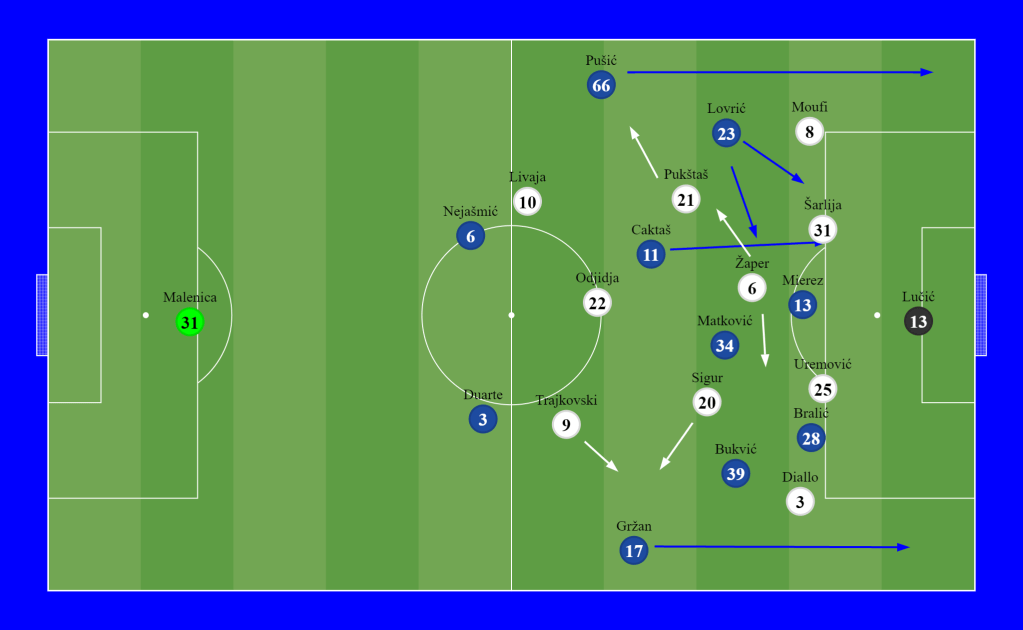
But in the end, Osijek didn’t score, although Lovrić had a great shot at the last minute, but hit the crossbar.
Players with most significant game impact:
Jugović (Osijek) – made a mistake, leading to Livaja’s goal, but was excellent in defensive positioning and covering spaces in all three systems (3421, 532, 541). He made many essential inbox runs in the second half when he was a defensive midfielder in 4231 and found himself in three great shooting chances. Unfortunately, he wasn’t precise in taking quick shots and didn’t score under Hajduk’s defense pressure.
Livaja (Hajduk) – scored the winning goal with pure class. He made himself available for teammates in midfield, providing numerical and geometrical superiority in the first half, pulling Osijek’s central defenders out of positions for Hajduk’s eights to exploatate with deep runs in the box.
Lovrić (Osijek) – made a significant impact on the wing when he entered the game. Taking one-on-one, winning fouls in dangerous positions around the box, and at the end, taking hard shot hitting the crossbar. It’s a shame he is unfit because his football mastery is evident with every touch.
Pukštas (Hajduk) – returned quickly after a knee injury, imposing himself as an essential box-to-box midfielder. With a lot of defensive running and space covering.; in the attacking phase, cutting in the box for crosses, unfortunately, he didn’t adjust his shooting and heading weaponry jet after the injury. Still, the guy is an absolute midfield machine and a player for Hajduk’s future.
Nejašmić (Osijek) – Made a lot of covering runs, especially in the first half, managing to cover midfield and helping close Osijek’s right flank against Dajaku and Krovinović until Zekić helped him with necessary 5312 in 541 formation transformation. The second half is dictated by Osijek’s game from the deep midfield position, even staying in the central back role at the end.
Mierez (Osijek) – was cut off his team in the first half, and although he was receiving a few long passes, he wasn’t provided with offensive midfielders’ support. The second half was dangerous, almost taking a shot twice, but he was late on the ball. Although he didn’t make the expected scoring impact, he tied himself to Hajduk’s defense.
Žaper (Hajduk) – The first half distributed passes well and was a part of Hajduk’s midfield’s good fluidity passing game. The second half did a lot of an “invisible” job, providing his team with many back-covering runs, imposing himself on opponents’ shooting lanes, and helping cover Mierez and Caktaš in the second half. Perhaps a defensively crucial player, with defensive and space-covering actions, made his team endure the second half without receiving a goal.
Sigur (Hajduk) – Although young, he is a versatile footballer. Tacticly mature and very intelligent, he can play a lot of positions in different formations. He started as a right fullback in 4123 and did a great job in the first half, overlapping whenever possible, taking some one-on-ones, and giving a few crosses in the box. In the Second half played as left number eight in 4123 and 4132, covering space with a lot of running, helping cover flank positions, especially when playing in a diamond shape midfield.
Krovinović (Hajduk) – seeing such a technical and creative player can’t endure even 60 minutes of the game is a pitty. The first half dictated the game very well, distributing the ball and occasionally attacking space through Osijek’s defense pockets. But in the second half, someone turned him off. Not taking any responsibility for build-up, it looked like he was hiding on the field. It’s a shame that this kind of problem always happens to him because he is a brilliant player.
Conclusion:
It was a tactically exciting game, but in the end, does the result show what tactically happened on the field? Of course not! Neither would be an injustice that Zekić won through his substitution and formation adaptation; neither is an injustice that Karoglan won because of excellent match preparation. But in the end, the game was decided through the player’s mistakes and the other player’s moments of inspiration, as it should always be!
 Diamond Football Tactics