

The former president of Hajduk Split once said, “When you wrestle with the pigs, you end up in the mud.”
However, if you know the pigs are coming to wallow in the mud and you arrive dressed in suits, ready to dance the waltz as if it were a night of classical dancing, then it’s clear that someone didn’t do their homework and failed to prepare for the match properly.
Although statistically Dinamo was the better opponent in the offensive phase, credit goes to Carević and his team for superbly preparing and executing their defensive tactics on the pitch, resulting in a 2-1 victory for Gorica.
Both teams had their cup matches during the week, and both emerged victorious.
Dinamo did not surprise much. They started almost as expected in a 4-1-2-3 formation, with Stojković taking the place of left winger, Vinlof positioned as left full-back, and Villar in midfield, making only three changes.
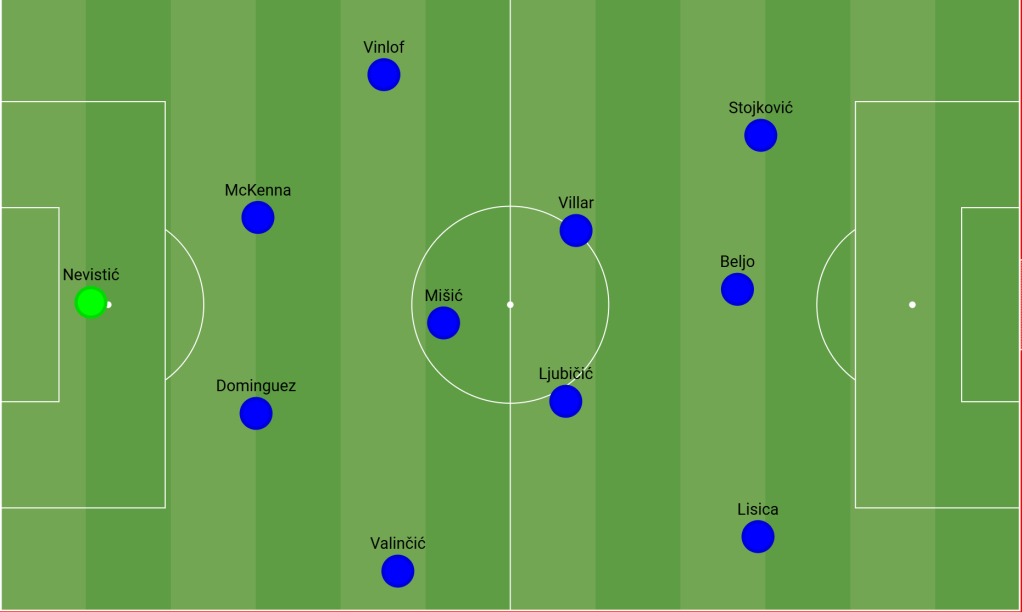
In the beginning of the match, Dinamo looked very lackluster. It seemed as though the players were lacking motivation and displaying low energy levels both on and off the ball. This resulted in numerous technical mistakes and an inability to win duels and second balls. Some may argue that the main reason for this lethargy was the pairing of Mišić and Villar in the starting eleven, but it was clear that the entire team was lacking collective energy.
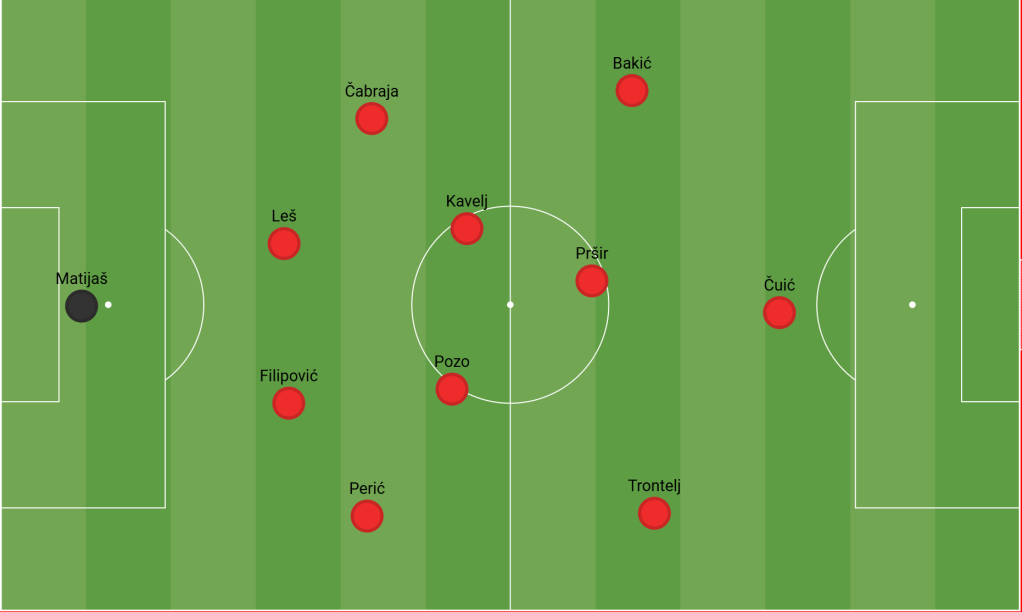
On the other hand, Carević did not have wingers in his squad, so he had to adapt his personnel selection. It was evident that Gorica would rely on quick transitions and counterattacks after winning the ball defensively. Consequently, he opted for a 4-2-3-1 formation, positioning Bakić, who usually plays as a midfielder, on the left wing and Trontelj, typically a wing-back, on the right. The defensive structure was crucial, as Gorica, through the combined efforts of Pršir and Čuić, pressed Mišić, forcing him to make several critical mistakes during the buildup phase. An interesting tactical variation involved Čuić often moving from the central position to the left wing, where he delivered excellent crosses and assisted in the scoring of the second goal. It is worth noting that both of Gorica’s defenders, Filipović and Leš, did an outstanding job of stopping Beljo.
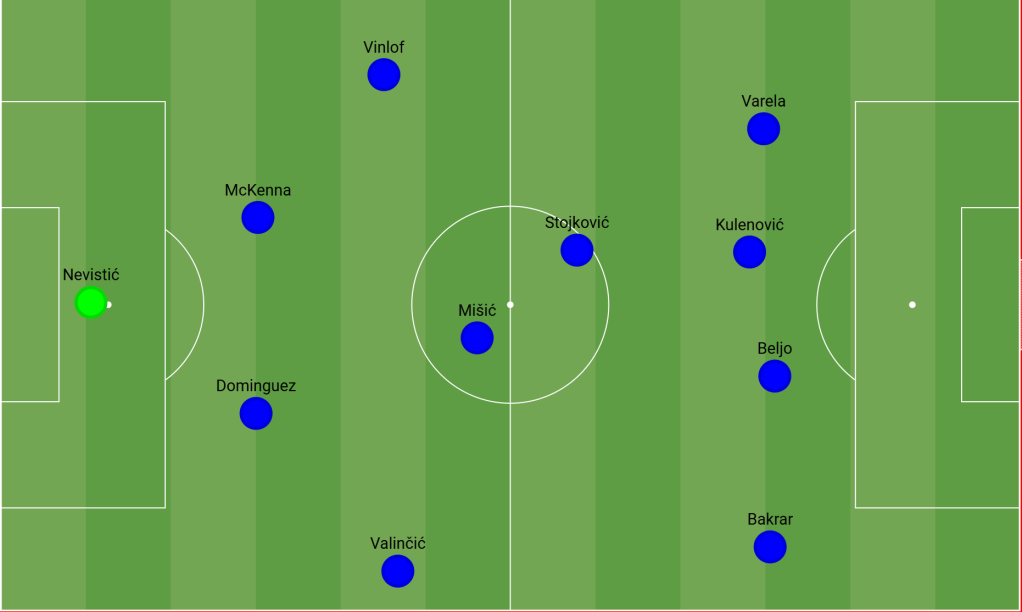
At the start of the second half, Kovačević made three substitutions: Bakrar came on for Lisica, Varela replaced Villar, and Goda took the place of Vinlof. Later, Kulenović also came in for Ljubičić to play upfront alongside Beljo in a 4-4-2 /4-2-4 formation and even managed to score with a header from the near post after a corner. Kovačević later switched to a 4-2-3-1 formation, bringing Vidović on for Beljo, but it wasn’t long until Stojković received a red card, forcing Dinamo to continue in a 4-4-1.
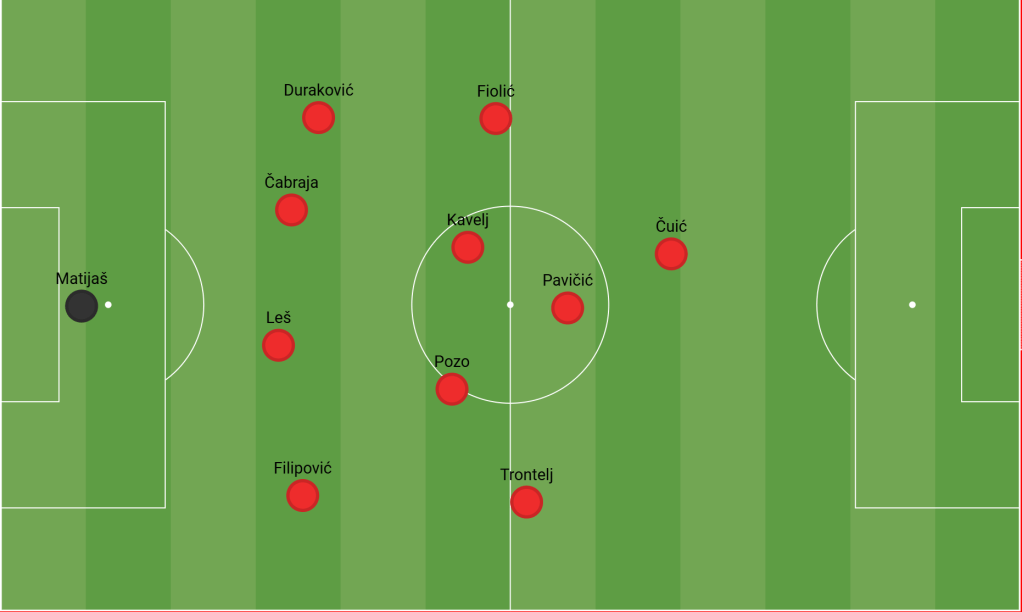
After Gorica scored to make it 2-0, they defended strongly, trying to disrupt the match’s rhythm by feigning injuries, similar to some of the more notorious Italian players, and testing the referee’s patience. Despite having one more player on the field, Gorica struggled to dominate possession but managed to maintain its lead. It’s also worth noting that Gorica’s midfielders, Kavelj and Pozo, effectively covered the pitch defensively against the best team in the league.
 Diamond Football Tactics