

If this match were a chess game, it would look like two kids who just learned the rules two minutes before kickoff were going head-to-head. Imagine a football pitch where one coach had his team ready to play Cluedo and the other was set for Twister. Honestly, it was chaos! In the first half, it seemed like the Cluedo coach was trying to solve a mystery with his pawns, while the Twister guy was busy tying his players into knots. Unsurprisingly, the Twister team won the first half—probably from all that stretching!
But then, in the second half, the Cluedo coach suddenly decided to play actual chess, leaving the Twister coach fuming. “Hey! My team was just getting into the twisty groove!” he yelled, while his players stood around looking confused, longing for the good old days of body contortions. What a fucking mess!!!
In the first half, Vukovar played similarly to their initial match against Lokomotiva. It’s important to note that Gorica employed the same tactics as Lokomotiva. Vukovar was attempting to build up play in a 4+2 formation while facing a 3-4-2-1 Gorica’s press. Defensively, Vukovar organized in a 4-4-2 formation to cover Gorica’s midfielders. Given that the same patterns as in the game against Lokomotiva were on display on the pitch, it’s hard to expect a different outcome.
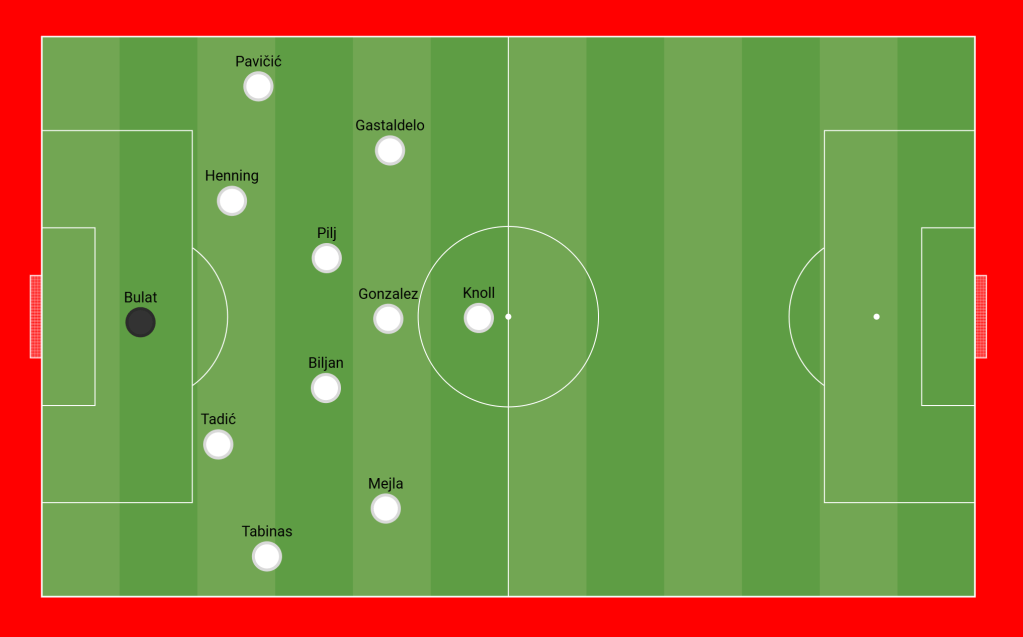
Knoll struggled to receive the ball upfield, facing three Gorica defenders on his own. Vukovar’s pressing of Gorica’s buildup lacked the necessary energy and structure, with three players attempting to challenge Gorica’s five. The wingers found it difficult to exploit space on counterattacks because they were trying to receive the ball at their feet in very crowded areas. Additionally, midfielders Pilj and Biljan made enough poor decisions for the whole match, not just for the first half.
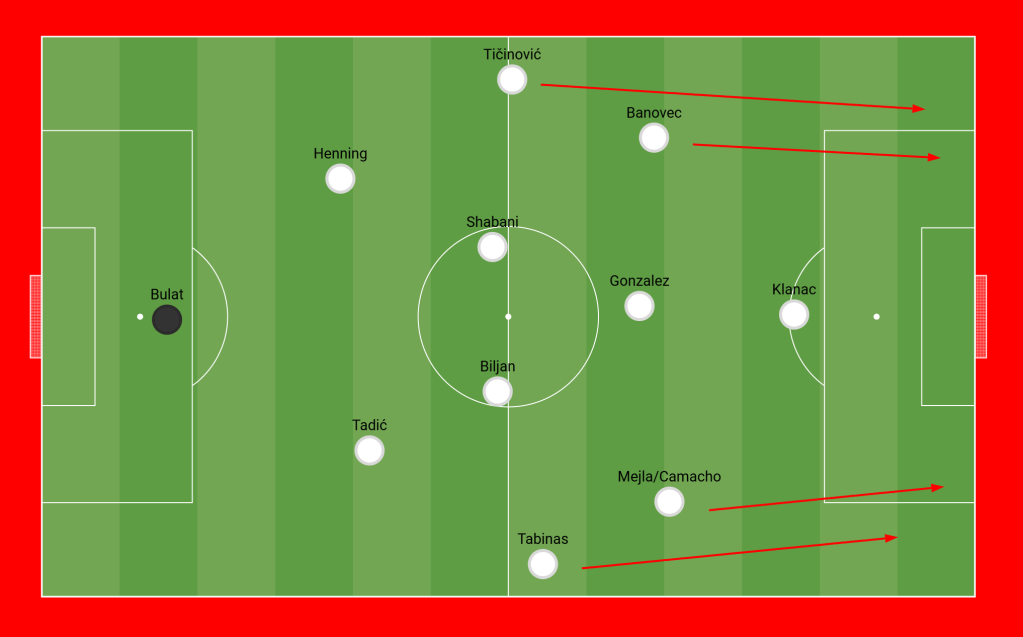
In the second half, Schindelfeld acknowledged his mistakes and made adjustments that improved his team’s performance, making it more dynamic. He positioned the team higher up the pitch, placing less emphasis on buildup play and not overly focusing on covering Gorica’s central midfielders. Instead, they effectively exploited Gorica’s tactical weaknesses and used double flanking to create space.
Carević set his team up in a familiar 3-4-2-1 formation, which featured a box-shaped midfield and emphasized pressing as the primary tactic. However, several issues needs to be addressed. Aside from Čuić, none of the players in the starting eleven has capacity of a true attacking killer in front of goal. Additionally, Carević selected his squad for the season without including any wingers, which places the next Gorica coach in a challenging position after his possible future departure. While he hoped for effective transitions and diagonal crosses into the box, there were no alternative strategies available for the attacking third. Despite managing to score twice, the team struggled to capitalize on more opportunities and failed to recognize that Vukovar’s first half performance was likely one of the weakest in the history of the Croatian football league.

In the second half, when Schindelfeld changed his tactical approach, there was no response from Carević. He continued to play his rigid style of football. The only reason he cited for nearly losing the match was that his players were trying to play too attractively, along with blaming the referees, as always happens when things don’t go according to plan.

Although the match was exciting because of the outcome, it was characterized by tactical chaos. It would have been better if one coach had prepared their strategy more effectively, while the other could have adapted and responded to the changing situation on the pitch.
 Diamond Football Tactics