
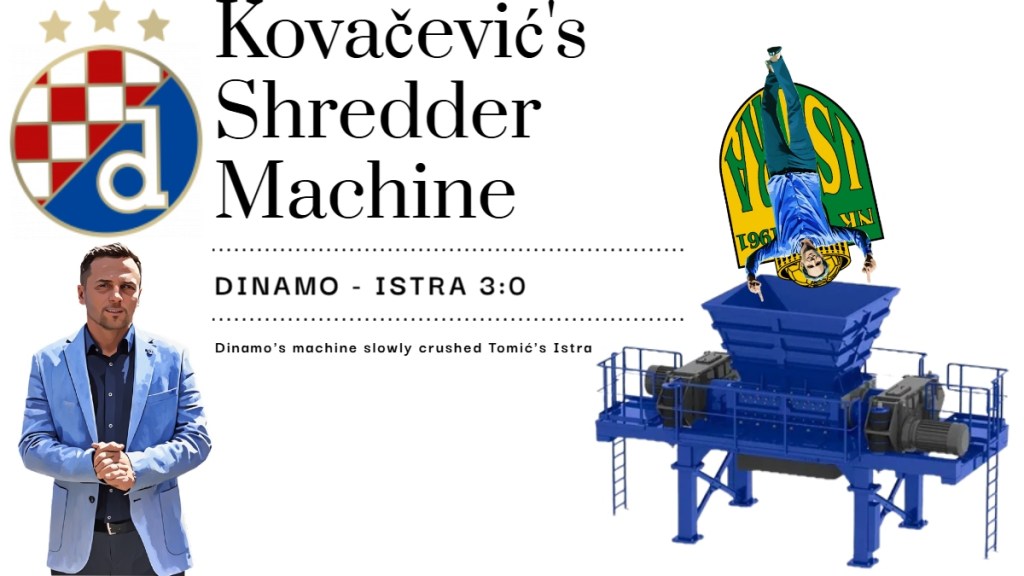
There is something hypnotizing about watching a shredding machine slowly demolish objects. When I describe Kovačić’s Dinamo tactics, I would say they resemble a possession-oriented shredding machine, methodically dismantling the opponent at a slow tempo with precision and technical accuracy.
Tomić’s Istra gave their all, but it simply wasn’t enough; they couldn’t even manage to commit five fouls throughout the match. They struggled to engage in any duels.
Kovačić is on the path to creating a team that will be hard to penetrate in the Croatian football top division.
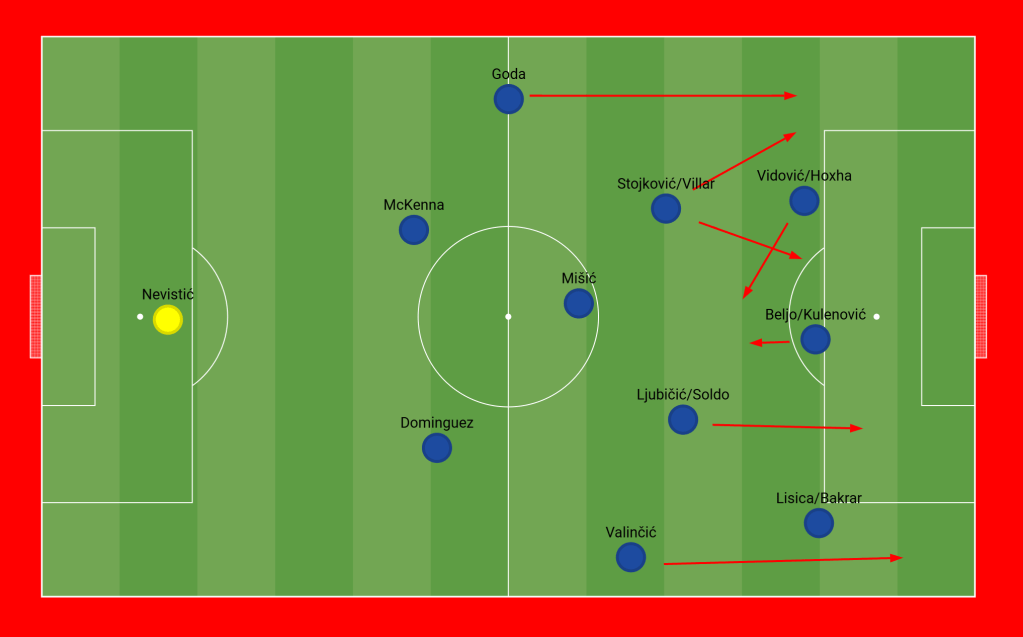
Against Istra, Mišić and Ljubičić dictated the tempo in midfield as excellent metronomes. Beljo’s first touch and striking technique are brilliant to watch. Stojković played a free role, much like a mezzala, while Vidović operated as a false winger, moving into the number ten space in midfield.
On the other side, although Lisica has plenty of room for improvement—especially in his one-on-one decisions and the precision of his back passes—he and Valinčić are cooperating excellently. Dominguec and McKenna, despite their brief time playing together, have been brilliant at defending open spaces so far. Villar, who came on in the second half, proved that he is first-team material, while Kulenović is showing potential to be something like what Solskjær was during Sir Alex Ferguson’s time at Manchester United.

Tomić tried to cover Dinamo’s midfield, occasionally resembling man-marking—Lončar on Mišić, Radošević on Stojković, and Maurić on Ljubičić, mirroring Dinamo’s midfield. However, their approach was too slow and soft for Dinamo’s dynamics. Even when they were close to winning the ball, Dinamo’s players were able to gather the loose ball due to better positioning and quicker reactions.

I can confidently say that Dinamo is on the perfect path to becoming a dominant force in Croatian club football for the foreseeable future.
 Diamond Football Tactics