

In the name of the state
It’s all about perspective. Everything depends on how we view the world. While some people struggle to understand why a country shouldn’t invest in more productive areas like education, salaries, or healthcare instead of purchasing destructive weapons, others gather to celebrate war.
For some, it is shocking that 500,000 people came together to sing songs about war, thereby enriching a mediocre singer in the process. However, others find joy in glorifying the war, believing it brought them freedom, even though it’s clear that all war really brings are casualties. Meanwhile, there are those who are more than happy to profit from it.
Indeed, those who benefit from war seem to hold the perspective that counts. In the 21st century, we embrace rationality and progress, but it still comes down to perspective. Shouldn’t 95% of our beliefs be based on common sense, leaving only 5% to subjective viewpoints? However, common sense is itself subjective. You may believe that only 5% of the Croatian state’s budget goes to the war industry while the other 95% supports common sense—or does it? I apologize for the confusion. 🙃
Tactics
Now, let’s shift to football—specifically, Dinamo’s tactics in their game against Vukovar. Kovačević is obviously trying to standardize the team by putting the same starting eleven on the field as the last match. The most interesting aspect is the idea of three players, more akin to a ‘number six’ role in midfield, interchanging positions and controlling the tempo of the game through passes and various combinations. Notably, Vidović on the left flank, Beljo in the central forward position, and fullback Valinčić are also occupying the middle of the pitch.
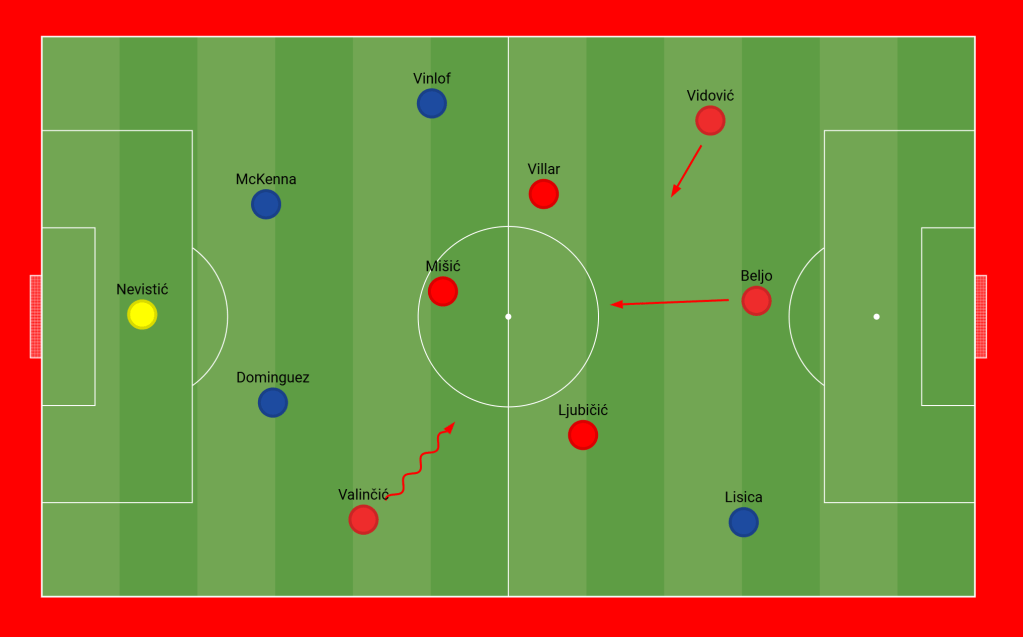
Some might think this strategy is overcrowded, and for certain matches, it could be, but as a playing style, it resembles the Croatian national team and Zlatko Dalić’s system. Personally, I like it; it’s about reading space and employing a technical approach to tight areas, which should be a Croatian trademark. In my opinion, Kovačević should stick to this approach and endure any criticism about changing his style.
While bringing in Stojković, Hoxha, and Kulenović adds more depth to the game and makes Dinamo more vertical, it also means losing control of the game. I believe he shouldn’t change the style just yet; he should wait for the players to better understand the system, play together, and coordinate their movements and timing.
Dinamo is dangerous and versatile. They are clearly attacking the 16-yard box in diverse ways—through mid-range shots, one-twos at the edge of the box, with through passes, low crosses, and crosses into the box area. They are even dangerous on counterattacks.
On the defensive side, time is needed to coordinate; it’s a completely new quartet trying to prevent opponents’ counterattacks and transitions. So far, they have managed to keep clean sheets in their first two games, thanks in part to a bit of luck. Dinamo is on the right track to build a trademark style of technical football in crowded spaces—something that Croatian and Zagreb football has been known for since the beginning.
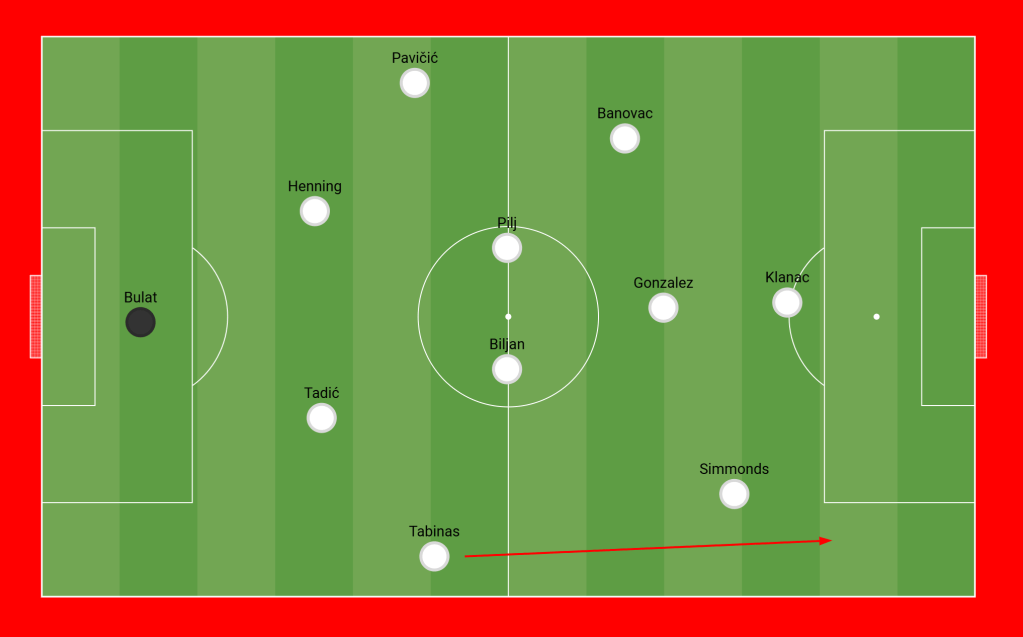
On the other hand, Vukovar has made significant efforts to adapt their strategy compared to their previous match against Lokomotiva, showcasing a wider array of options in the offensive phase. When they regain possession of the ball, Schindelfeld aims to develop effective offensive plays. His use of the 4-2-3-1 formation is commendable, as he has centered the offensive strategy around the technical skills of players like Gomez, Pilj, and Tabinas, making them quite dangerous during attacking transitions. In this match, they were also a threat during corner kicks. Although they may not have ample time to fully implement all their strategies, I am confident that the team will coordinate and become familiar with Schindelfeld’s ideas after a few rounds. Even as a new coach in the top flight, he is already demonstrating adaptability and good game vision early in his career.
 Diamond Football Tactics