

In a shocking twist of fate, it appears that in 2025, the Osijek city government plans to spend about 2 million euros on exterminating mosquitoes. Meanwhile, Bruno’s Petković “bipolar best friend” somehow managed to spend even more cash extermeneting Dinamo’s dressing room mosquitos for the season 2025/26. I mean, who knew mosquitoes could be so “budget-friendly”?
While we can all agree that Osijek city and football club Dinamo are officially mosquito-free—bravo to the Bruno’s best friend and to the city government!—the burning question remains: can the coaches of football clubs Osijek and Dinamo manage to build a winning football team without clubs directoring boards losing their sanity or their wallets? Only time will tell.
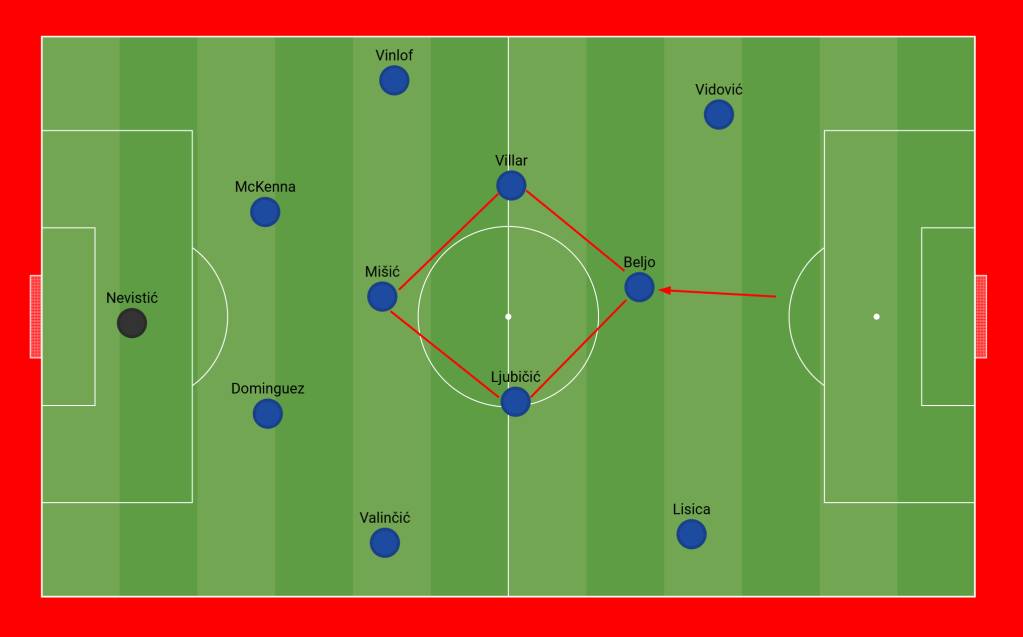
Joking aside, on Saturday evening (02.08.2025), Dinamo and Osijek played a thrilling match full of tempo and precision. Kovačević decided to line up his team in a 4-3-3 formation, as was expected from the pre-season matches. At the start of the new season, it’s clear that Dinamo will try to maintain ball possession at all costs. For this reason, Dinamo’s midfield is filled with players whose profiles resemble more of a number 6 than that of number 8s (Mišić, Villar, Ljubičić). They are very capable of controlling the pitch with their passing range, precision, and positioning. However, they may struggle when opponents apply pressure, as was evident in this match.
On the other hand, Kovačević has midfield players with different profiles who resemble more mezzalas and number 8s/10s—more pressure-resistant and able to drive progression through quick penetration via dribbling and running (Stojković, Mudražija). Once Dinamo dominated possession, it was impressive to see Lisica and Valinčić combine excellently on the right side, both of whom came from Istra.
Rožman, on the other side, built a strong and dynamic team capable of playing at a high tempo. Their style of play is competitive enough to challenge the best teams in the SHNL. Rožman prefers to impose a 4-2-3-1 system on the pitch. The core of the team lies in midfield, where youngsters Vrbančić and Babec orchestrate possession well and apply pressure on the opponents’ midfield. With their quick forwards (Omerović, Toure, Živković), they created significant problems for Dinamo’s defense during transitions.

From the beginning, Osijek applied intense pressure on Dinamo’s midfield, managing to win numerous possessions. Dinamo’s midfielders frequently lost the ball, especially Mišić, while the young Vrbančić applied great pressure on Villar, forcing him to make back passes and sideways passes. It was evident that Beljo dropped deep to provide numerical superiority in midfield, but Osijek’s players covered effectively. For the first thirty minutes, there were many possession changes, as both teams struggled to string together more than three passes in a row due to the intense pressure from each side. After some energy levels dropped, good chances began to emerge, with Dinamo controlling positional attacks and Osijek focusing on positive transitions. Osijek was very dangerous during transitions, but Dominguez, McKenna, and Vinlof did an excellent job preventing these opportunities, especially after Dinamo’s midfield lost balls during build-up play (particularly Mišić). Omerović and Živković were stopped from scoring in some good opportunities.
In the second half, Dinamo started to lose momentum as Villar, Mišić, and Ljubičić struggled in the midfield battle. Recognizing this, Kovačević made three crucial changes: Hoxha came on for Vidović, Stojković replaced Villar, and Kulenović came in for Beljo. Right away, Stojković added dynamism to Dinamo’s midfield; however, one more change was needed for Dinamo to gain the upper hand in the midfield—Vrbančić needed to come off the pitch. When he did, Osijek’s midfield lost its dynamism as Jugović is a different type of player, allowing Dinamo to take control.
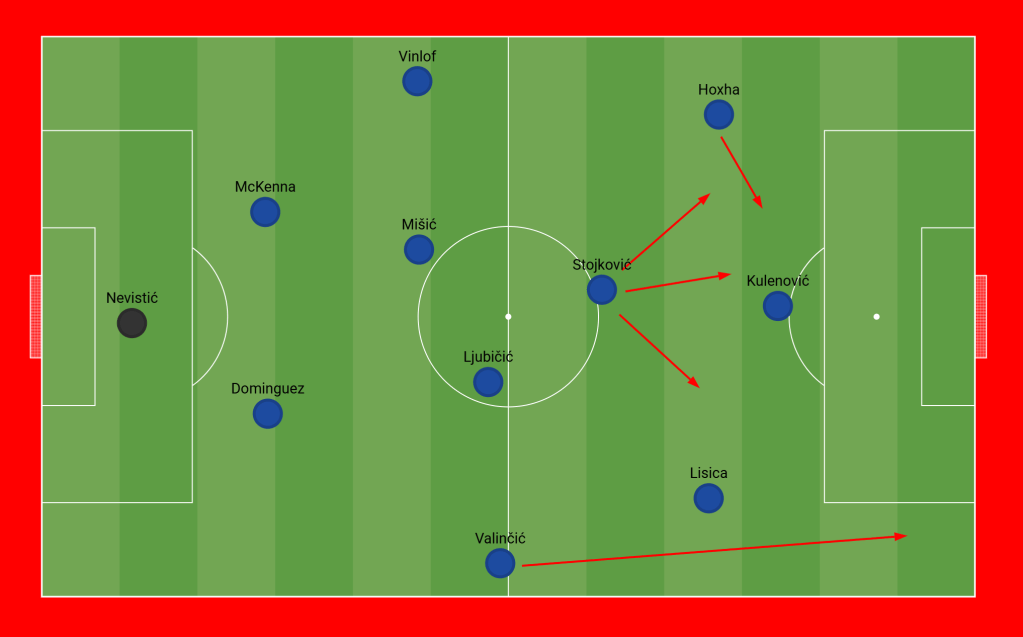
From that point on, everything became easier for Dinamo. Controlling the midfield allowed their strategies to become apparent, and suddenly, Valinčić began to impact the game from the right flank. Kulenović also contributed significantly.
Unfortunately for Rožman, he was unable to respond effectively due to the limitations of his roster. He made a strong tactical decision on the left flank by substituting Bukvić with Čolina. Bukvić struggled significantly against Dinamo’s duo, Valinčić and Lisica second half. However, this change came too late, as Dinamo had already gained momentum and taken a lead in the match when Rožman reacted. Despite the loss, Rožman’s team showed great determination, reinforcing what is already known: he is an excellent coach with remarkable game vision and one of the best in this part of Europe when it comes to developing young talent.
 Diamond Football Tactics