
In the lead-up to the match, opinions were divided about Gattuso’s tactical methods and the aesthetics of his team. However, one thing was certain: Hajduk needed a victory to maintain their position at the top of the table. Meanwhile, Lokomotiva’s newly appointed manager, the esteemed football expert Damir Ferenčina, arrived at Poljud Stadium with his team in a position where they had nothing to lose.
Gattuso’s interesting idea
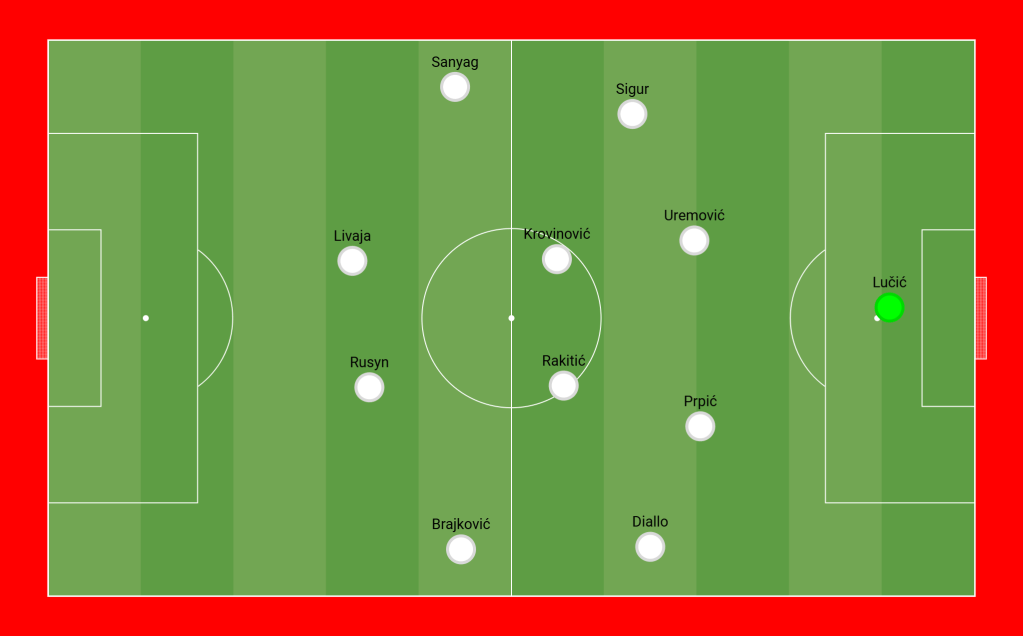
Gattuso implemented an interesting variation of the 4-4-2 formation, utilizing unconventional movement patterns from both fullbacks, Sigur and Diallo. In central midfield, Krovinović and Rakitić played their usual static roles, while Livaja and Rusyn roamed in the attacking third. Sanyag and Brajković occupied wide positions, allowing Diallo and Sigur to make inward movements and contribute to a dynamic buildup.
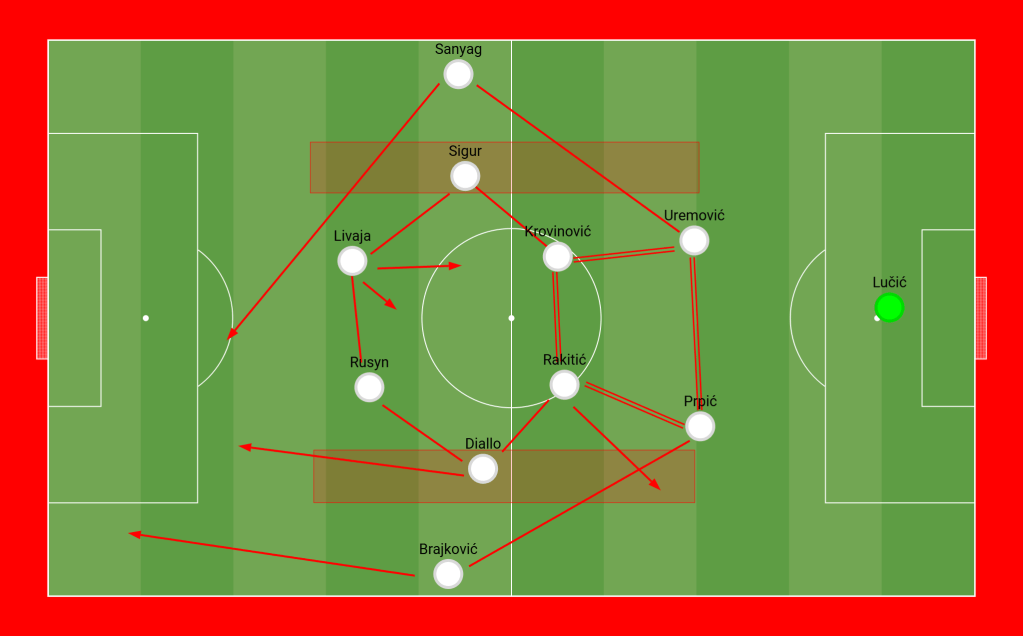
This formation and ball movement were effective against Lokomotiva’s pressure when transitioning into the offensive half. However, Hajduk faced significant challenges in the attacking third. Despite having several players in the box—including Rusyn, Sanyag, Brajković, and even Diallo and Sigur—their timing was off, resulting in ineffective crosses from the flanks. It is also worth noting that Livaja often dropped back to receive the ball in midfield and on the flanks, which left him outside the box.
Uremović and Prpić, along with Krovinović and Rakitić, were responsible for distributing passes, orchestrating the attack, and providing central protection when possession was lost. However, as had been the case in previous matches, Gattuso assigned Krovinović and Rakitić roles that required them to remain relatively static in order to control the game’s dynamics, preventing them from making penetrating movements up the field.
Hajduk’s red card, and Gattuso has adapted to a 3-4-2 formation
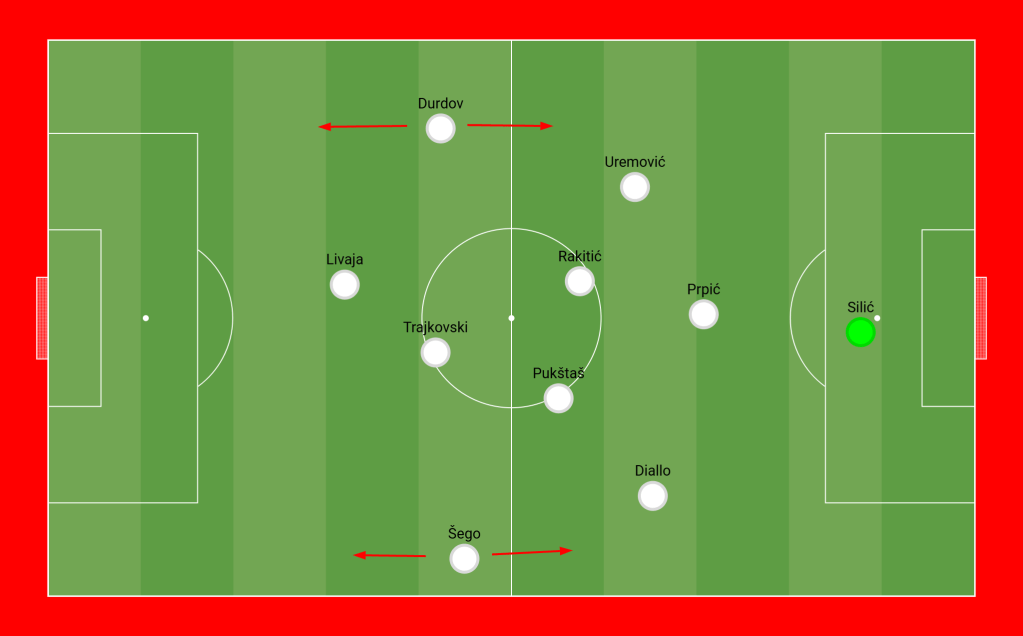
At the end of the first half, things started to complicate for Hajduk. Lokomotiva scored from a free kick, after previously being relatively undangerous. Then, in the 68th minute, goalie Lučić received a red card. Gattuso and his staff responded effectively by reshaping the team into a 3-4-2/3-2-4 formation, allowing Hajduk to remain offensive. Diallo, Prpić, and Uremović played as three defenders, while Šego and Durdov functioned as offensive wingbacks. Pukštaš and Rakitić directed the midfield, with Livaja and Trajkovski leading the attack. This strategic shift paid off, as Hajduk equalized in the last minute. Livaja penetrated the flank and delivered a cross to the second post, finding Trajkovski, who was left unmarked.
Ferenčina’s reactive 4231 system
Ferenčina lined up with an expected 4-2-3-1 formation. In the beginning, they attempted to press Hajduk, but after being outplayed in Hajduk’s buildup, they lowered their defensive lines. During the second part of the first half, Lokomotiva generated a few very good and direct counter attacks and even took the initiative in some plays. They managed to score from an exceptionally taken free kick by Karačić.
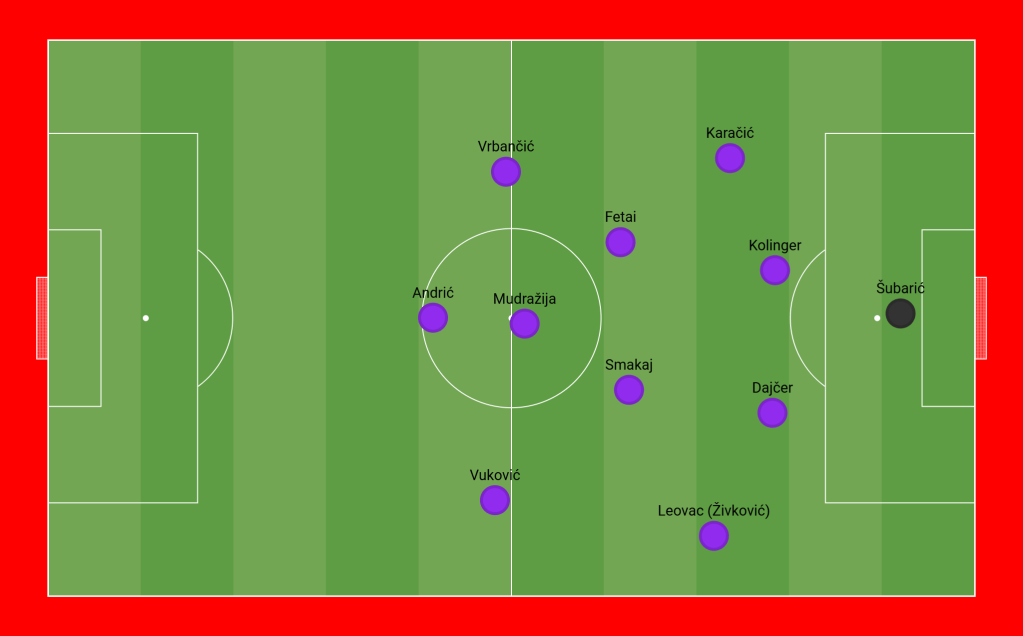
Ferenčina had to substitute Leovac and Vrbančić due to injuries, which was a handicap for them.
In the second half, Lokomotiva played with one man more but failed to capitalize on their numerical advantage or maintain possession of the ball. They dropped deeper into their own half and seemingly decided to defend their lead, a decision that proved to be misguided as Hajduk managed to score.
Ferenčina introduced young Katić and recovering player Krivak. Despite the result, Lokomotiva continues to develop their players, which is a positive direction for the club.
Conclusion
Hajduk managed to secure a tie despite being a man down, with an excellent reaction from Gattuso utilizing a 3-4-2 formation. However, few question about Hajduk attacking third play and effectivnes remains.
 Diamond Football Tactics