
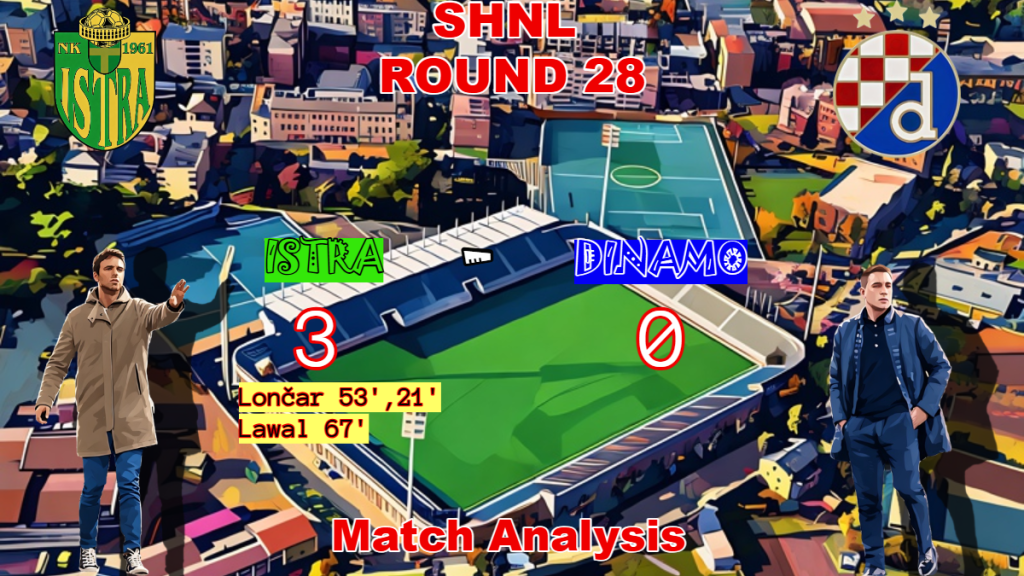
It should have been an easy Saturday afternoon for Fabio Cannavaro and his Dinamo at Aldo Drosina Stadium, but Gonzalo Garcia, the most promising coach of SHNL, had different plans for this overconfident Dinamo side. Garcia’s Istra gave Fabio’s Dinamo a lesson they will never forget. Despite having an intensive cup match against Rijeka earlier in the week, Garcia decided to employ an open tactic and line up his team accordingly. This could very well be the game in which Dinamo lost the championship. It was an excellent match.
Garcia’s Istra attacking shape
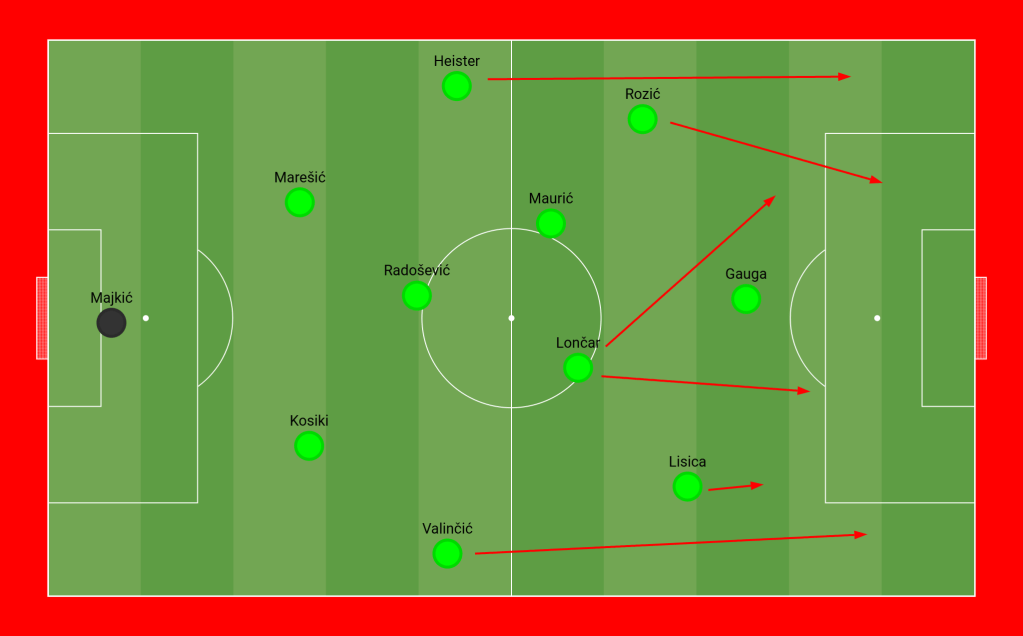
In attack, Garcia opted for a 4-3-3 formation. He positioned Lončar and Maurić as two attacking minded midfielders, making frequent runs into the 16-yard box, while Radošević played as the midfield fulcrum, facilitating buildup play and protecting the defense when Istra transitioned to the attacking third. The two central defenders, Koski and Marešić, remained calm in possession, along with goalkeeper Majkić, making excellent decisions to evade Dinamo’s press each time. Valinčić and Haister contributed significantly in the buildup, offering extra wide passing options and overlapping in the attacking phase when the opportunity arose.

Istra’s buildup structure, characterized by several diamond formations throughout the field, rendered Dinamo’s press ineffective. Istra’s midfielders found small pockets of space where they made themselves available for deep passes from Majkić, Koski, and Marešić, who were unafraid to play penetrating passes into those spaces, consistently breaking Dinamo’s press. When that was not possible, Istra’s players played diagonal passes, primarily targeting Rozić, or executed long balls to Gagua.
Wingers Lisica and Rozić played crucial roles, especially Rozić, who was the target for numerous diagonal passes and crosses after the opposite flank was successfully penetrated. Gagua acted as a reference point, particularly during quick counterattacks when Istra regained possession, protecting the ball to allow his teammates time to join the attack and providing them with well-placed through balls.
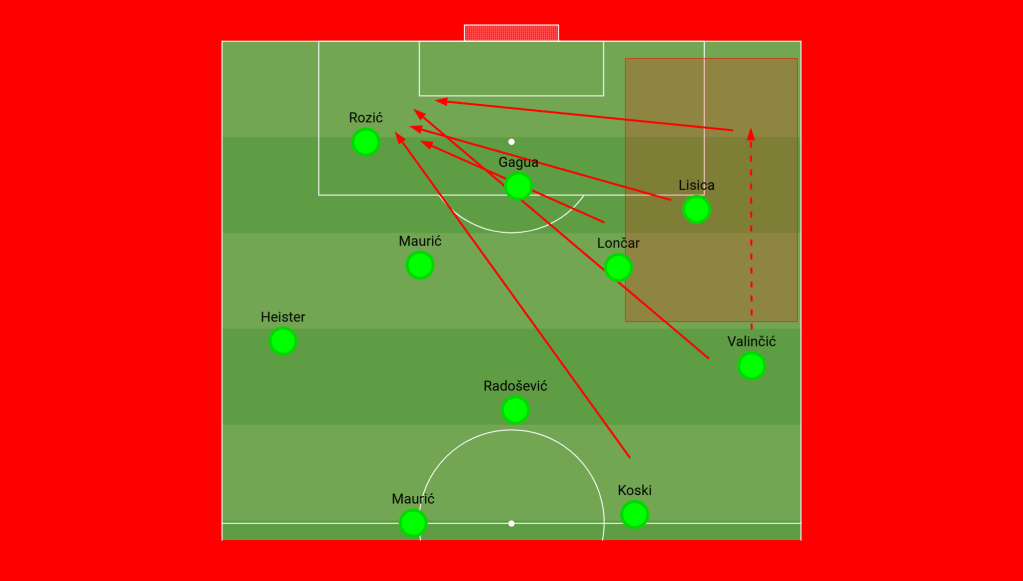
Midfielders Maurić and Lončar were especially active, frequently attacking the 16-yard box whenever possible and making themselves available for backpasses. The game plan focused on exploiting the second post through crosses or diagonal passes directed at Rozić, targeting Gabriel, who was clearly scouted as Dinamo’s weak spot.
Garcia’s defending strategy
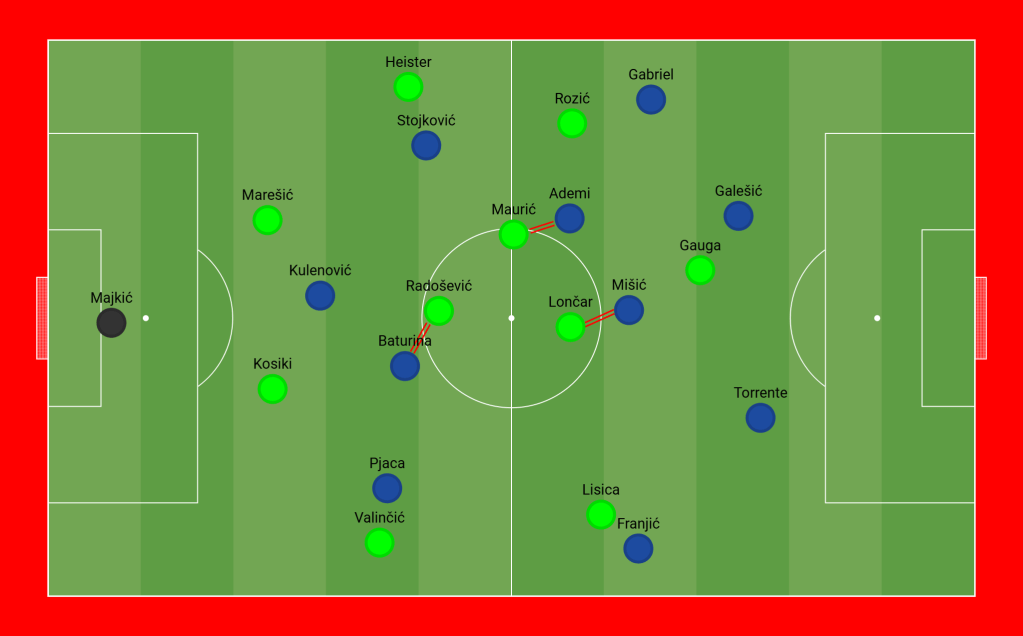
Defensively, Istra’s midfielders mirrored Dinamo’s shape in a man-marking system (Lončar on Mišić, Marešić on Ademi, and Radošević on Baturina).
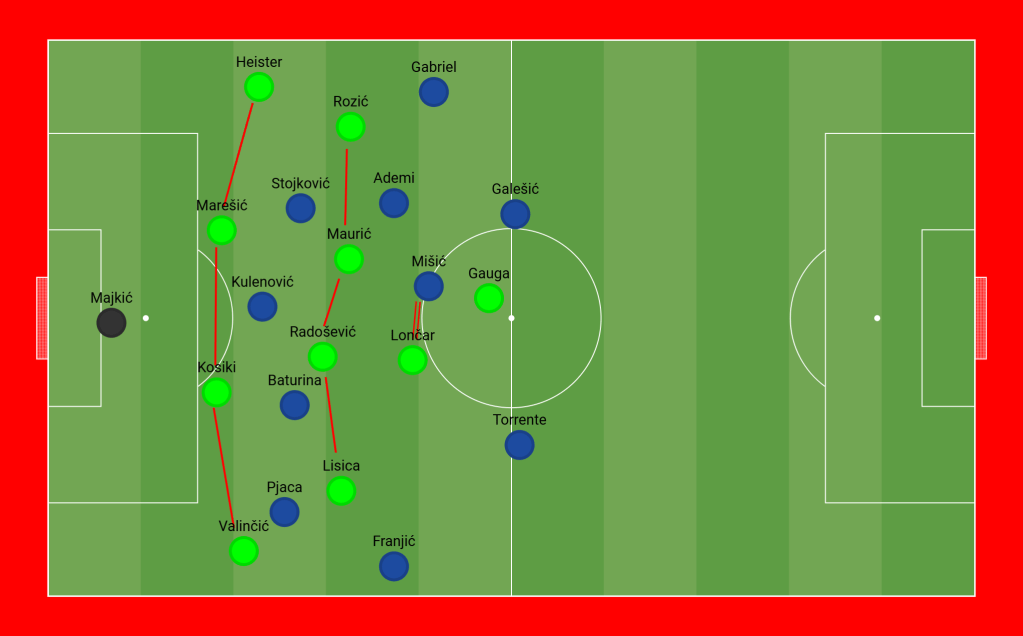
When Dinamo managed to advance the ball past Istra’s high and midfield lines, Istra’s players would drop back into a more defensive position, resembling a 4-4-2 formation. In this setup, Lončar and Gagua disrupted Mišić’s passing distribution, reducing the fluidity of Dinamo’s attacks. From these deep positions, Istra generated excellent high-speed counterattacks that caught Dinamo’s central defenders off guard. This transitional defense was a situation in which Dinamo faced significant challenges, and Garcia had clearly anticipated it well.
In the second half, Garcia made changes to refresh his team while keeping their shape and playing style intact. Lawal provided additional value by coming on for Rozić and, just a few minutes later, scored by converting a diagonal cross into a goal.
Helpless Fabio’s strategy

Fabio Canavaro once again demonstrated his preference for an active, possession-oriented attacking style of football. However, like many coaches before him, he struggled to maintain fluidity in the game when the opponent man-marked Mišić, preventing him from taking on the role of orchestrator in Dinamo’s creative gameplay.
Canavaro chose Ademi to play as an eight and Baturina as a ten, allowing Stojković to have a free role on the right flank. Unfortunately, these four players were not enough to dominate the midfield, and Istra won that battle. Canavaro positioned Pjaca on the left wing, but he was largely ineffective. Franjić and Gabriel were expected to provide possession fluidity from the flanks, while Torrente and Galešić were tasked with protecting Dinamo’s attacks in the final third.
It became evident from the beginning that Gabriel, Galešić, Torrente, Franjić, and Mišić would struggle during negative transitions. Each time Dinamo’s defensive line was forced to retreat towards their own goal, they appeared disoriented, and Istra exploited this weakness, particularly on Piere Gabriel’s side.
It should be noted that Dinamo did have some good periods, producing a few well-structured attacks that ended with crosses or shots from just outside the 16-yard box, but they failed to create any clear one-on-one chances. Their struggles were compounded by the absence of Petković, whose attacking creativity was missed, as Kulenović was unable to provide the same level of creativity in the attacking third.
Canavaro attempted to pressure Istra’s buildup, but the press proved to be too light for Istra’s players in this match. It was clear that the tempo of the press and the aggression were not sufficient to challenge Istra effectively.
Fabio’s second-half idea (Dinamo’s 442 shape)
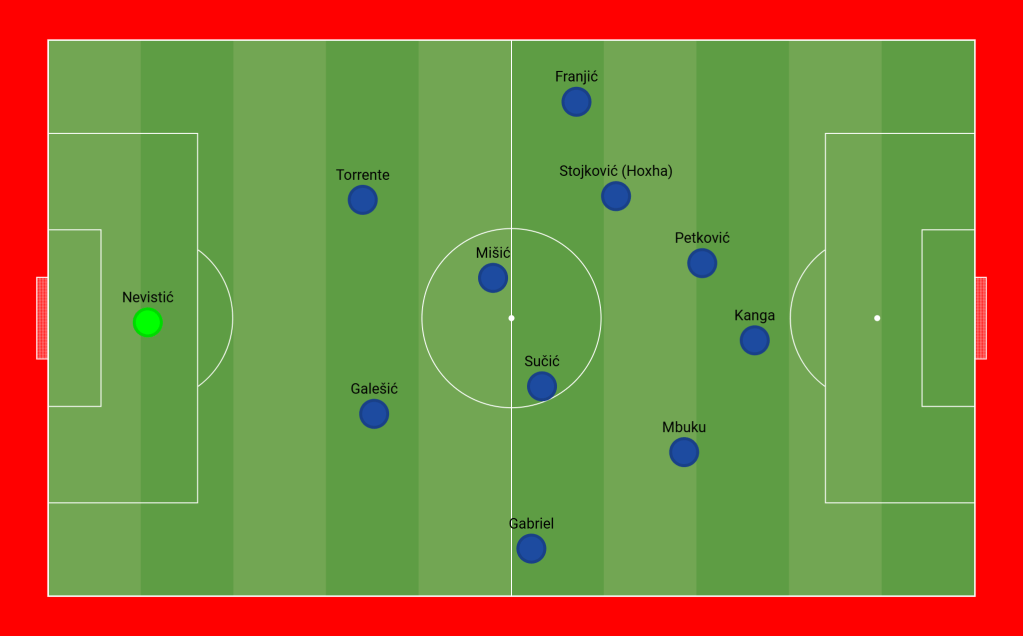
During the second half, Canavaro made significant changes, introducing Sučić for Ademi, Petković for Kulenović, and Mbuku for Pjaca, later bringing in Kanga for Baturina and even altering the system to a 4-4-2. However, these changes did not yield much success and seemed more like desperate moves. Ultimately, Dinamo lacked solutions against Istra’s coach Garcia’s tactical patterns.
Conclusion
Garcia completely outsmarted Fabio in terms of tactics. The man-marking of Dinamo’s midfield, particularly Mišić, combined with clear attacking patterns, made this victory even more thrilling. It’s worth noting that Istra players like Lončar, Gagua, Rozić, Fawal, and others were especially inspired, although they were likely a bit tired from their earlier match against Rijeka that week. On the other hand, Dinamo didn’t perform poorly but struggled to find a solution to crack Garcia’s tactical puzzle. Although Fabio’s decision to change the system in the second half was a good idea, his tactical approach wasn’t enough to score against an excellent Istra team. This match likely marks the end of Dinamo’s hopes for the title.
 Diamond Football Tactics