
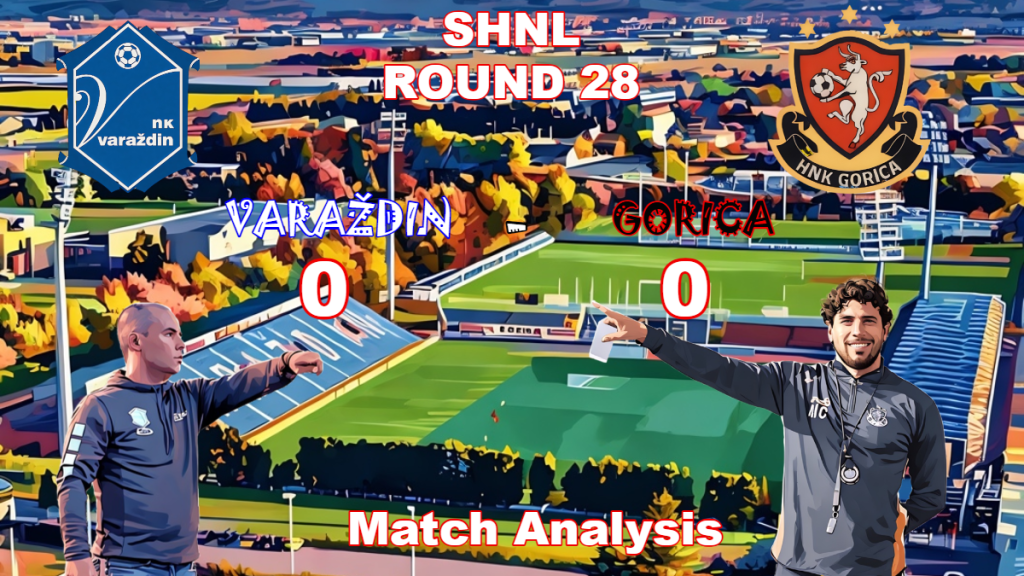
Two different coaching styles were evident on the pitch on a sunny Friday afternoon at Varteks Stadium.
On one side, Šafarić’s Varaždin played possession-oriented football, harnessing the players’ skills in a game that had high aesthetic value through geometric shapes and two or three-player cooperation. They exploited space with various tactical approaches, including give-and-go plays, one-twos, dribbling, and engaging a third player. On the other side was the highly pragmatic Carević’s Gorica, focused primarily on compactness and preventing goals.
Šafarić’s game flow and geometrical structure

Šafarić lined up his team in a 4-2-3-1 formation, aiming to exploit Carević’s three central defenders system by creating triangles on the flanks. Fullbacks Maglica and Boršić engaged in give-and-go plays and overlaps. Šafarić attempted to utilize Gorica’s flanks with central forward Dabro and attacking midfielder Mamić making penetrating runs into those areas. This tactic drew Gorica’s defenders out of position, opening space for Varaždin’s midfielders to attack the vacant areas in the box once the flanks were penetrated. Duvnjak and Marina controlled the midfield with good passing range and skillful evasion of Gorica’s pressure when necessary. However, the main issue for Varaždin was a lack of precision in finishing, especially during transitions after regaining possession. Their counter-pressing was excellent, and Gorica contributed to this by making numerous passing mistakes in their buildup.
In the second half, Šafarić made substitutions, bringing on Mitrovski, Antunović, and Alić in place of their counterparts, but they still couldn’t convert their great chances into goals.
Carević’s defensive pragmatism and suffocating geometry
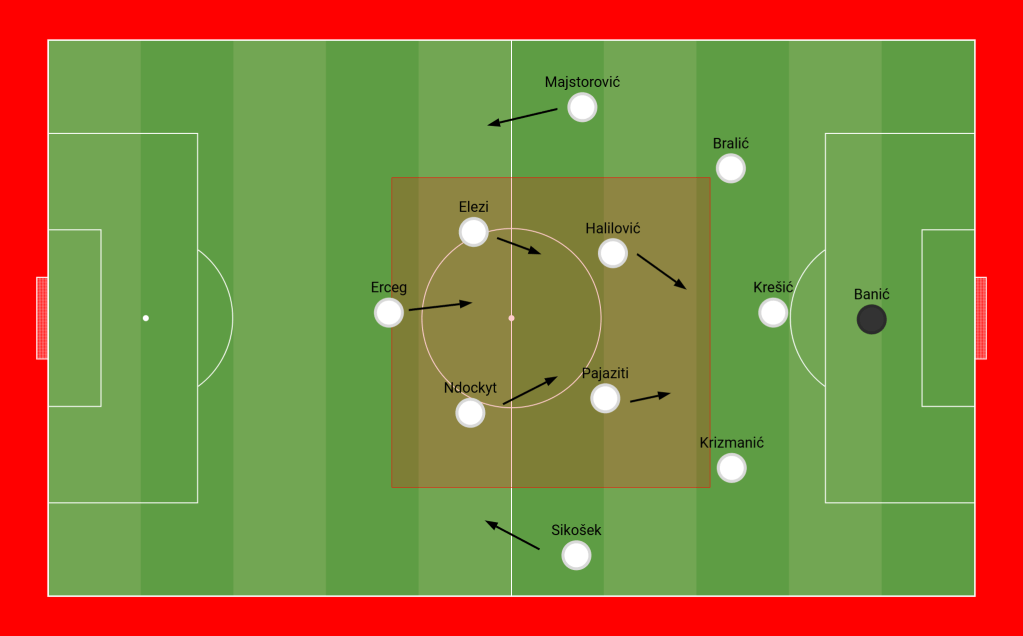
It was clear that Carević’s goal was to avoid conceding. Gorica played very compactly and defensively, trying to cover spaces in front of their box. The primary issue for Carević’s team was their possession strategy. Despite having creative players like Halilović, Pajaziti, Ndockyt, and Elezi, they struggled to develop cohesive ideas in buildup. The presence of multiple creative players crowded the midfield, suffocating one another and providing insufficient space for any possession idea to take shape. As a result, Gorica lost a lot of possession, and no one provided the necessary depth to allow for through passes, leading to catastrophic buildups filled with passing errors. This suffocating geometry in possession is unsustainable for Gorica in the long term.
In the second half, Carević attempted to change the possession dynamics by switching to a 3-5-2 formation. He positioned Halilović as the midfield fulcrum to gain stability while in possession and introduced Čuić and Erceg as a forward duo. However, it was clear that this was an improvised solution and did not significantly improve possession stability. After just 10 minutes, he reverted to a 5-4-1 formation to regain defensive stability.
The only positive aspect of Gorica’s game was their defensive reactions to Varaždin’s crosses, along with goalkeeper Banić’s impressive performance. Ultimately, the result and their defending inside the box are the only things worth noting for Gorica from this match; everything else is best forgotten.
Conclusion
In the end, all game parameters favored Varaždin: game aesthetics, possession, big chances, and second balls. They outperformed Gorica in every football metric but ultimately lacked precision in finishing. This was the only reason the match did not end in a high-scoring victory for Šafarić’s Varaždin.
 Diamond Football Tactics