
Ranieri opted for a formation resembling a 3-5-2, with Pellegrini playing as the left mezzala. He implemented a middle block that transitioned into a low block, defending in either a 5-3-1-1 or 5-4-1 formation. The team’s strategy revolved around quick counterattacks. During these counterattacks, Dobyk served as a focal point, drawing Lazio’s defenders toward him and creating space for Dybala and his teammates, allowing them time to join the attack.
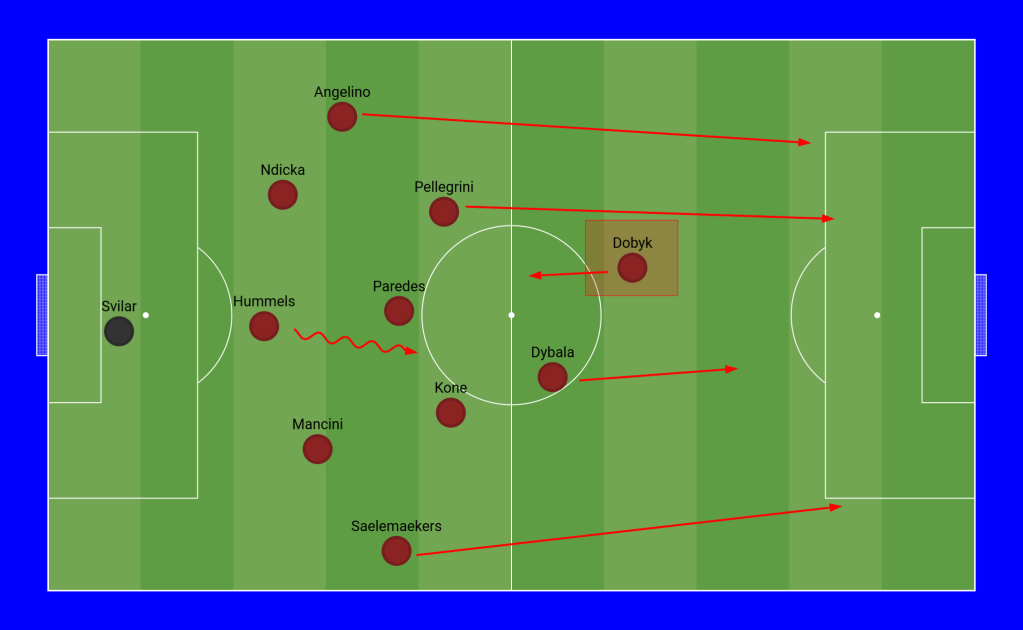
It was clear that Ranieri instructed his team to build up play whenever possible, as evidenced by the various buildup patterns that emerged in the first half. However, in the second half, he shifted the team’s focus to defence, with a noticeable reduction in attacking intent.
When defending, Roma’s players moved from a mid-block to low defence, making Lazio’s attacking patterns unnecessary and ineffective.
When defending in a low block, Roma’s players utilized lateral movement, staying compact and blocking passing lanes. Whenever necessary, Roma’s defenders marked Lazio’s midfielders and wingers, who attempted to create confusion by changing positions both laterally and vertically. This strategy was very effective in stopping Lazio’s positional attacks and their pattern of positional changes.
It was exciting to watch Mancini follow Zacagni in midfield while Cogne dropped deeper to cover for Lazio’s midfielders on their forward runs.
Buildup patterns were evident when AS Roma players had secure possession of the ball. One noticeable aspect was that Hummels frequently engaged in rotations with the midfielders and had the freedom to dribble the ball upfield. The wingbacks would position themselves further up the field, while Dybala made himself available for passes from the defenders or midfielders. Additionally, Dobyk’s layout pass facilitated the transfer of the ball into the opponent’s half or helped link the team during counterattacks.
Whenever they gained possession, Roma players would often initiate counterattacks. The ball frequently went to Dybala or Dobyk, who helped create opportunities for their teammates to join the attack. Both wing-backs, Salemakers and Angelino, along with Pellegrini, made aggressive runs that enhanced the effectiveness of these counterattacks. This strategy proved to be very effective for AS Roma, as they scored twice.
Baroni maintained his Lazio style and system with minimal adaptations for Roma. He opted for a 4-2-3-1 formation focused on positional attack, transitioning to a 4-4-2 mid-block when defending. There were occasions when the team would step out of their zonal defending structure in response to specific situations.
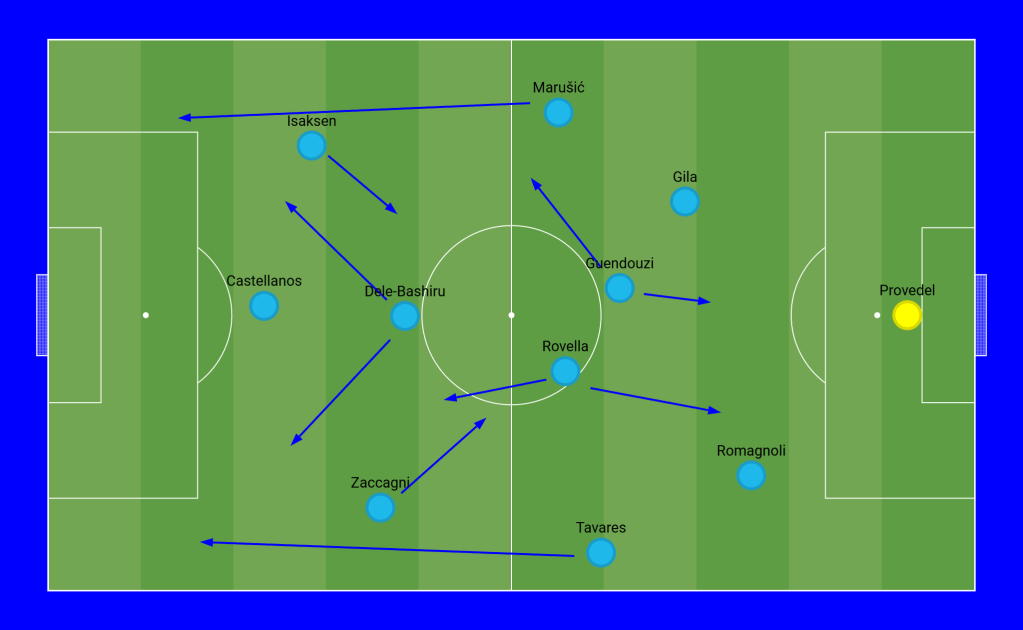
The build-up patterns in attack were evident but somewhat unnecessary, as Roma would quickly drop back into defense after Lazio initiated their attack. Due to Lazio’s high defensive line while in possession, the midfield and defense struggled to cope with Roma’s counterattacks. Dybala and Dobyk posed significant challenges during transitional play, and it was clear that Lazio had difficulties covering Roma’s wing-backs, Salemaekers and Angelino, during these counterattacks.
During the buildup of the attack, both Rovella and Gendouzi would drop deep. Often, one of them would position themselves between the center-back and the fullback, allowing the fullbacks to push up the pitch. However, it wasn’t always necessary to follow these buildup patterns, as Roma players would quickly retreat into their defensive half.
Zacagni and Isaksen were moving into spaces between the lines, while Bashiru joined them in an effort to pull Roma’s defenders out of position, creating empty spaces behind them. When there was space available on the flanks, the fullbacks, Tavares and Marušić, would make penetrating runs. This was particularly evident in the second half when Lazio had many crosses stemming from this tactical approach.
When spaces were vacated centrally—if Zacagni, Bashiru, Isaksen, or Castellanos drew Roma’s central defenders out of position—midfielders would then make penetrating runs. Although this strategy seemed well-coordinated, it ultimately did not have much effect for Lazio in terms of results and goals.
When defending positionali, Lazi players would be in compat 442 midblock shape. Bashiru and Castellanos would cover passing lane’s in midfield. When necessary Zacagni and Isakse would jump out in ocasional press on flanks, but press didnt have much intensity and structure, so Roma players didn’t have lot of problems with it.
Baroni’s positional attacks, although much more complex and requiring greater coordination, did not lead to victory. Lazio played well-organized, position-oriented football but lacked the finishing touch and clear chances in the attacking third.
It can be argued that Ranieri outsmarted his counterpart with a more compact defensive approach and a more direct style of play, occasionally utilizing counterattacks. The game was ultimately decided during a 10-minute lapse by Lazio, during which Roma scored twice and successfully defended their lead until the end of the match.
Nevertheless, Ranieri harnessed his team’s potential with pragmatic tactics, and with a very inspired performance from Pellegrini in the mezzala position, he made the victory possible.
 Diamond Football Tactics