

In the Nations League quarterfinals, two consecutive matches feature managers who have significantly influenced their countries’ football eras. The first match, held in Split, ended with a decisive 2-0 victory for Croatia. The second match is scheduled to take place tomorrow, March 23, 2025, in Paris.
Split, 20.03.2025
Dalić fully understands the immense potential of his midfield and leverages Croatia’s creative prowess to perfection. He orchestrates a solid defensive strategy, allowing his midfielders the freedom to express their creativity when in possession. This approach not only constricts the opponent but also establishes a rhythm that empowers players like Modrić, Kovačić, Baturina, and others to gain a distinct technical and tactical edge in their confrontations. Such scenarios have been witnessed time and again.
In contrast, Deschamps leads a diverse team packed with pace and potency in attack, yet lacks the midfield creativity that Croatia possesses. By employing a diamond-shaped midfield when his team is in possession, Deschamps inadvertently played into the hands of the Croatians, placing his fast players into congested spaces. Consequently, the French players struggled to generate solutions and frequently found themselves stifled.
It’s evident that Deschamps lacks Griezmann, whose offensive play between the opponent’s lines is crucial, especially against teams that set up a low block. France desperately needs a creative player of his caliber and is clearly struggling in the attacking third. With over 60% possession, their attacks still fall short due to a lack of creative cooperation, preventing clear chances for their attackers. When the opposition has a strong defensive line and a goalkeeper on form—just like Croatia did in Split on Thursday night—scoring becomes a monumental task.
In the Croatian team, Budimir and Perišić showcased their ability to translate club-level performances to the national stage. Budimir played a pivotal role by effectively drawing the attention of Konaté and Saliba, making smart movements to create space for his teammates.
It’s nothing short of remarkable to witness Modrić at 39 and Perišić at 36 actively creating advantages on the pitch. This underscores the significant advancements in sports science, which empower players with outstanding genetics and a strong work ethic to perform at such an elite level well into their later years.
Both managers must enact changes if they want to advance. Dalić faces a pressing challenge because Modrić has played full match and logged substantial minutes for Real Madrid. Decisions regarding whether Kramarić will start on the flank or if Budimir will play in the central forward position are critical, along with potential alterations to the attacking lineup. Croatia lacks quick counterattacking players on the wings; had they possessed this profile, the result could easily have exceeded the 2-0 scoreline, particularly since France played with a high defensive line in the second half, leaving themselves open to counterattacks.

Conversely, Deschamps must restore his team’s confidence following the defeat in Split and identify solutions in the midfield. A change in attacking shape is essential, and it’s likely he will implement a 4-3-3 or 4-2-3-1 formation for the match in Paris.
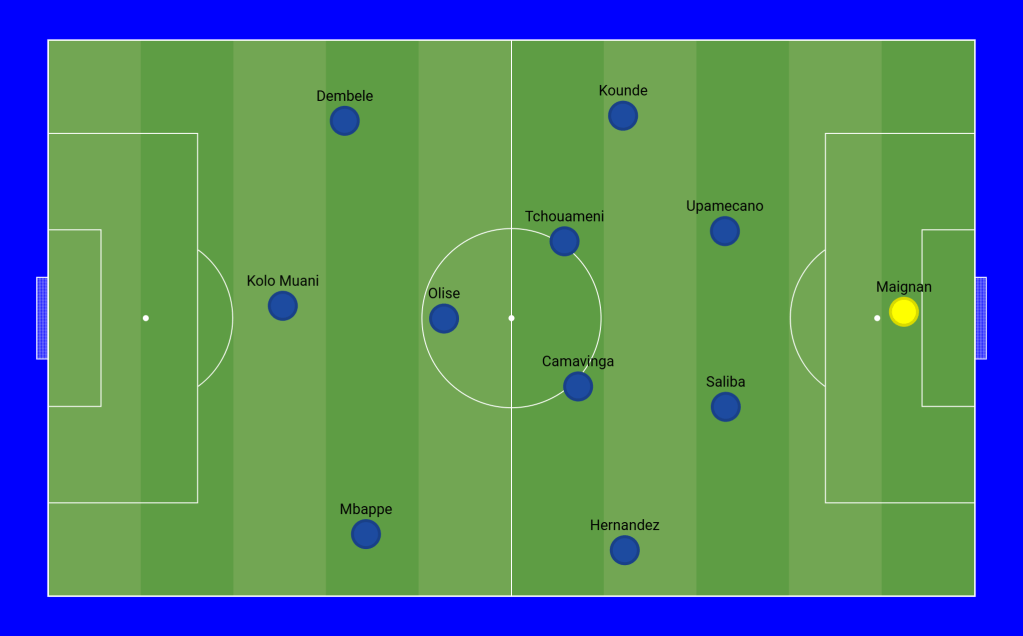
The stage is set; let’s see what Zlatko and Didier will bring to the field on Sunday night in Paris.
 Diamond Football Tactics