

Lokomotiva – Hajduk 1:1 (Goričan/Benrahou)
Kranjčevićeva Stadium was filled with Hajduk fans. It was the first game of matchday 18 and probably the best one. The game was full of dynamics, quick transitions, good crossings, and excellent saves from both goalkeepers.
Čabraja set up his team in a 4-2-3-1 formation, with Goričan, Mudražija, Šotiček, and Tuci as the attacking four. Leovac played the left fullback position. The rest of the team was as expected: Bubanja and Marić as pivot midfielders, Živković and Mersinaj as central defenders and Bartolec as right fullback.
Karoglan started with a 4-3-3 formation, with Žaper as a defensive midfielder and Pukštaš and Krovinović as the two number-eights. The formation changed to a 4-4-1-1 when defending deep in the defensive third, with Krovinović and Livaja in front of Pukštaš and Žaper.

From the very beginning, it was obvious that Čabraja had scouted Hajduk’s game excellently, and it was evident that Lokomotiva would not solely depend on defending on its own half. From the beginning, Lokomotiva imposed pressure on Hajduk’s buildup and dropped back only when penetrated.
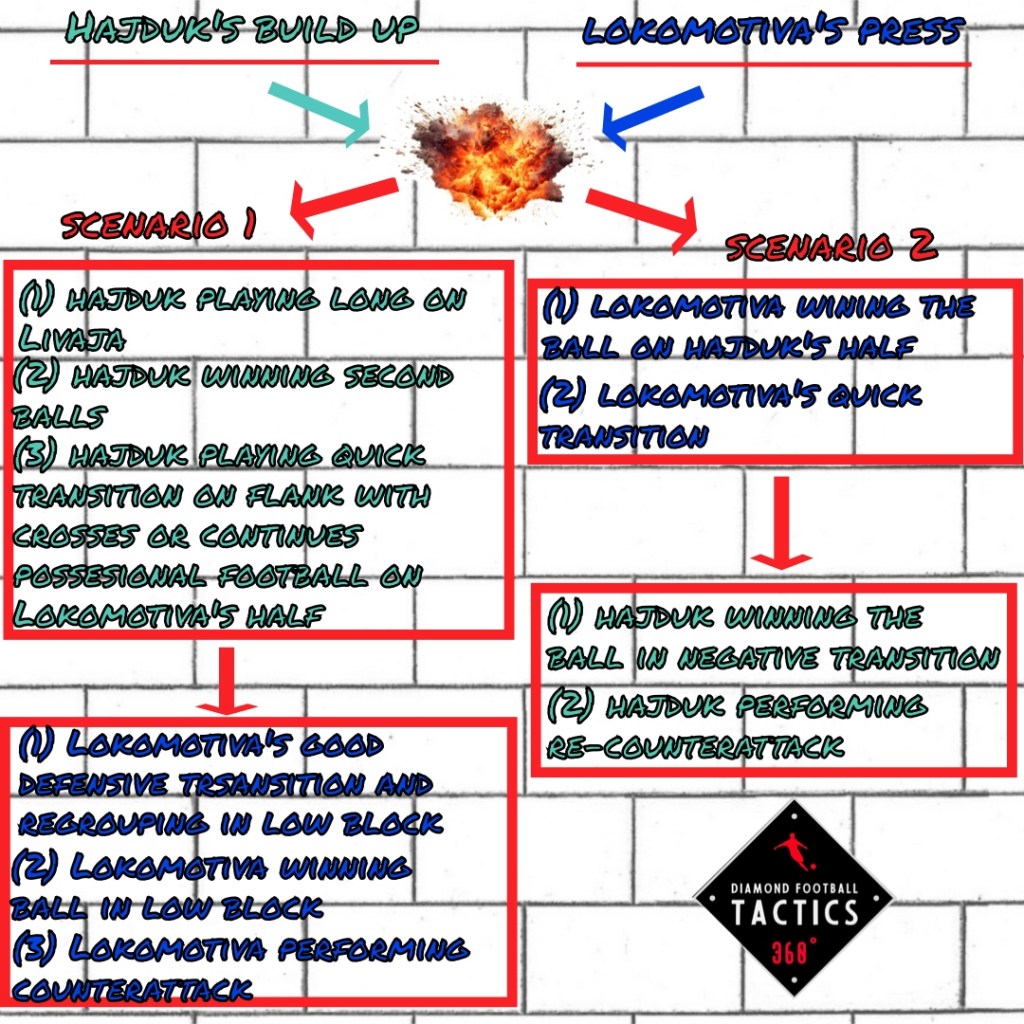
To respond to this, Hajduk had to play long on Livaja multiple times, and luckily for them, they were good on second balls, transferring the ball to their opponents’ half this way. Youngster Živković did a great job of distracting Livaja, but Hajduk’s midfielders, particularly Pukštaš, were quick on bounced balls. So, during the match, the pattern evolved:
Scenario 1
- Hajduk builded-up
- Lokomotiva pressed
- Hajduk played long on Livaja
- Fight for second ball
- If Hajduk won the bounced ball, it went on the flank for crosses in quick transition or possession football continued on Lokomotiva’s half, especially if Lokomotiva’s players made a good defensive run.
- If Lokomotiva takes the ball on the defensive half, counterattack takes place.
Scenario 2
- If Lokomotiva took the ball in press on Hajduk’s half, a quick transition took place
- If Hajduk took the ball in defensive transition, re – counterattack occurred
Of course, there were phases of the game when Lokomotiva didn’t pres but played in the low block.
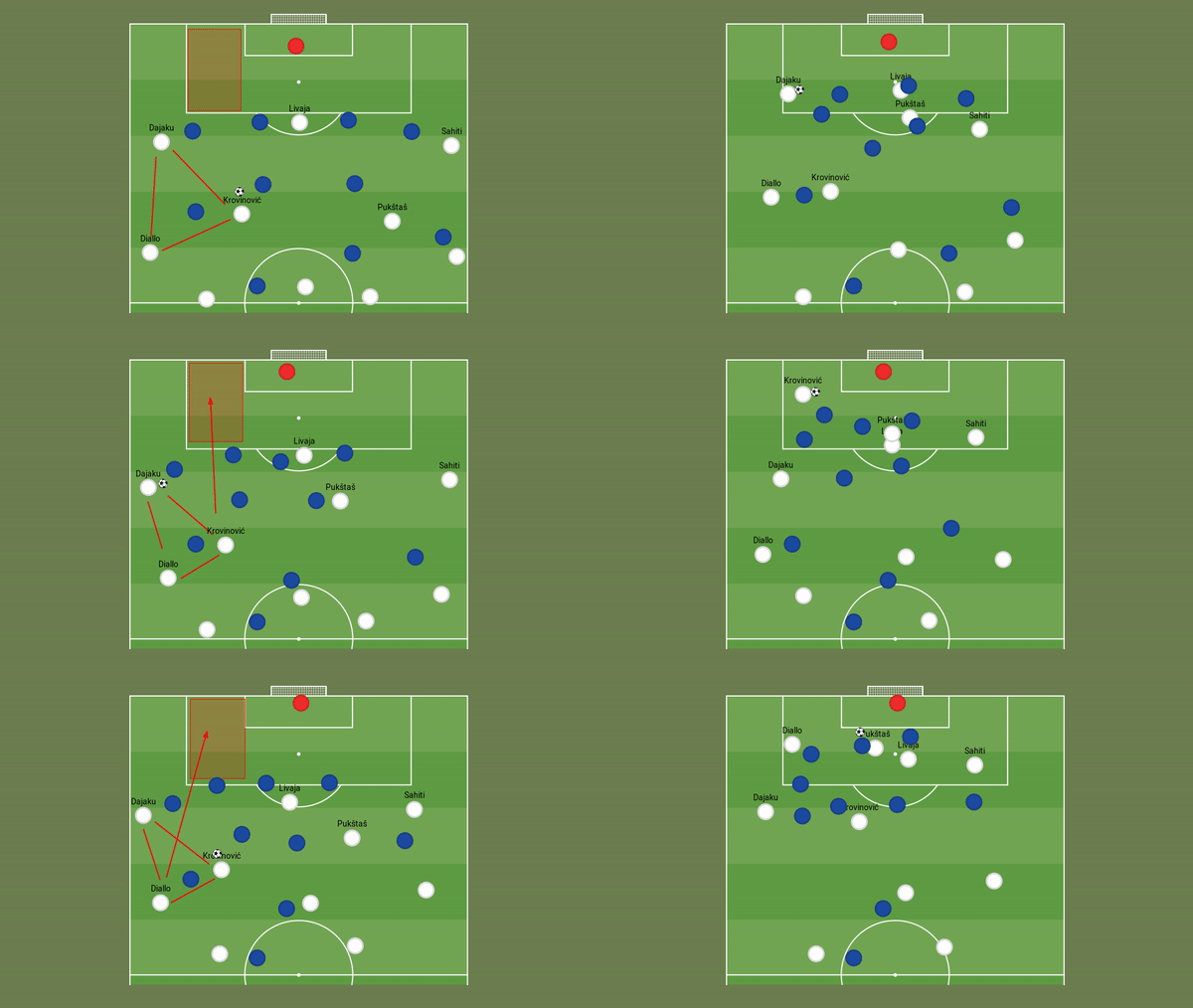
During the first half, Hajduk attempted to exploit Lokomotiva’s right flank. They tried to use packets between right fullback Bartolec and right defender Živković, where triangle Dajaku, Krovinović, and Diallo were positioned. After penetrating the flank, back passes, low or high crosses were delivered in the box. Despite Livaja and Pukštaš showing their presence, they failed to score in the first half.
On the other side, Lokomotiva played quick transitions and counterattacks. Their players looked for diagonal passes and crosses on Goričan, causing significant problems for Hajduk’s defence. Goričan had two great opportunities, but Lučić made a great save to keep his net clean on the first occasion. However, on the second occasion, when Mudražija crossed the ball on the second post, Lučić was powerless, and Lokomotiva took the lead with Goričan’s header. Unfortunately, Sigur lost sight of Goričan, who had an easy job to score undisturbed.

At halftime, neither of the managers made any substitutions. However, ten minutes into the second half, Karoglan noticed that Krovinović was losing energy, so he replaced him with Kalik. Later, Karoglan brought in Benrahou and Odjidja, narrowed the formation and regained control of the match. Hajduk took advantage of Lokomotiva’s defensive midfielders’ poor performance in recovering second balls. On one of these occasions, Benrahou capitalised on Lokomotiva’s slow reaction and volleyed the ball into the back of the net.
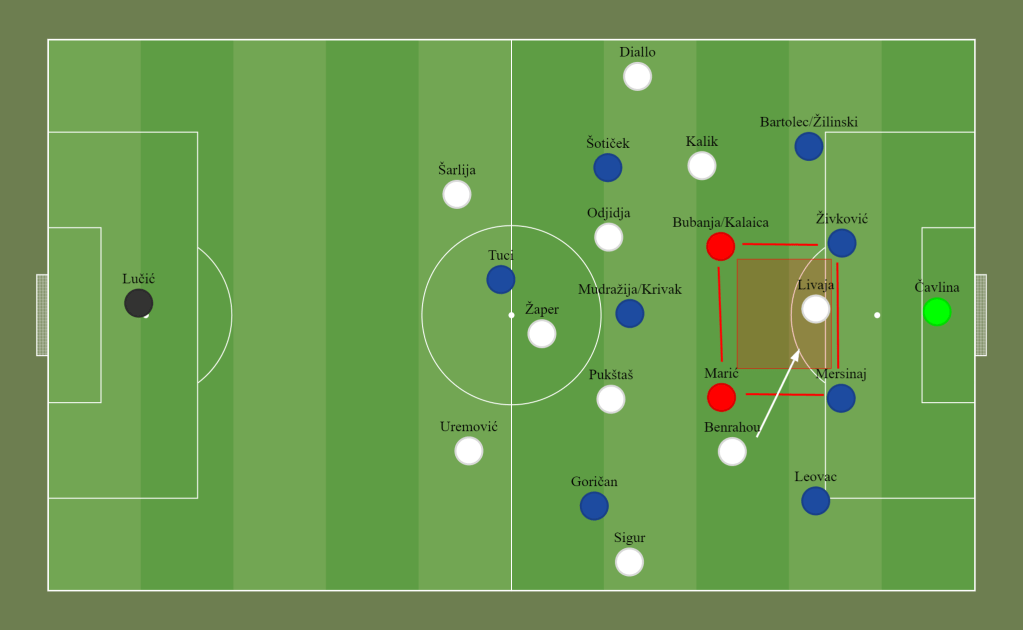
Čabraja tried to improve Lokomotiva’s reaction on second balls and replaced Bubanja with Kalaica in the 70th minute, but it didn’t help much. Although Hajduk created a few dangerous chances, Benrahoui and Pukstaš failed to score.
In the end, Čabraja decided to change the formation to 4-4-2, with Čop and Tuci playing as the two forwards. Žaper had to be substituted due to a hamstring injury, and Karoglan replaced him with Moufi, who played as the right fullback. Sigur took up the defensive midfielder position for the rest of the game.

The result was fair. These games showed some weaknesses from both teams, such as Lokomotiva’s midfielder’s inability to collect badly bounced balls and Hajduk’s problems in the build-up when faced with good pressing and quick attackers on quick transitions and counterattacks.
Gorica – Istra 0:0
It was an exciting and tactically interesting match. Gorica received an early red card, which made the game even more tactically enjoyable. Both coaches made tactical corrections to adapt to the situation on the field.
It was expected that Gorica would play offensively, but no one predicted that Jeličić would start with three strikers up front: Matevž as a central striker, and Jurić and Vujnović as wingers. The midfield trio consisted of Soldo, Mrzljak, and Pršir, and the defensive line was as expected.
Catala lined up Istra in a 4-3-3 formation.
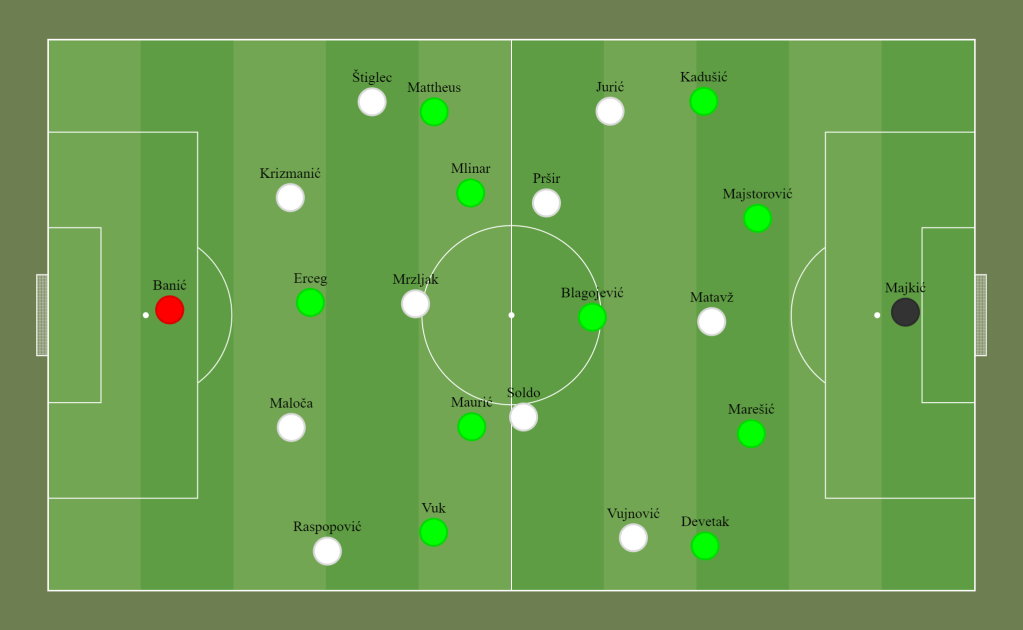
In the third minute, Krizmanić made a bad receiving of the pass judgment and lost the ball to Mlinar, who was pressing him. Mlinar went alone towards Gorica’s goalkeeper Banić, and Krizmanić received a red card.
Jeličić quickly made a tactical adaptation. First, he changed Vujnović and introduced young Leš to the central defender position, and then he moved Soldo from midfield to the right flank. This formation looked like 4-4-1, and it changed to something that looked like 6-2-1, especially towards the end of the match when Istra attacked and fullbacks overlapped a lot. Despite being one player down, Gorica attacked through counterattacks a few times very effectively.
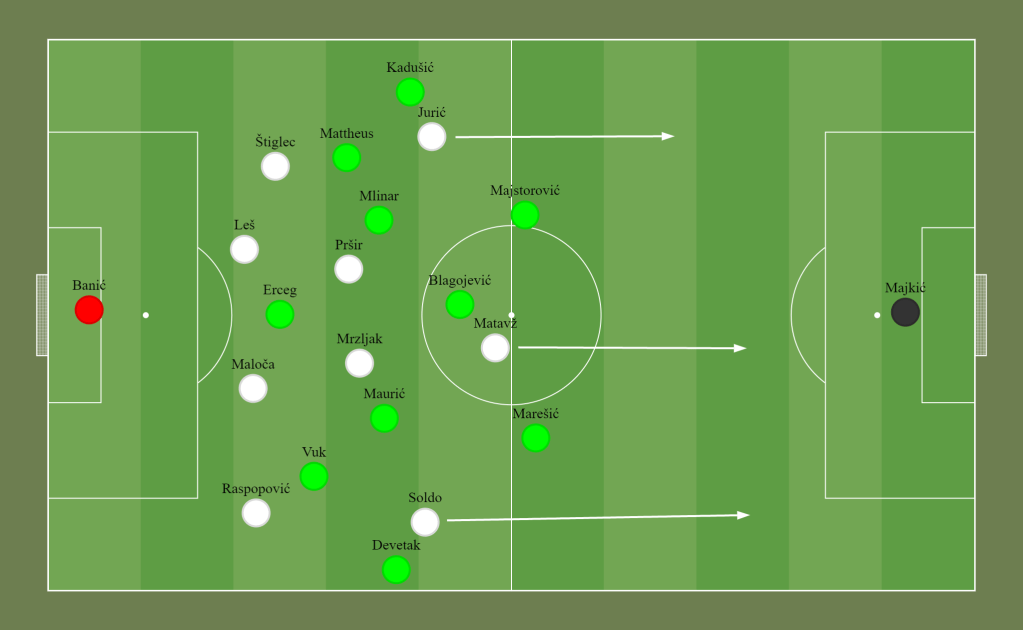
Istra tried to attack continuously and was in the offensive third with the ball a lot, but they failed to create clear chances against Gorica’s compact block.
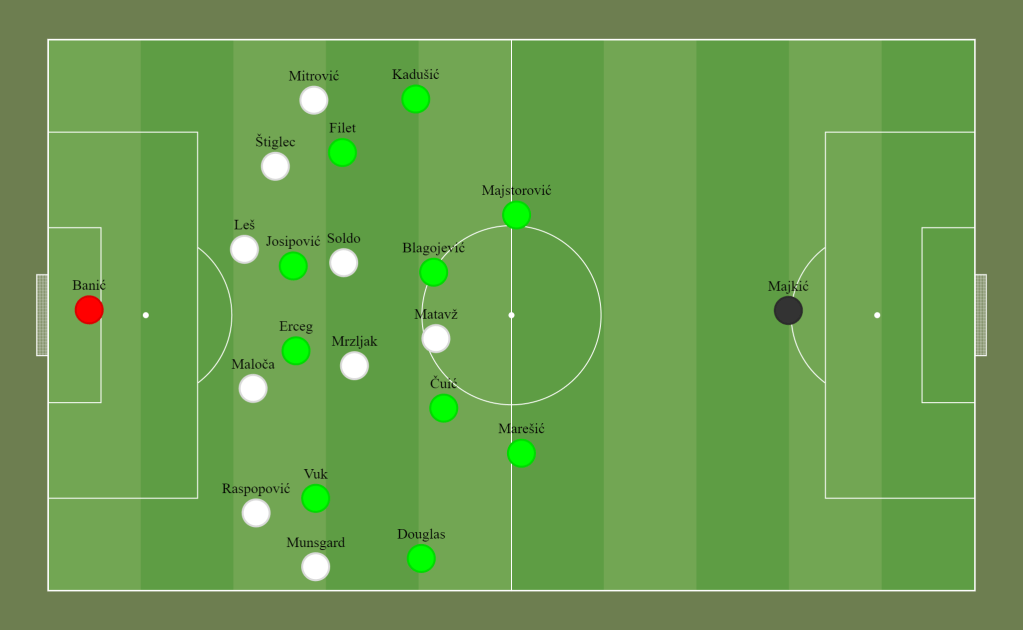
It is evident that Jeličić’s main idea was to defend, so he even changed his best player, Pršir, and brought in Munsgard to double the right flank and moved Soldo, a more physical midfield player. Gorica did a great job in defense.
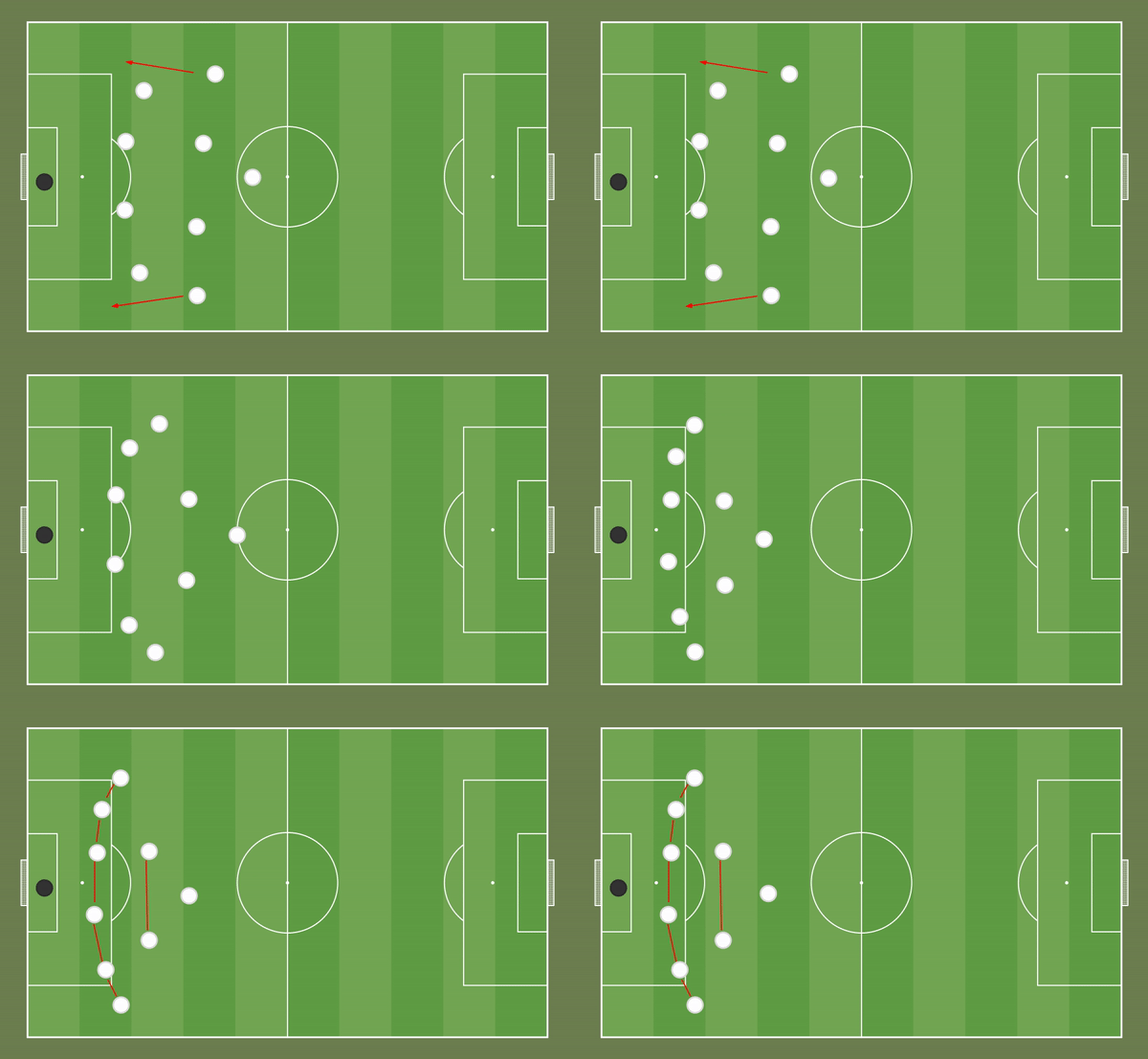
Catala even changed the formation to 4-4-2 in the second half to change some things in the box. He put Josipović alongside Erceg, but it didn’t impact the result. Istra had few long-range shots, but they didn’t cause any significant problems for Banić.
Gorica hung on defensively and deserved to grab a point.
Dinamo – Rudeš 1:0 (Kulenović)
Varaždin – Osijek 2:2 (Postonjski, Pilj / Mierez, Bralić)
We witnessed an exciting match with two different approaches. As predicted in the preview, Šafarić opted for Varaždin’s well-known possession-based football while Zekić chose a low block, counterattacks, and long balls on Mierez.
Šafarić went with the expected 4231 formation with two new players in the starting eleven. Pellumbi and Ba were injured, so Škaričić took the central defender role alongside Jelenić. Bručić started instead of Boršić on the left fullback position. Brodić recovered but started on the bench.
Zekić chose to start with a more experienced team than against Rijeka in the last round. Caktaš took the number eight position, and Lovrić took the left-wing position. Guedes kept the right fullback, so Gržan stayed on the bench.

The game started as expected, with Varaždin taking possession and playing buildup with their goalkeeper Zelenika playing as the third defender. Osijek stayed in the middle block and dropped back in the low block when Varaždin transferred the ball into the opponent’s half. However, one quick transitional action in the 5th minute gave Varaždin the lead. Mierez received a vertical pass in space from Lovrić, ran with it 20 meters, dribbled past Jelenić, and scored a great goal from the top of the box.
After the 20th minute, Varaždin dominated possession completely, resulting in a goal from a penalty at the end of the first half.
At halftime, Šafarić made some substitutions. Brodić replaced Belcar, and Boršić replaced Bručić. He did some rotations; Šego went on the left winger, Mitrović on the attacking midfielder position, and Drožđek went on the right wing. Brodić in front made an immediate impact. Varaždin had excellent dynamics in possession, resulting in few goalscoring chances. Zekić substituted Bukvić with Gržan.
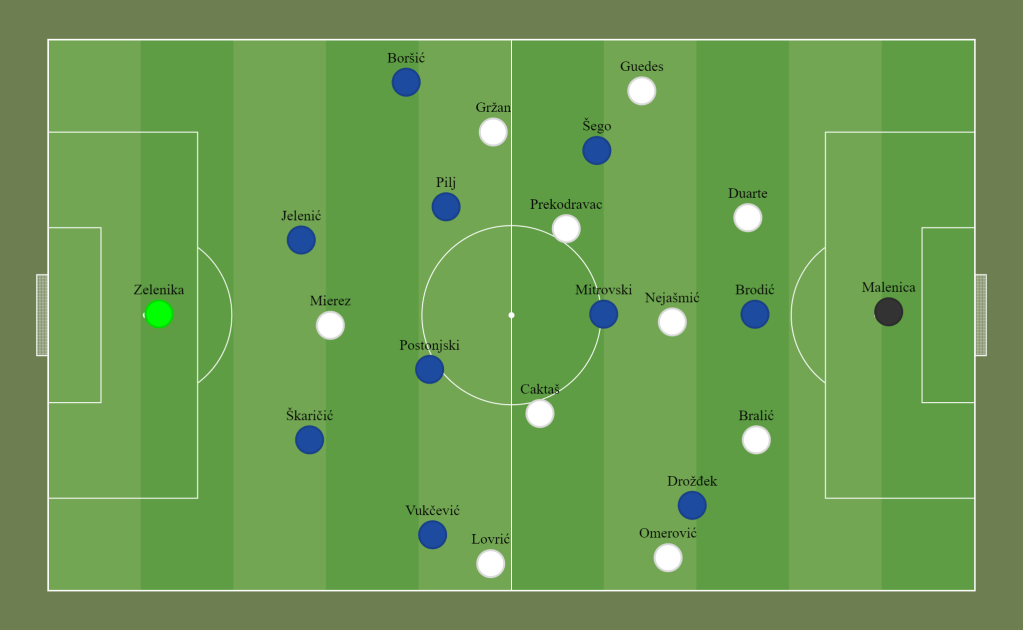
Varaždin continued with possession football, and Osijek tried with long balls on Mierez, which was the only way they attempted to make attacks. Zekić brought in Jugović for Nejašmić and Brlek for Caktaš, adapting the midfield shape. Seeing this, Šafarić brought Marina instead of Mitrović into the straightened midfield for second balls.

After this change, Varaždin scored, but from a transition in which Pilj made a penetrating run in the box, received a deep pass, and scored.
Ultimately, Zekić sent Bralić into an attacking position while Brlek stayed as the defender. Šafarić reacted by bringing Nekić in for Drožđek and, changing formation in 3412, and sending Bralić in attack, which paid off for Zekić as Bralić scored the header in the final minutes of the game.

During the match, Varaždin exhibited excellent possession football, and Brodić’s entry in the second half immediately made an impact. His contribution highlighted how much Varaždin had missed his presence. Zekić struggles to find the right starting eleven and playing style that will lead to victories. On the other hand, Osijek’s tactics in this match involved playing direct football with long balls, ultimately sending a defender into the striker position. However, this tactical approach cannot be a long-term solution.
Rijeka – Slaven Belupo 2:4 (Ivanović, Obregon / Štrkalj, Mioč, Caimacov, Hoxha)
The preview of the match raised doubts about whether Sopić would stick to his football style and how he would make up for the club’s decision to drop Selahi from the team. Unfortunately, things did not go well for Sopić. In the beginning, he chose not to abandon his playing style, but after Belupo’s coach Ferenčina laid a tactical trap, Sopić made another decision.
At the start of the match, Sopić’s Rijeka played with a 4123 formation. Instead of Selahi, he introduced Hodža in a defensive midfielder role. Fruk and Banda were two eights in the attacking phase. Sopić chose Pjaca on the left wing. Occasionally, when defending in the low block, they would turn into 4411 formations, Fruk in front of Hodža and Banda as two holding midfielders. However, most of the time, Rijeka’s defending line was on the centre of the pitch. Rijeka imposed a high press when losing the ball. It’s worth noting that Veiga played in Smolčić’s position of right fullback due to Smolčić’s yellow card suspension. As shown in this game, Smolčić and Selahi’s absence significantly impacted Sopić’s Rijeka.
In the match against Lokomotiva in the 16th round, Ferenčina lined up his team in a similar fashion as in this match. He chose a 451 formation to defend in a disciplined manner and to produce counterattacks when possible. This strategy worked well even this time, as two central defenders (Boras and Međimorec) and three midfielders (Lepinjica, Agbekpornu, and Mioč) covered significant zones of the pitch, while Sušak’s great performance in goal made this result possible.

The match began as expected, with Rijeka trying to maintain a high press whenever they lost possession. However, Belupo’s midfielders were able to resist Rijeka’s press quite well, which meant that it was not always necessary for them to go long every time Rijeka pressed. Although Lepinjica, Mioč, and Agbekpornu made a few mistakes, Rijeka’s attacking line failed to take advantage of them. Ferenčina’s tactics proved to be effective as he allowed Rijeka to have more possession. He invited them to come forward, thereby making them solve problems against a compact, low zone defence. Rijeka’s players struggled to play against such a compact and solid defence, and found it harder to solve problems in this situations than in transitional play.
During the match, Rijeka attempted to score by changing the sides of the play. They brought both fullbacks upfield and relied on the cooperation between Fruk and Pjaca. Pjaca even took some individual actions in attacking the third. Despite Rijeka’s quick offensive line, Pjaca, Ivanović and Pašalić were deprived of space to run into. Rijeka managed to create a few good chances, but most of them came whenever Belupo moved their back-line upfield to protect against counterattacks. This made it easier for Rijeka to make a re-counterattack, but they didn’t score.
At the end of the first half, Belupo scored from a prolonged counterattack. Štrkalj laid the pass for Mioč, who missed the shot, but the ball bounced back to Štrkalj, who had enough time to adjust his body position and score. Belupo scored in excellent time and could continue with their defensive game in the second half, waiting for Rijeka to make their move.
And Rijeka did make a move. Sopić changed the formation to 352 in the second half, pulling out Čabraja due to injury and putting Radeljić in as the third defender. Pjaca was substituted for Grgić, and Pašalić took the left wing-back position. Obregon replaced Veiga, who went into the striker position alongside Ivanović. This tactic looked like 334.

Belupo exploited the width deficit of Rijeka’s formation against their 451 formation. Caimacov entered the pitch for Liber, giving Belupo’s team more quickness on breaks. Rijeka’s defending trio (Dilaver, Mitrović, Radeljić) were not played in to cover such a great space in the defensive transition, especially when the team was high up the pitch. That resulted in some basic individual and group mistakes in Rijeka’s defending counterattacks. Three defenders were left alone in a vast space against quick players, making Belupo’s attacker’s job of scoring counterattacks much easier.
Mioč, Caimacov, and Hoxha eventually scored for Belupo in transitions, exploiting Sopić’s wrong decision to leave his three defenders in open space. The match ended in a 4-2 result. Sopić’s 334 formations did make Rijeka’s players pose some threats, but it was too risky a tactic to take, making them extra vulnerable on the break.
It should be noted that without Selahi and Smolčić, Rijeka’s team struggled to protect their high defensive line and pressing game. However, that was not the reason for losing the game in this manner. Štrkalj had a great game, running a lot in defence, keeping his composure and concentration in finishing, assisting and pulling Rijeka’s central defenders on himself, allowing space for Hoxha, Mioč and Caimacov in quick counterattacks.
In summary, the match was great for Ferenčina and his players, while it was a significant learning experience for Sopić and his team.
 Diamond Football Tactics