
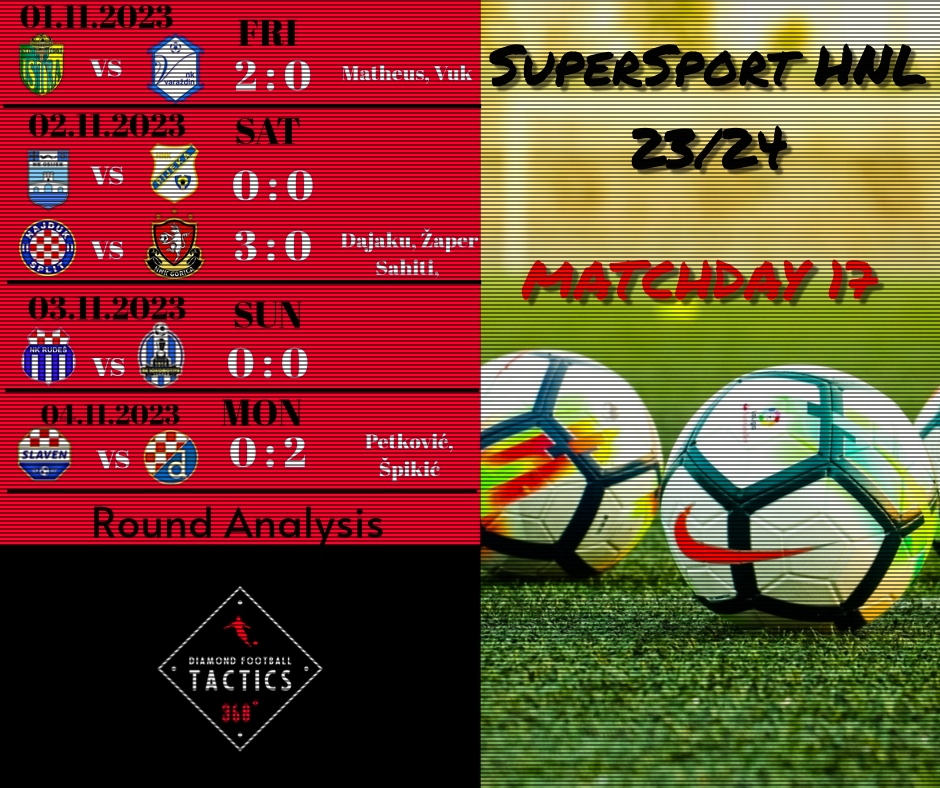
Istra 1961-Varaždin 2:0 (Mathaus, Vuk)
After a packed stadium during their game against Hajduk, Istra only attracted fewer than one thousand spectators for their next match. However, the supporters who did attend were very vocal and provided excellent support for Istra’s players.
Istra’s coach, Catala, made minimal changes to the team, opting for a 4-3-3 formation. Mathaus took the place of Lisica and Ekong on the right wing, while Majstrović returned to the central defender role after serving a card suspension. Hujber replaced Kadušić in the right fullback position but was substituted after only 2 minutes due to an elbow ligament injury.
Kovačević, the coach for Varaždin, made some changes to his team to refresh their performance. Ba took the defender’s role instead of Pellumbi, Marina joined Postonjski in midfield, and Balcar played in an attacking midfielder position. Banovec was given the nod over Drožđek in the left winger position, and the team lined up in a 4-2-3-1 formation.
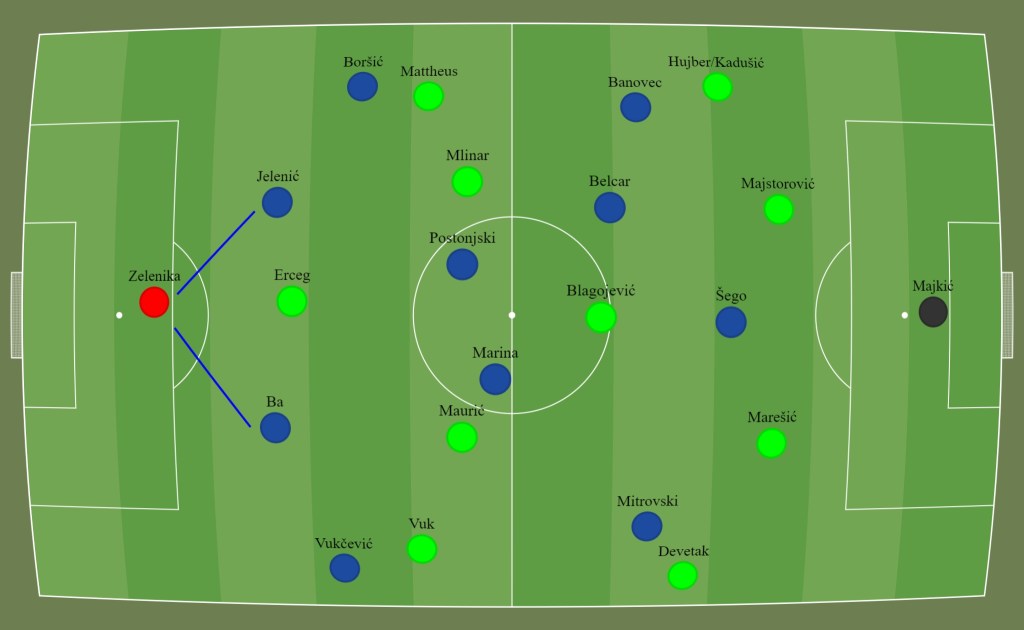
During the first ten minutes, both teams played a possession game, but as the game progressed, it became apparent that Marina, Postonjski, and Belcar were losing the midfield battle against Blagojević, Maurić, and Mlinar, so Istra took control of the play in the first half. This was in part due to Kovačević’s decision to include Marina in the starting lineup instead of Pilj, who is a more defensively-capable player with less creative power.
Varaždin had several problems in the first half, with the offensive trio of Šego, Mitrovski, and Banovec failing to maintain possession in the offensive third and pose any significant threat in the attacking third. Istra’s four defenders did an excellent job against Varaždin’s offense.
On Istra’s side, several players were in good form, with Ante Erceg putting pressure on Varaždin’s defenders and goalkeeper Zelenika during build-up. Matheus was inspired and took on Bartolec one-on-one, cutting inside with the ball, and making many dangerous passes around the box. He scored an excellent goal at the end of the first half, bouncing the ball off the edge of the box.
At halftime, Kovačević made two substitutions, replacing Marina with Pilj and Banovec with Drožđek. This change immediately led to a shift in the game’s dynamics, with Varaždin gaining more possession. However, Istra remained dangerous when in control of the ball. Catala saw that Varaždin was good on the ball, so he strengthened his team’s right flank defensively by bringing in Petrusenko for Mlinar and Valinčić for Mathaus. This way, Držđek was doubled up against two fullbacks on his side.
Maurić and Vuk showed excellent cooperation even in this game, with Murić making thorough passes and Vuk making deep-cutting runs. This pattern was also evident in their game against Hajduk, resulting in Istra’s second goal in this match.
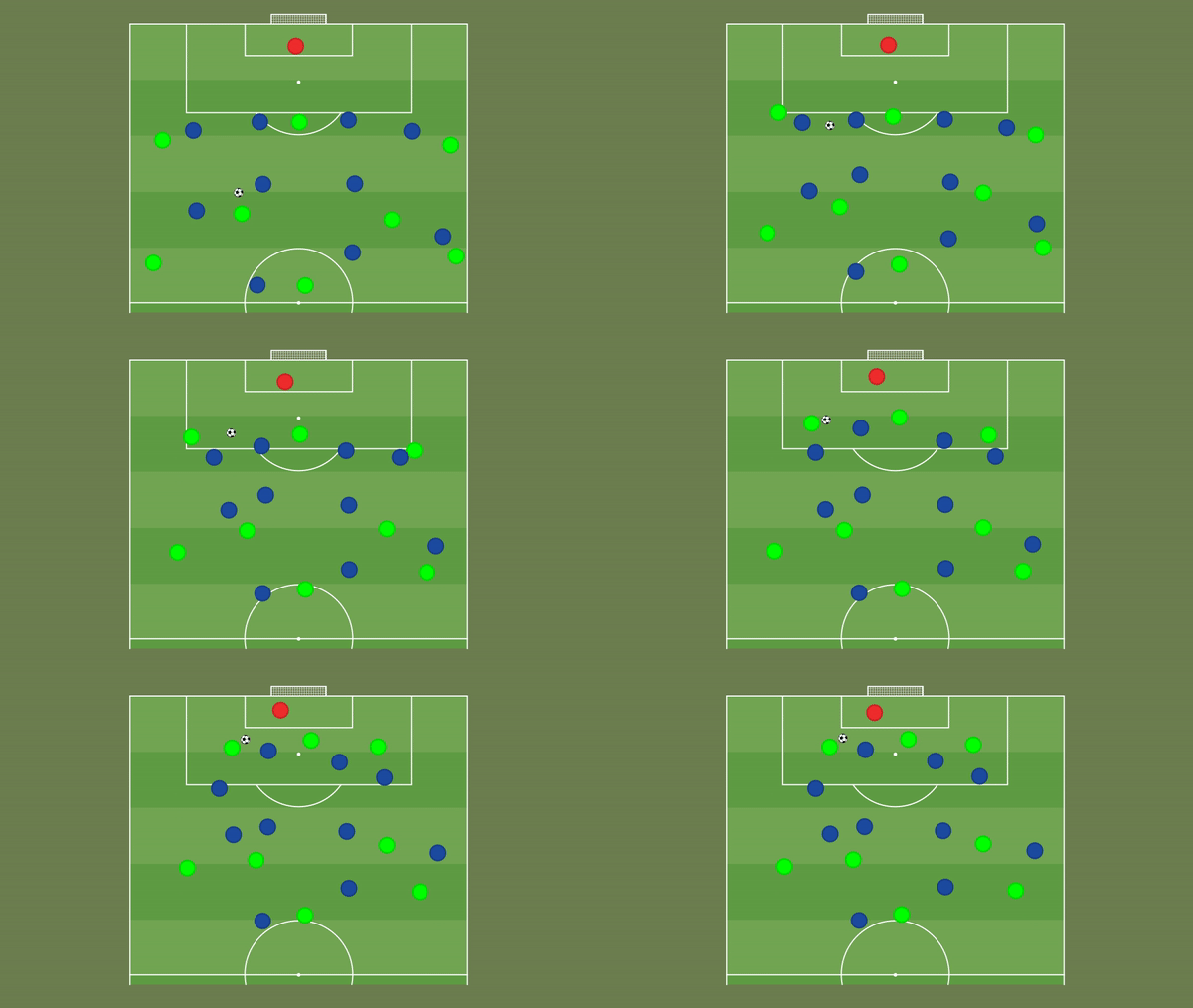
After the goal, Catala changed the system once again, bringing in Čalušić and Čuić to transform the team into a 4-4-2 formation for the last 10 minutes.
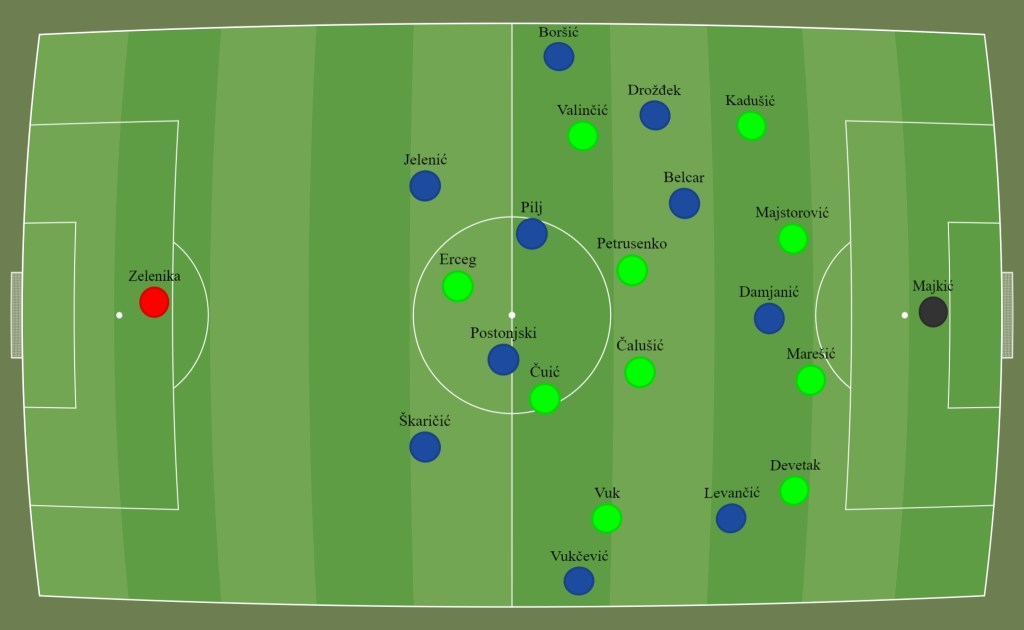
Although Kovačević tried to shake things up by replacing Šego with Domjanić in the striker’s role, it did not have any significant impact. Varaždin had possession but failed to create any serious scoring chances. In the end, Istra won the game comfortably, and Varaždin is still struggling to find their match in the attacking third ever since Brodić’s injury.
Osijek – Rijeka 0:0
The match was played with a lot of energy and dynamics. Both teams played aggressively and directly, resulting in patterns of pressing, transition, counter-pressing, and re-counterattack.
After a good game against Dinamo last week, Zekić decided to give Prekodravac a chance in the starting eleven. The youngster has been playing very well defensively and his aggression on the field is impressive, especially for a senior football player. He could be a good prospect for Osijek midfield in the future. Zekić opted for the 433 formation, leaving Caktaš and Lovrić on the bench, with Fiolić in midfield, and Pušić on the wing in the starting eleven.
Osijek’s team pressed when Rijeka played from the back, with quick transitions when winning the ball in the attacking third. If Rijeka developed an attack and progressed on Osijek’s half of the pitch, they used 4141 defensive blocks and played counterattacks when winning the ball. On the other hand, when Rijeka applied pressure on Osijek’s buildup, Osijek played long passes on Mierez a few times, even successfully. They were able to gain second balls and possessions in the attacking third, and even fullbacks (Guedes and Dambraev) went upfield.
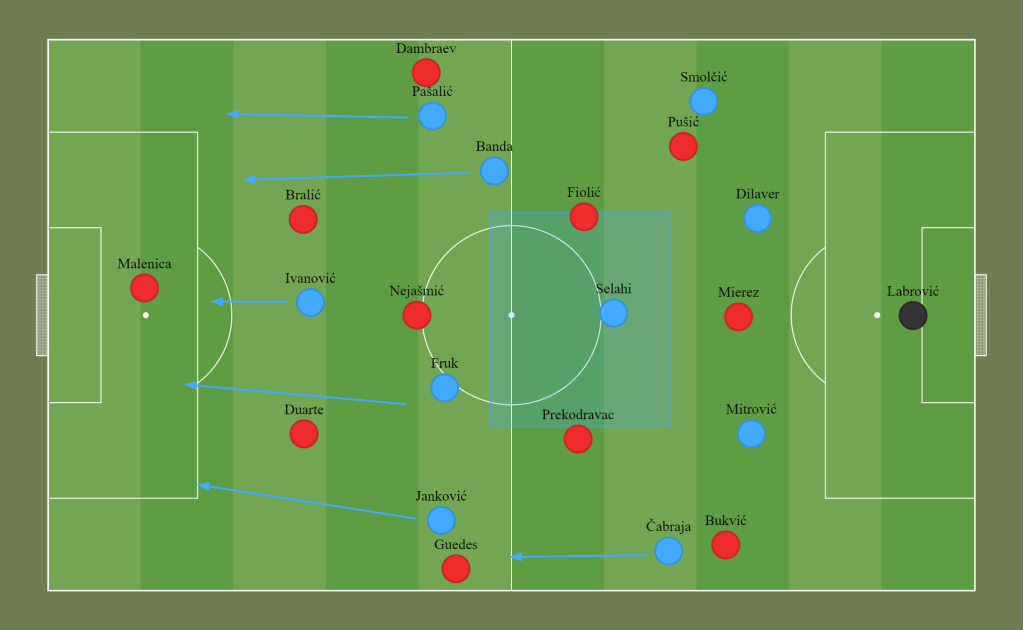
Sopić lined up his team as expected, with something that looked like 433, with Selahi covering Fruk’s and Banda’s back in the attacking phase, and adopting 4411 if dropping deep in the defensive third for zonal defense with Selahi and Banda taking positions of two pivot midfielders, Fruk and Ivanović covering space in front of them.
Rijeka applied occasional pressure but was extremely dangerous through quick counterattacks and set-plays, although they could not score.
In the second half, both coaches refreshed their teams to keep up with each other’s tempo. Zekić even changed the system to 4231, giving Caktaš the opportunity to play in the attacking midfield position and Brlek alongside Nejašmić in the number six position.
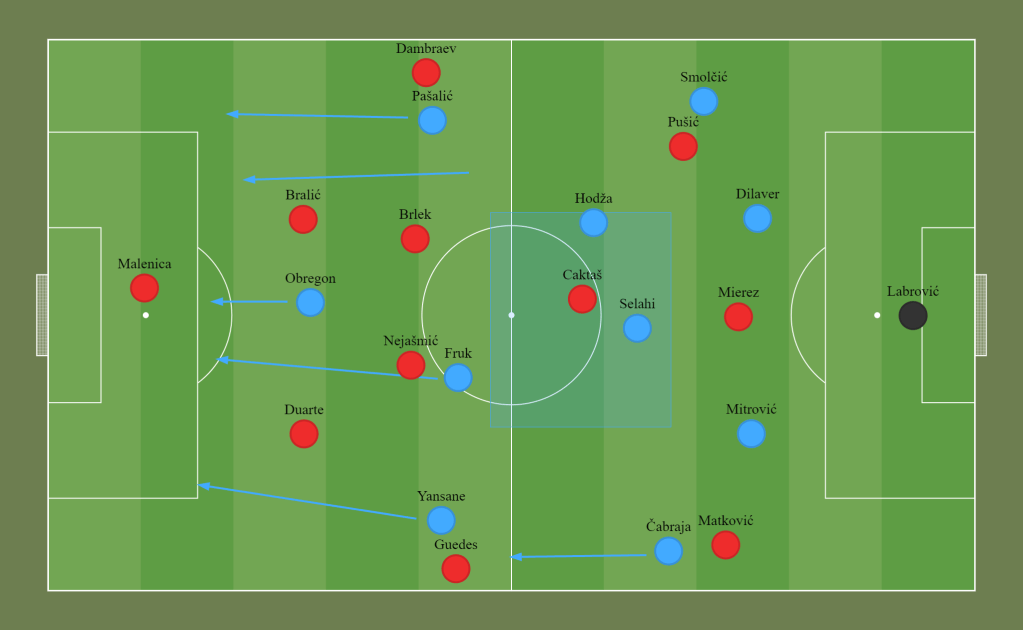
Sopić substituted several players throughout the game, but the formation and playing structure remained the same. Yansane came in for Janković, Obregon for Ivanović, Hođa for Banda.
In the game’s last five minutes, Zekić and Sopić were looking to protect the draw, introducing defensive-oriented players who gave their teams defensive stability. Zekić strengthened the right flank with Mkrtchyan for Pušić, and Sopić brought in Galešić for Selahi in the defensive midfielder position.
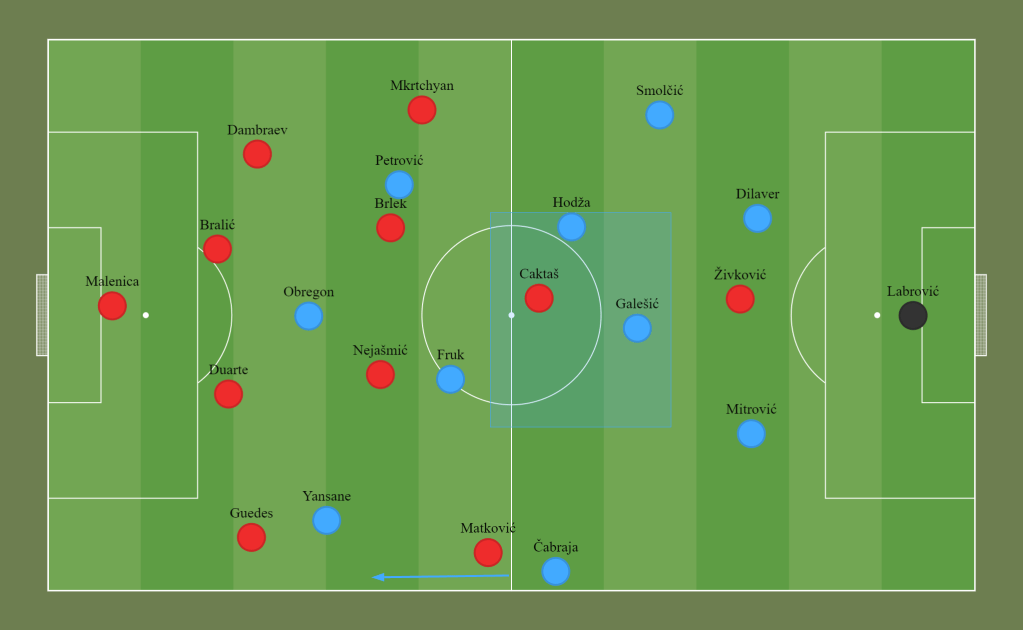
Ultimately, both managers were satisfied with the result because the game could have gone either way, so a draw was a fair outcome.
 Diamond Football Tactics