
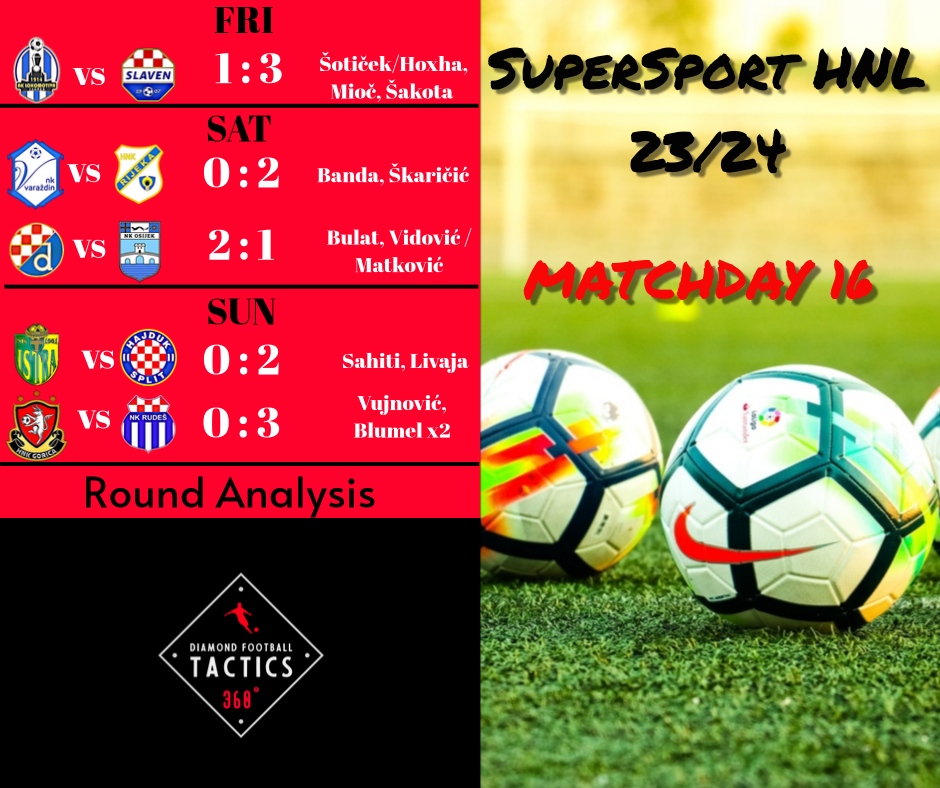
Lokomotiva – Slaven Belupo 1:3 (Šotiček/Hoxha, Mioč, Šakota)
Coach Ferenčina adapted the team’s style and system, resulting in a victory.
During the match, Lokomotiva followed a possession-oriented strategy while Belupo focused on defending with a low block and counterattacking. Both teams had several opportunities to score. Lokomotiva penetrated Belupo’s defence by exploiting their flanks, delivering low crosses, or using corner kicks. On the other hand, whenever Belupo gained possession, they posed a threat through counterattacks or prolonged counterattacks. It was a very high-intensity game.
Ferenčina employed a low 4-1-4-1 block and gave possession to Lokomotiva. Agbekpornu played as the defending central midfielder, Mioč took up the right midfield position, while Lepinjica occupied the left midfield. This tactical approach lured Lokomotiva’s central defenders (Kalaica and Mersinaj) high up the pitch, encouraging their fullbacks (Bartolec and Leovac) to make overlapping runs. However, this left a lot of space behind Lokomotiva’s players, precisely what Ferenčina wanted. Belupo’s players were well-prepared for this match model. So, Hoxha, Mioč, Štrkalj, and Liber took advantage of the free space in counterattacks whenever possible.
During the game, Lokomotiva had control of the ball. Their central forward, Tuci, positioned himself near the midfield to make himself available for passes. He also served as a target for his teammates and tried to draw Belupo’s defenders out of position. Lokomotiva’s attacks focused mainly on the left side, where Goričan and Leovac worked together to create overlapping runs against Liber and Bosec. They sent in many dangerous low crosses, which caused problems for Belupo’s defence. This tactical approach allowed Lokomotiva to score the equaliser, with Šotićek scoring after Goričan’s low cross.
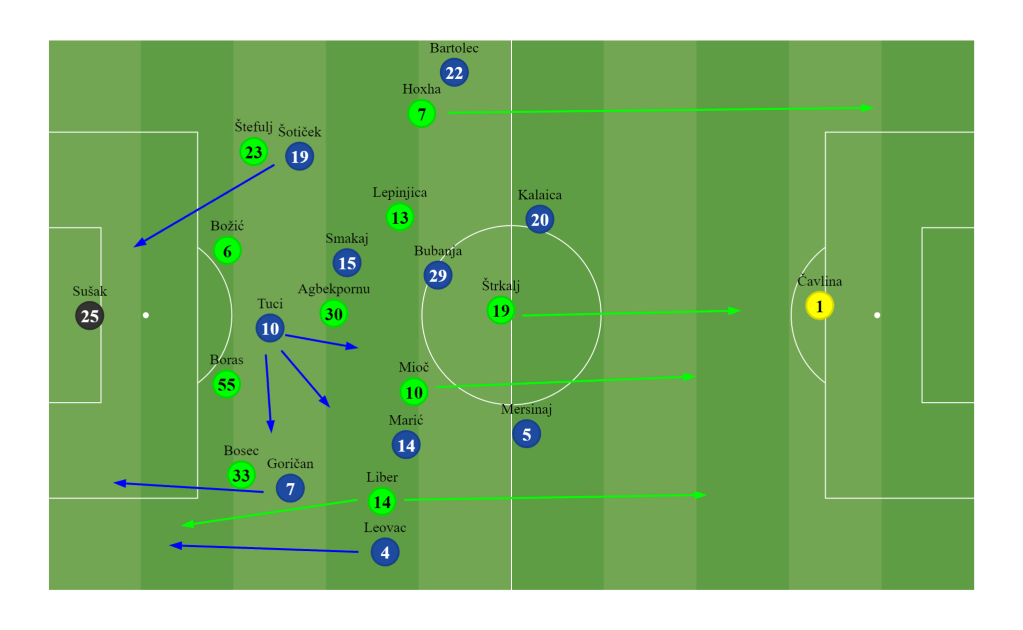
Bartolec frequently went upfield during the match, leaving Hoxha uncovered and providing him plenty of free space to exploit. As previewed before the game, the outcome of the Hoxha-Bartolec duel was crucial. Belupo gained the lead thanks to Hoxha’s excellent individual skill, as he dribbled past Bartolec and then Bubanja with his right leg and took a shot, which Kalaica tried to block but ended up deflecting into his own net.
At half-time, both coaches made substitutions in midfield.
At the half-time, Caimacov replaced Agbekpornu. The substitution was either due to Agbekpornu receiving a yellow card in the first half or the need to add more creativity to the team’s possession. Ferenčina changed the team’s system to 4231, moving Mioč to a defensive midfielder position and placing Caimacov as an attacking midfielder. However, this substitution did not significantly impact Belupo’s possession percentage.
Čabraja substituted Bubanja for Mudražija to increase offensive potential as Mudražija is a more attacking-minded midfielder than Bubanja.
The game model stayed the same; Lokomotiva attacked, creating chances through both flanks with low crosses or back passes, but they couldn’t score. Belupo’s goalkeeper, Sušak, made excellent saves to prevent Lokomotiva’s offensive players from scoring.
Belupo took a 2-1 lead after Mioč scored with a header on the second post following Štrkalj’s shot that hit the crossbar during one of their counterattacks.
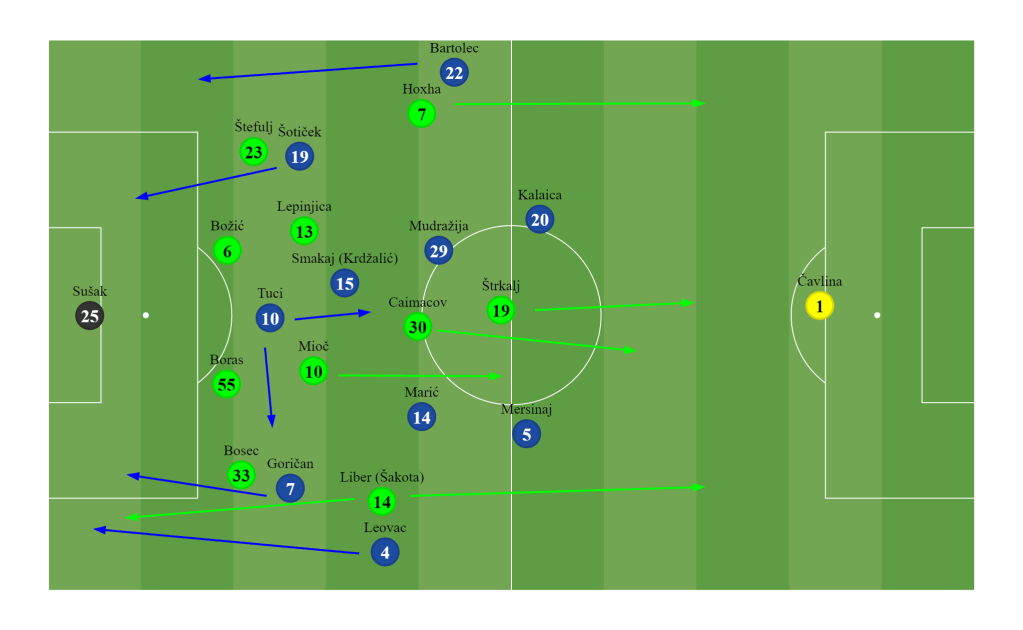
In the match’s final moments, Čabraja made a tactical substitution by bringing Čop into the game, which resulted in a change to the system in the 424 formation. In response, Ferenčina swapped out a striker for a defender and replaced Štrkalj with Međimorec, adjusting the system to a 541 formation. At the very same moment that this change was made, Šakota seized the ball and sprinted 30 meters to score the final goal, resulting in a 1-3 victory.

The match was excellent, with a lot of direct play. Ultimately, Ferenčina’s Belupo outwitted Čabraja’s Lokomotiva tactically and won the game.
Varaždin – Rijeka 0:2 (Bande, Škaričić)
As expected from his mentality, Sopić didn’t change anything in the game style, using his 4141 (415) formation. He put Janković on the left wing, Fruk took a left eight position, Banda right eight, Yansane right-wing position, and Čabraja left fullback position; the rest of the team lineup was as in the previous game. The front five players imposed aggressive press and counter-press after possession loss, with Selahi covering their back if the opponent penetrated the press. Selahi is the best league ball stealer with excellent reading game and opponent vertical pass anticipation.
During the attacking phase, Rijeka primarily utilized long balls and attacked bounced balls. As expected, they played a very direct style of football, with the attacking five players making numerous deep runs in space. This forced a lot of through balls between Varaždin’s defensive players.
In the match, Varaždin’s coach, Kovačević, made some personnel changes but stuck to his playing style and formations, with some variations of the 4231/433 formation. He introduced young Škaričić as the right fullback, brought Vukčević onto the right wing, and made Mitrovski the attacking midfielder in front of Pilj and Postonjski behind Šego as the central striker. The primary concern before the game was whether Varaždin’s midfield could resist Rijeka’s pressure and maintain their passing dynamics. The answer is reflected in the game result.
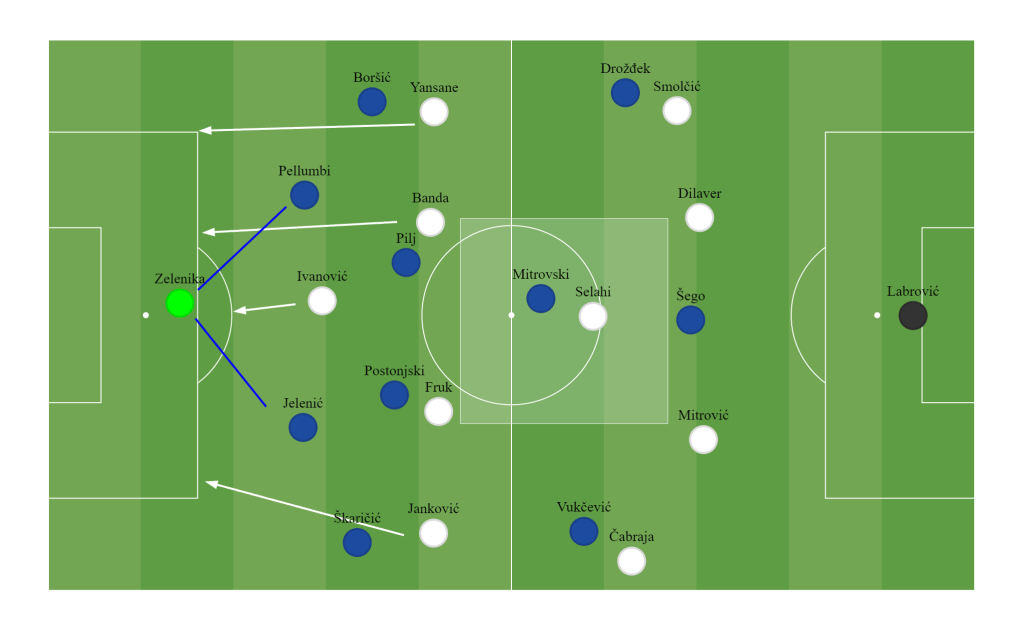
From the beginning, Varaždin attempted to play a passing game from the back, with their goalkeeper Zelenika involved in the buildup. However, they were not very successful in executing this strategy. Rijeka’s press and counter-press, led by Ivanović, Janković, Fruk, Bande, and Yansane, proved too strong for Varaždin’s passing dynamics. As a result, Varaždin resorted to playing long balls after three or four passes without much success in recovering second balls.

On the other hand, Rijeka posed a significant threat in transition after winning the ball through pressing or counter-pressing, creating numerous excellent scoring opportunities. They capitalised on one such chance to score the opening goal. Varaždin tried to move the ball out from the front of their 16-yard box, and Postonjski played a deep pass to Mitrovski. However, Selahi, who is the best ball stealer in the league, anticipated the pass and won the ball through a strong tackle, disposing of Mitrovski, who did not protect the ball well and had a poor first touch, possibly because he went into the duel too softly.
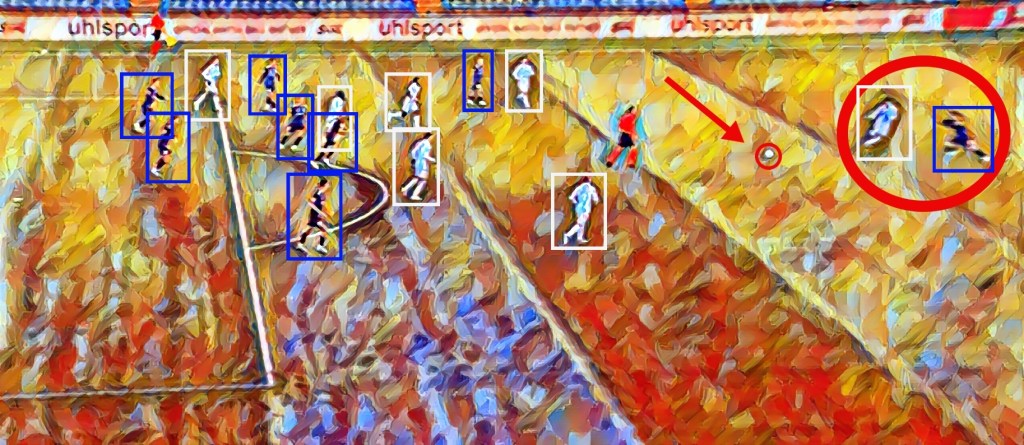
Selahi won the ball after a solid challenge and passed it to Fruk. Fruk spotted Bande making a run into the box and played a perfectly timed through ball using the outside of his foot. Banda received the pass while running at full speed and scored.

Selahi was effective in reading Varaždin’s buildup and intercepting passes.

It needs to be said that Varaždin did puncture through Rijeka’s press several times, resulting in a lot of free space to be exploited in further attack progression. Only the defensive line is left to beat if you penetrate Rijeka’s pressing line. But to beat Rijeka’s pressing through the middle, you need to think quickly and be quick on the ball with excellent pass precision. On one occasion, Postonjski’s vertical pass from deep in Mitrovski’s legs resulted in further attack development and a traditional low cross into the box from Drožđek to Šego, but Šego missed it. This action revealed some holes in Sopić’s strategy, but no team has made Rijeka suffer this way, yet.
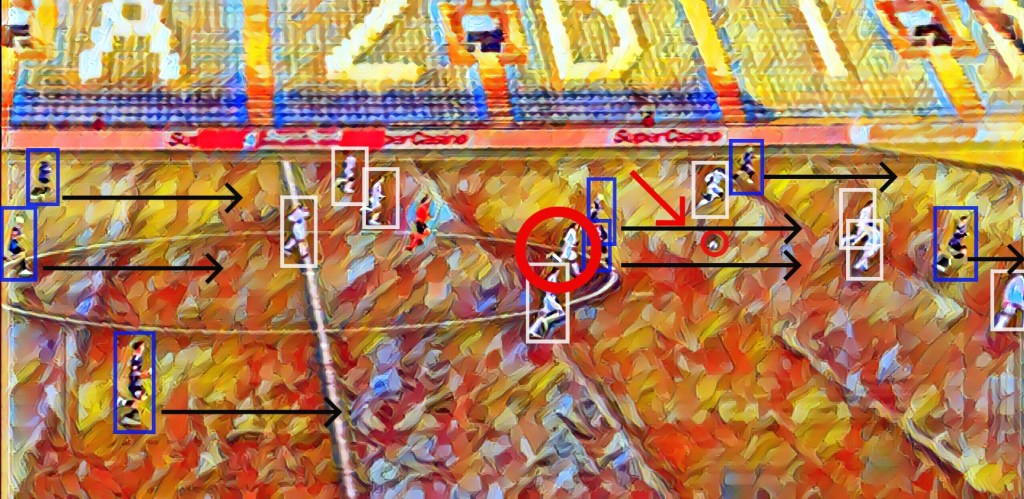
During the match, Varaždin attempted to put pressure on Rijeka’s build-up. However, their midfielders focused more on man-marking Rijeka’s players, particularly Šego and Mitrovski, who were keeping a close eye on Selahi when Rijeka’s defensive line was changing sides with the pass. Varaždin also reacted by pressing to Rijeka’s back pass from midfielders to defenders.
The main issue with Varaždin’s press was that it was too wide. The wingers would stay wide, leaving the midfielders to play a marking game on a large space, which allowed room for Rijeka’s deep pass or easier reaction on second balls. If the wingers had stayed narrower, the area for Varaždin midfielders to cover would have been smaller, and the press would have been more compact, resulting in more balls won. This was probably the main problem in Varaždin’s defensive strategy. Nonetheless, they managed to take a few balls.
It was observed that Varaždin’s press faced another issue as Rijeka’s defenders did not force buildup through midfield. In every risky situation, they resorted to a long pass and then applied great pressure with their front line on the second balls. This way, Rijeka was able to resolve the midfield battle in the buildup and take absolute advantage of their aggressive strategy.

In the second half, Rijeka did lower their press and gave possession to Varaždin, waiting for counterattacks and set pieces.
After conceding the second goal, which came from their own goal after Fruk’s cross, it became clear that the Varaždin team had realized it was not their day. Typically, the Varaždin team maintains their passing style of play regardless of the result. They are quick to exploit any lapse of concentration or defensive weakness from their opponents. However, in this particular game, it was evident that Rijeka would not lose focus.
Varaždin did make some second-half substitutions but without impact on the game dynamics.

Ultimately, it must be said that Rijeka’s winning strategy combined press, counter-press defending, and aggressive second-ball play. They also utilised long balls in the buildup and direct play with many through passes in transitional play. Sopić’s invention of Selahi in defensive midfield positions allowed the rest of the midfield to be more attack-minded and aggressive. They know that if they lose the ball or get beaten in duels, Selahi is covering their backs and doing it wonderfully.
Sopić is doing an excellent job with his tactics in Rijeka this season.
Dinamo – Osijek 2-1 (Bulat, Vidović / Matković)
Dinamo Zagreb started the game in a 4-3-3 formation. However, coach Jakirović used a press conference as a tactical tool to mislead the opposition. He provided false injury reports for Špikić and Perković but then used Perković as a left full-back and Špikić as a left winger, which was unexpected by the opposition. Patković started the match, which was good news for Dinamo. The two defenders were Šutalo and Catherine, and the expected midfield trio of Mišić, Bulat, and Baturina were also in the starting eleven.
Zekić opted for a 4-3-3 formation with midfielders Nejašmić, Brlek, and Pušić. Lovrić played on the left wing, while Dambrajev took the left fullback position. The rest of the team played as expected in this formation.
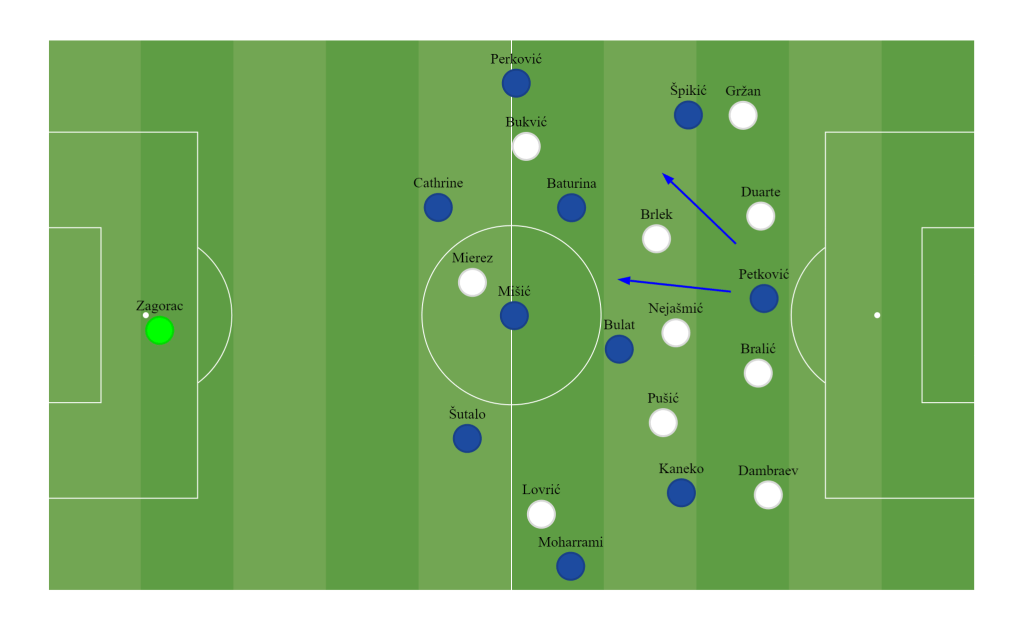
In the first fifteen minutes, Dinamo had more possession and tried to create chances by switching sides through Mišić and Baturina. However, they were unable to produce any real opportunities during this time. Petković, as usual, was always ready to receive a pass from his teammates, which helped maintain Dinamo’s fluidity during their attacks.
Bulat did an excellent job of scoring from 16 yards, even though Osijek’s block was late to react (Pušić was late). However, Dinamo’s main problem this season is that Bulat is not contributing to the team’s creativity during the game. As a result, Baturina and Mišić are compensating for him in this aspect of the game. Nonetheless, with his great set-piece skills and a good shot, he is still making a valuable contribution to the team.
The advantage is that he and Baturina interchange positions in midfield throughout the game, allowing him to attempt shots from various angles. In contrast, Baturina can provide a creative impact on the opposite side.
Osijek displayed a strong defensive game, and the intensity of play was high. They employed a 451 formation when lowering their defensive block. Dambraev, who played as the left fullback, had a particularly noteworthy game. As a result, Dinamo struggled to penetrate Osijek’s defence. However, offensively, Lovrić and Mierez did not perform as well as expected. Mierez lost some aerial duels, while Lovrić was not as effective in counterattacks. Osijek managed to create only one excellent counterattack chance in the additional time of the first half. Bukvić caught Perković off guard and left him behind in a penetrating run. He then received a superb diagonal pass from Nejašmić, but Zagorac managed to save it.
At halftime, as usual, Zekić implemented some changes that had an impact on the game.

Mijo Caktaš replaced Lovrić, taking his natural attacking midfielder position, with Pušić on the left wing (but narrower) and the young prospect Matković subbed in for Bukvić. The system looked like a lopsided 4-2-3-1.
Ademi came on for Špikić in the second half, and Jakirović appeared to switch to a midfield diamond shape (4-3-1-2) while attacking.
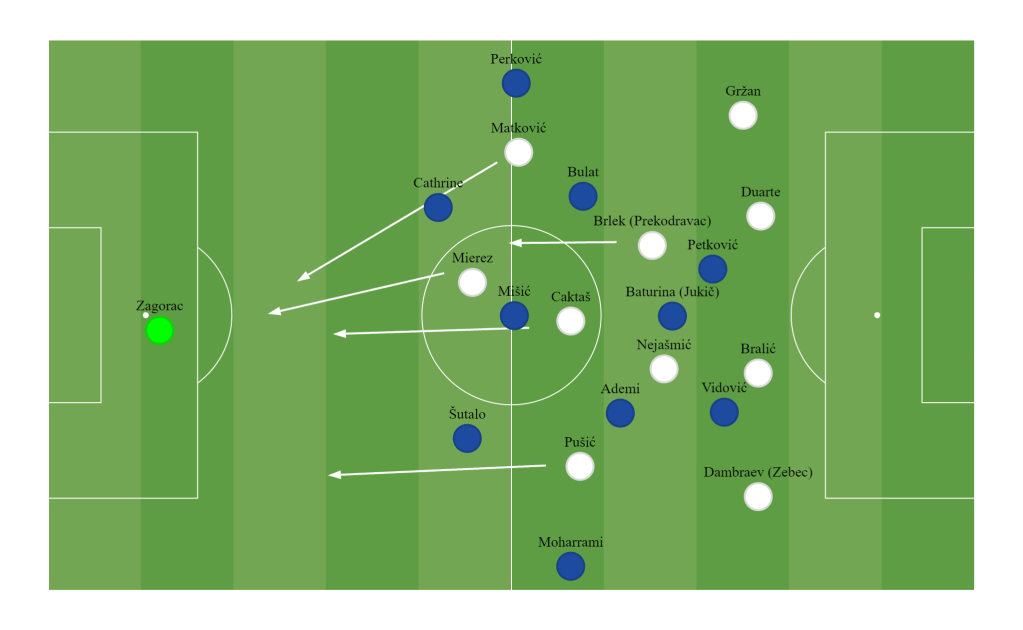
This way, Dinamo changed midfield geometry. This was especially evident when Ademi made a great pass to Bulat, but unfortunately, Bulat missed the shot. Ademi significantly impacted the game when he entered, giving his teammates energy and motivation. However, the team struggled to keep possession and lost the ball frequently, leaving them vulnerable to counterattacks.
Osijek scored a goal right after Zekić introduced a new young player, Prekodravec, in central midfield. After Bralić intercepted Dinamo’s bad pass, he initiated a quick counterattack. During the counter-attack, Pušić provided an excellent pass for Matković, who outran Cathrine and took advantage of Zagorac’s poor depth perception to score a goal.
After Osijek scored, Dinamo took absolute control of the game. Jakirović brought in Halilović for Bulat and Jurić for Baturina to have more options inside the box. However, their attack lacked structure and relied more on individual quality. Ademi missed a good chance from close range, and it seemed like the game would end in a tie. But in the last attack, Vidović took advantage of some confusion in Osijek’s defense. Zebec, who had replaced the injured Dabraev minutes earlier, misjudged the ball’s flight, and Vidović brilliantly received the ball. Bralić attempted to block Vidović’s shot, but his deflection ended up in the net.
In the end, Dinamo won the game more due to luck than football skills. Osijek lost once again, despite Zekiće’s great halftime reaction and introduction of two very promising youngsters.
Istra 1961 – Hajduk 0:2 (Sahiti, Livaja)
As stated in the game preview, both coaches followed their expected strategies in this match. However, Catala realized that his game plan and approach weren’t yielding any positive results. He also noticed that Hajduk was vulnerable and decided to change his team’s strategy during the first half, which allowed them to gain better positions on the field.
Karoglan made a decision to field a standardised Hajduk team, with the only exception being that Benrahoui was not included in the lineup. As a result, Sahiti played in the right-wing position, while Dajaku was introduced to the left-winger position. Later in the text, we will see that this lineup with two wide-wingers resulted in different movement patterns during various attacking phases. Hajduk employed two shapes, 4123 when attacking and 442 (4411) when defending. The main reason for the defensive shape was due to Krovinović’s poor defensive form.
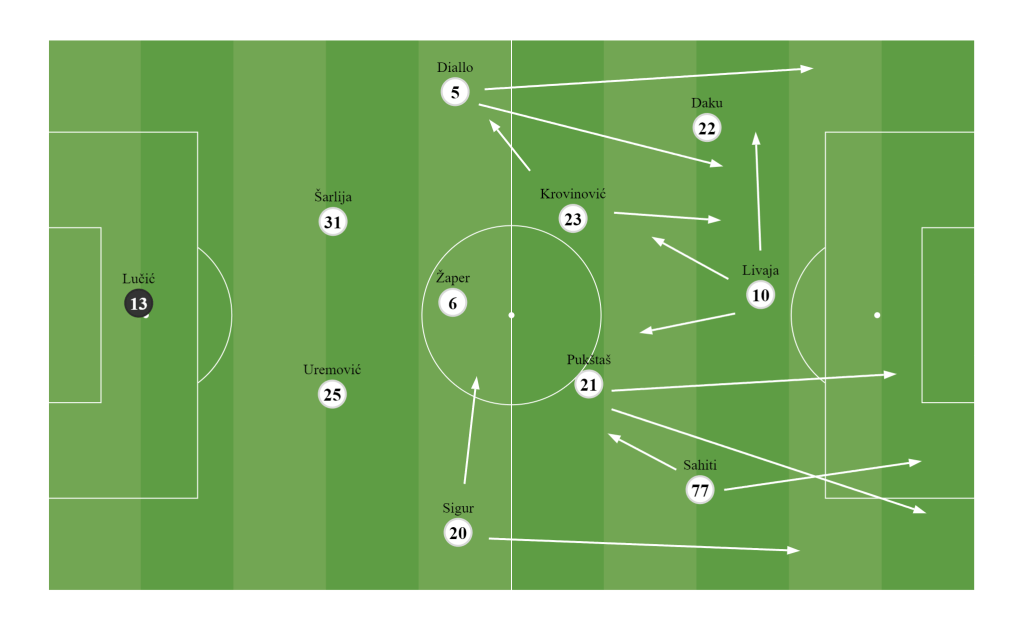
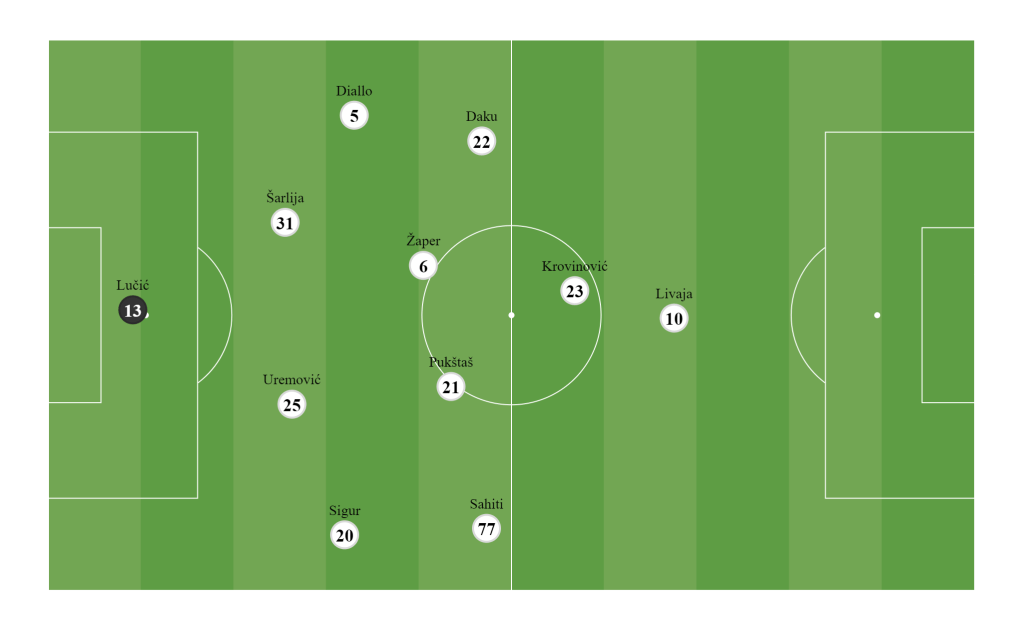
Catala began the game with a 4-1-4-1 formation, using Blagojević as the midfield corrector and the attacking trio of Lisica, Erceg, and Vuk to exploit Hajduk’s high defensive line through counterattacks. Although they attempted to build up play with passes, Hajduk’s pressing forced them to resort to long balls.
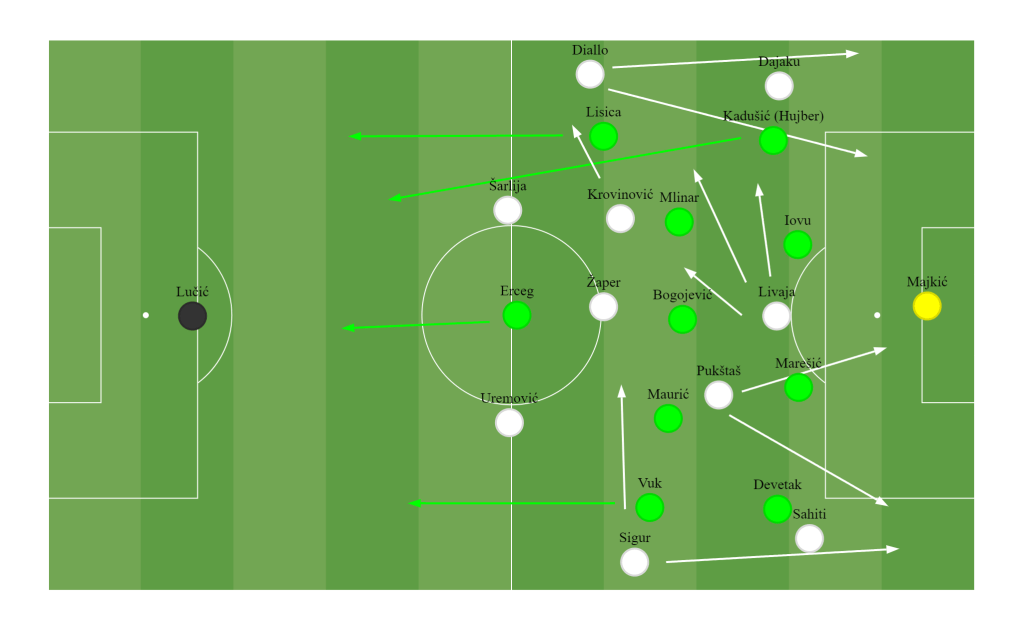
The game model developed as expected. Hajduk controlled possession and was aggressive in counter-press after losing the ball and pressing on Istras’s possession, not allowing Istras’s direct or counterattack to develop.
Hajduk had specific movement patterns. Karoglan prefers his team to have many off-ball movements during the attacking phase, with two neighboring players always making counter-movements. This tactic creates space for through passes and third-player games. However, this kind of game requires high levels of concentration and energy and may stifle players’ creativity. Perhaps this is why the team struggles in the second half of games, as they cannot maintain their energy and concentration levels. This leads to their attacking patterns falling apart, resulting in chaos and the team resorting to a more defensive structure.
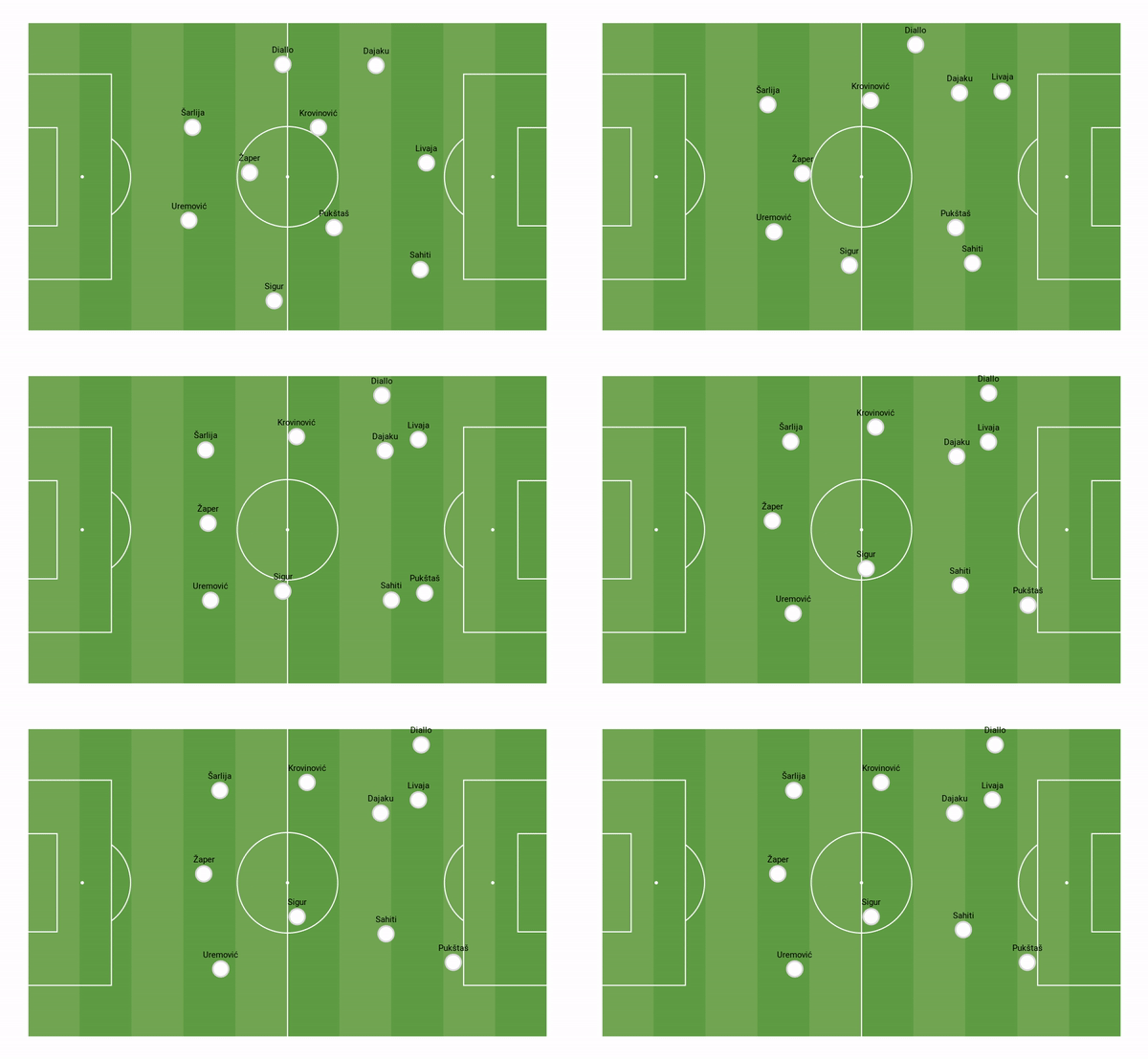
During gameplay with two wide attackers, an interesting pattern emerges: Sigur enters midfield, and Žaper enters between two defenders. However, these patterns are still not being executed with time-space coordination. For instance, Žaper enters between defenders without any pressure from the opponent and the defenders do not move into more advanced zones when Žaper comes in between. Pukštaš, Sahiti, and Sigur do rotations without gaining any advantage yet. Livaja sometimes comes in midfield for the ball but doesn’t make any impact, only suffocating midfielders. Perhaps these patterns require more time to become effective. The team needs to implement them in more suitable situations with better time-space coordination to gain an advantage on the pitch.
Hajduk performed well on the field, but they could only score due to Istra’s defensive mistake and Sahiti’s brilliant strike. Istra’s low block defence led Hajduk to attack from the left flank. Diallo crossed the ball through the box on the second post, where Devetak left Sahiti unmarked. Sahiti positioned himself perfectly and used the outside sole of his foot to hit the ball into the opposite corner of Majkić’s goal, displaying exceptional skill. Though Hajduk took the lead, it was due to individual quality, as only a few players from top-level Croatian football could have scored such a goal.
After 20 minutes, Catala realized that his team wouldn’t benefit much from a low-block approach. Therefore, he decided to press Hajduk by applying a pressure on Hajduk’s two defenders and goalkeeper, particularly Erceg. This led to numerous mistakes, yellow cards, and nervousness. Both teams had very reactive players who couldn’t control their emotions under pressure, such as Sahiti, Livaja, and Šarlija on Hajduk’s side and Devetak and Blagojević on the other.
Erceg was the leading provocateur in the match, using mind games to his advantage. He never backed down from a duel and often added an “extra touch” during fights. By playing with his opponents’ minds and getting under their skin, he was able to change the match dynamic completely. As a result, Hajduk’s players lost their focus on tactics and their game suffered. It was truly a pleasure to watch Erceg’s skilful manipulation of the game.

During the game, Hajduk’s players overreacted to physical contact and became overly focused on the referees and their opponents, particularly on Ante Erceg. They seemed to prioritise complaining about the opponent’s physical game over sticking to their game plan, causing their offensive game to fall apart. If Istra had scored in the last third of the second half, they would have likely won the match by making Hajduk’s players so nervous that their quality of play would have been compromised. Catala should have taken advantage of this weakness from the beginning. Hajduk’s players, who seemed very unstable, fell for Erceg’s bait. After that, Istra had several excellent scoring opportunities, but unfortunately for them, they did not capitalise on them.
In the second half, Hajduk played in a 4-4-1-1 formation, focusing on their defence but struggling to make meaningful progress with the ball. Istra’s players took an aggressive approach, pressing and passing, and managed to dominate possession with over 60% in the second half. This aggressive play led to many technical mistakes from both teams, resulting in poor passes and frequent turnovers. As a result, Hajduk lost all attacking momentum and could mount serious threats only through counterattacks.
Catala decided to refresh his team in the second half, sending Hujber and Matheus on the pitch.
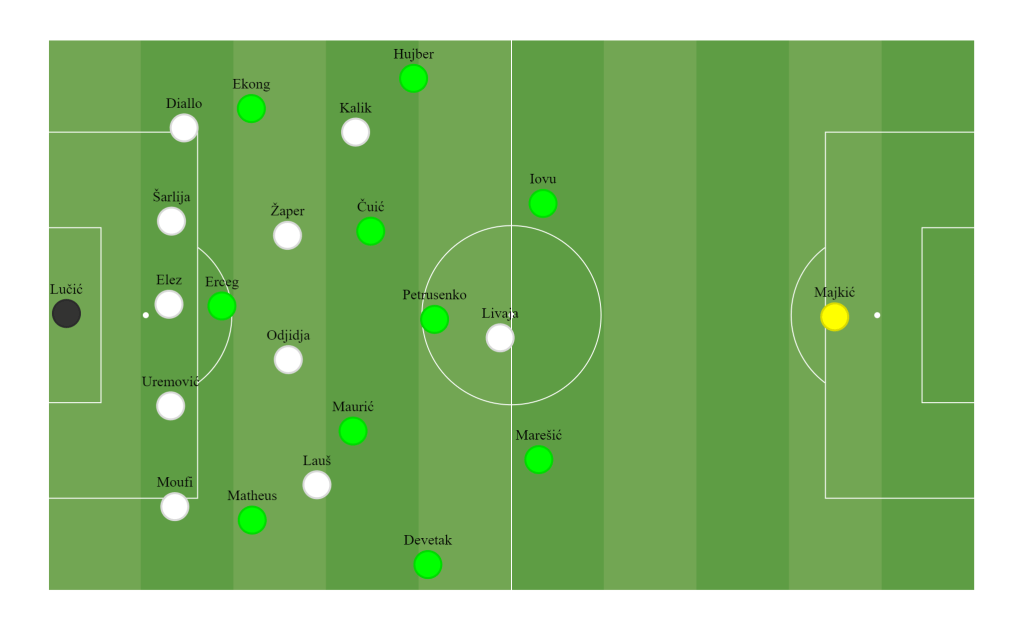
Karoglan tried to change possession dynamics by substituting Dajaku and bringing Kalik in. But without any effect. Hajduk was dangerous only through counterattacks.
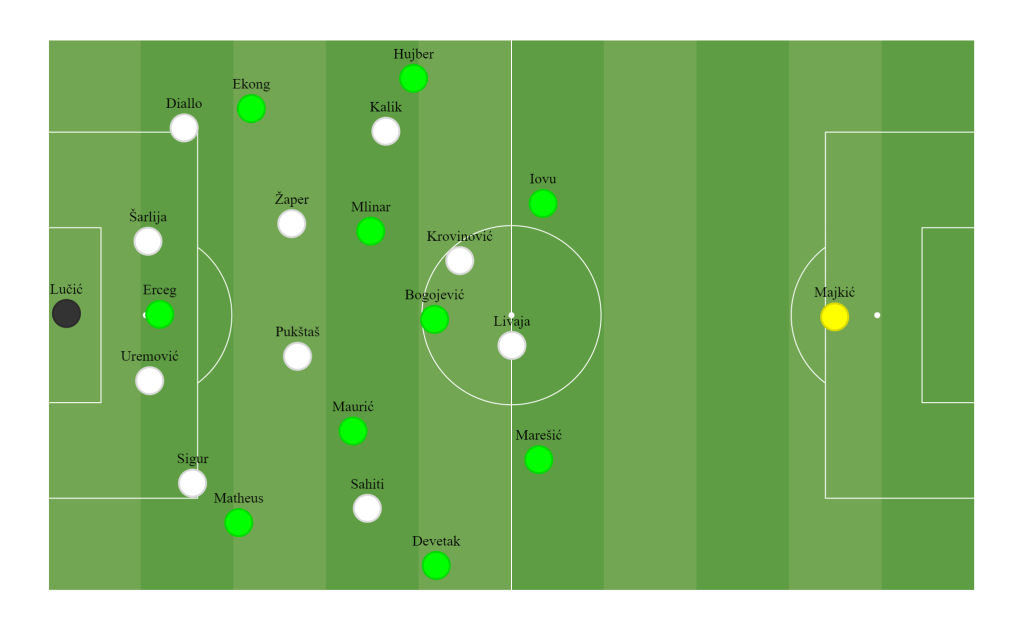
Around the 75th minute, Catala made two substitutions to refresh his midfield, bringing in Petrusenko for Blagojević and Čuić for Mlinar, but it didn’t result in a much-needed goal.
In the 90th minute, the opposing team managed to score a goal. Hajduk seized the opportunity and capitalized on one of the many passing mistakes that Istra had made, thereby winning a penalty from a counterattack. Kalik played a brilliant vertical pass to Livaja, who was given space to deliver the ball to Krovinović. During the continuation of the attack, the ball accidentally hit Hujber’s hand, resulting in a penalty that Livaja converted into a goal.
In the end, Karoglan made some cosmetic changes in the last few minutes, including reorganizing into 541 formations.
In this match between Istra and Hajduk, Istra demonstrated agressive tactical approach. Hajduk players showed significant mental vulnerability when faced with aggressive, attacking-minded football. It remains to be seen if other teams will take advantage of this weakness and whether Hajduk can maintain their game and mental stability throughout the entire 90 minutes of play. Hajduk has had difficulties when their opponents can read their game, and it’s not the first time this season that their players have been forced to defend in the second half. Although the result may seem going well, they could be punished for the second half’s overly defensive approach. It will be challenging for them to continue defending like this against teams with greater individual quality.
Gorica – Rudeš 2:0 (Vojnović, Blumel x 2)
Gorica played in a 4-3-3 formation, with Mrzljak playing a more defensive midfielder role, although the midfield trio of Mrzljak, Soldo, and Pršir rotated a lot during the build-up. Jeličić chose Maloča and Krizmanić as central defenders.
On the other hand, Ivan Mijač lined up Rudeš in a brave and offensive 4-3-3 formation, changing more than half of the starting lineup.
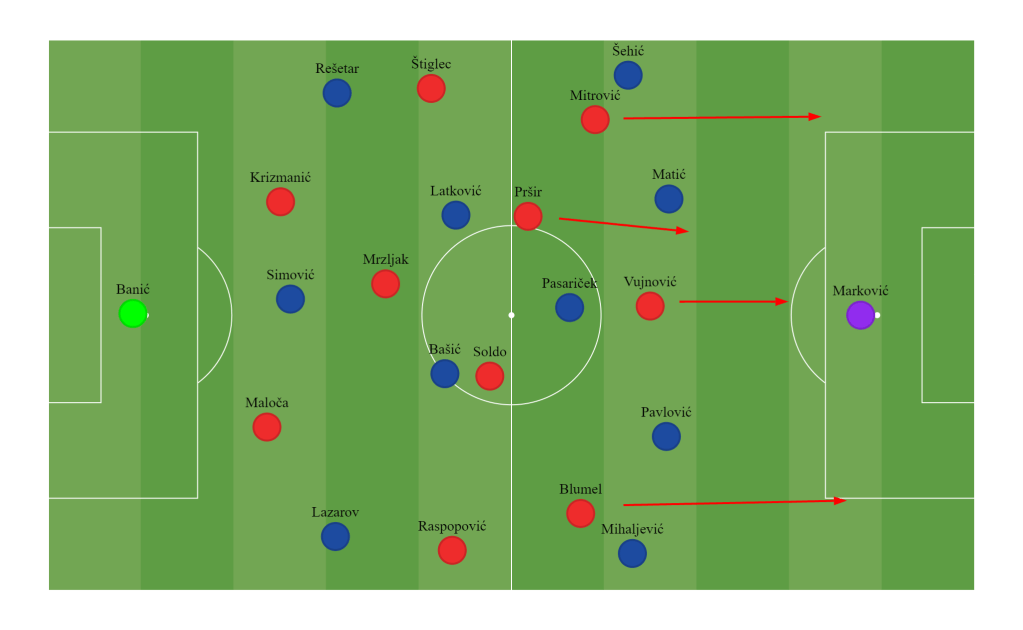
The game followed the expected pattern, with Rudeš playing open football and putting pressure on Gorica’s players. However, this only accelerated Gorica’s possession play. Rudeš players were often late in pressing, and when pressing lines were penetrated, the defensive line was left high up the pitch without midfield cover. As a result, Gorica’s players found it easy to give through passes and develop transitional dynamics.
Pršir was exceptional in breaking through Rudeš’s defensive line with through balls, making it easier for the offensive trio of Mitrović, Vujnović, and Blumel to develop and finish transitional situations (3v2 or 3v3).
In the second half, when the score was 3-0 for Gorica, Jeličić decided to try some players in different positions and gave a chance to some bench players. As a result, Rudeš had few chances but nothing significant enough to change the match’s final outcome.
In the end, Gorica won 3-0, but the victory was probably easier than they expected.
 Diamond Football Tactics