


Three key Croatian football matches yielded mixed strategies and results.
The Belupo vs. Rijeka game saw Zekić earning victory through a simpler, more realistic game plan, overpowering Rijeka’s ineffective standardized mechanisms of attack.
The Hajduk-Dinamo match ended in a draw, with Hajduk’s high on-field aggression and Dinamo’s fatigue affecting the game flow.
Finally, in the Varaždin vs. Osijek match, Osijek’s initial aggression ended in defeat as Varaždin took control via attacking geometry and passing, shifting the game dynamics.
- SLAVEN BELUPO – RIJEKA
The match between Belupo and Rijeka showed that even a simple idea could bring a victory, especially if it’s practical and well incorporated into the game plan. The matching model was evident from the beginning. Zekić decided on a more realistic approach and gave more than 50% possession to Rijeka. Cosmi didn’t make many tactical adaptations for this match, which ultimately proved fatal.
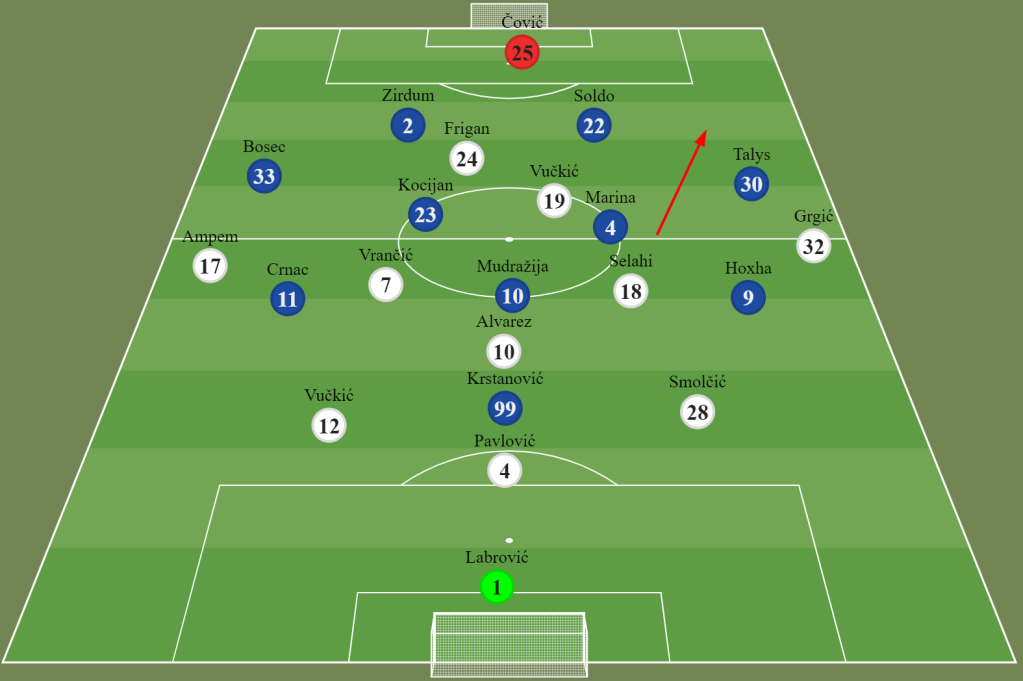
Cosmi decided on an already standardized 352 system. He tried to win the game through standardized mechanisms of attacking with possession. DCs from the right and left sides (Vukčević and Smolčić) overlap whenever possible, and DMC Alvarez enters alongside DC Pavlović when the attack builds up. But despite good ideas, Rijeka wasn’t efficient in developing the onfield, primarily because of Belupo’s aggressive and reactive game.
Zekić decided to change the game system in 4231. Otherwise, he mostly played 352/3412 or 3421, clearly scouting and preparing for Rijeka. Belupo played aggressively in the defensive phase, not pressing or counter-pressing all the time, but was very aggressive on second balls. In the attacking phase, Zekić decided on an elementary idea. Quick counterattack after winning the ball, searching excellent wingers Hoxha and Crnac, especially in fast transitions, or the team was searching Krstanović, who put down and held long balls, passing them too quickly, joining wingers (Crnac and Hoxha) and AMC (Mudradžija).
The game was won because of Hoxha’s great individual skill. In the second half, Rijeka developed their game even in finishing third and grabbed an equalizer through great Alvarez’s final pass. Vučkić’s goal Belup’s defenders didn’t cooperate well in taking him over. But after the penalty and Rijeka’s red card, Belupo’s players took control, and the game ended.
2. HAJDUK – DINAMO 1:1
Karoglan and Čaćić prepared derby in different team ambients. Dinamo is in a series of games every three or four days, exhausted from the champions league during the week and home league during weekends. Hajduk with play every seven days, with much more time for game preparation and recovery between the matches.
Karoglan decided to play in the 4411 formation in the defensive phase, with Krovinović and Livaja upfront. And something that looked like 433 or 4312, depending on the Sahiti and Krovinović movement or one of Hajduk’s standardized attacking mechanisms that were used.

Karoglan decided to play reactive football. It allowed Dinamo to build up but pressed them on every lousy touch or back pass to the goalkeeper. It was an excellent tactic. Interestingly he put man-to-man midfield marking, with winges Sahiti and Biuk playing narrow, cutting passing lanes in midfield, allowing Dinamo to go wide toward fullbacks with chipping balls, but that gave them time to rearrange their defensive shape and adjust positions and press even fullback positions. For this to be possible, the most crucial thing was Livaja and Krovinović running and the cooperative movement in covering and neutralizing Mišić, with pressure on Dinamo’s DC position, allowing them to shadow all midfield and cutting off one side., especially when the ball would go toward the flanks. Because of this, energy expenditure in the first half was extraordinary.
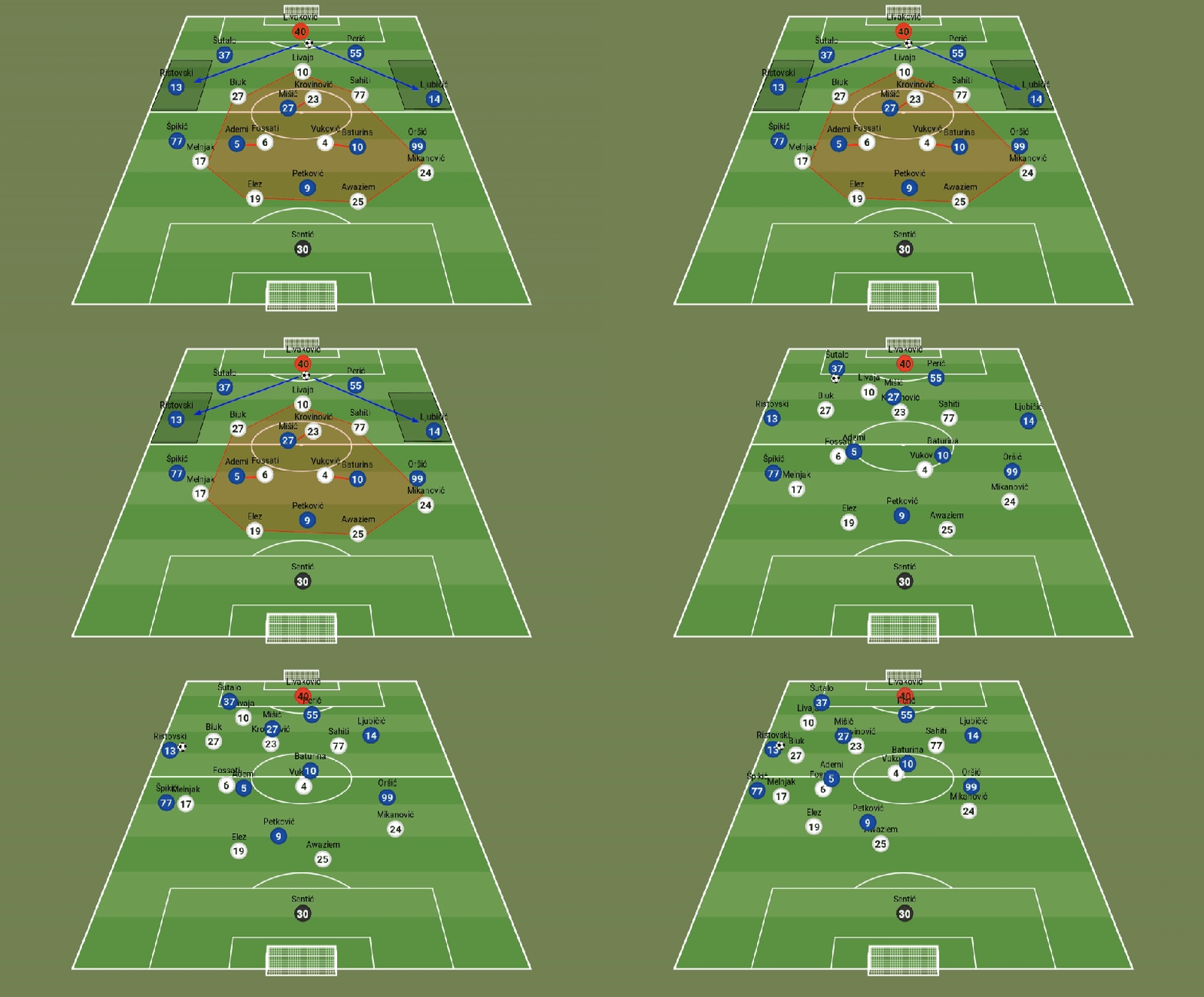

Dinamo was also aggressive on Hajduk’s buildup play. Still, Hajduk didn’t have a problem going long toward Livaja whenever pressed and trying to win second balls or CB Awaziem to go in the midfield with the ball. Hajduk players didn’t want the possession at any cost. So with that approach, they minimized the possibility of making mistakes in the first third of the field. One exciting movement that Hajduk uses when going upfield is Sahiti’s movement in the central position, receiving and turning with the ball, trying to penetrate the opponent, and allowing fullback (Mikanović) to exploit space on the wing.

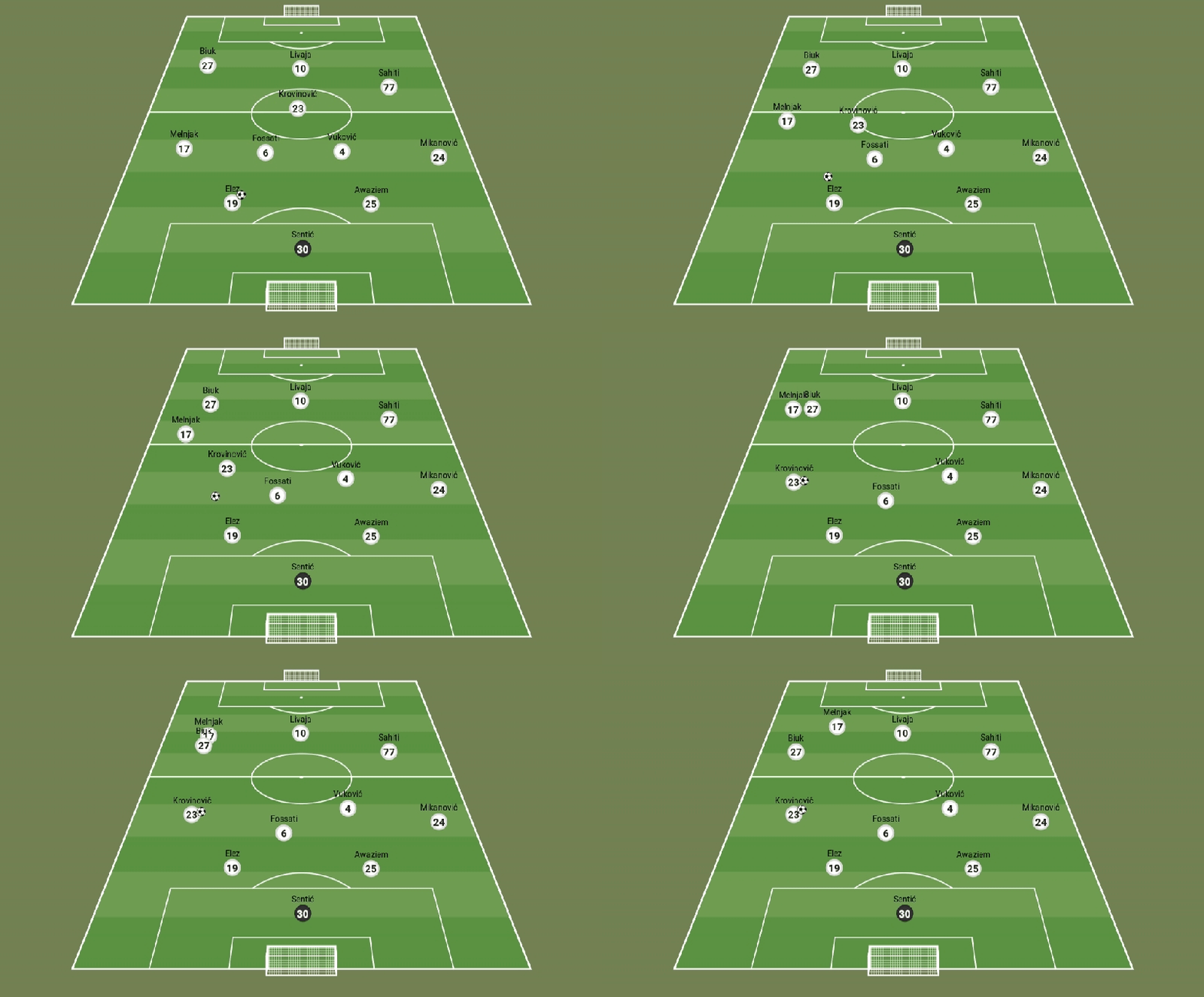
Čačić didn’t make any adjustments for the match, probably expecting that his players would be able to bring the ball upfield through their usual geometry and attack build-up. He didn’t expect that his team would be limited by Hajduk’s high upfield aggression and energy level and that his team’s fatigue would make them that much slower and less precise in passing and decision-making. Because of the Hajduk press, it was evident that during the attack build-up Mišić was coming between center backs (Šutalo and Perić) to dictate the game rithm. Still, because of man-marking in midfield areas and narow wingers making midfield areas in their shadow, the only free space was toward fullbacks positions (Ljubičić and Moharami). Ademi and Baturina couldn’t move away from the pressure when receiving the ball and were forced to play back pass, or were fauled, so Dinamo game was losing dynamics all the time. Petković, Oršić and Špikić were cut off all the time. When the ball would arrive upfield (mainly through long passes toward Petković), Hajduk players (especially Vuković and Fossati) took most of the second balls.

It must be said that neither Hajduk nor Dinamo had a game domination in the first half that would allow them to make significant number of opened play chances. Hajduk scored via corner kick and had a few promising situations but without any real danger for Dinamo’s goal.
Second half Čačić did make adjustments. Makeing changes, and adjusting the geometry dinamics in game, Dinamo was reliving Hajduk’s pressure. It needs to be said that hajduk lowered defensive agression intesity second half, allowing Dinamo players to play their game with less pressure.
3. VARAŽDIN – OSIJEK 4:1
Kovačić and Poms are the two most progressive coaches in Croatia. Both play active possession-oriented football, Poms a bit more direct one, Kovačić exclusively geometry and pas oriented.
The game model on the match start was as expected. Osijek playing aggressively with shorter attacks. When Osijek lowered energy and intensity level, Varaždin started to control the game via attacking geometry and passing game, changing game dynamics completely.

For this game, Kovačić decided to change Varaždin’s shape from 433 to 3511. It probably had to do with the players he had at his disposal (Šego – FC/WF injured and Ba DC returning from injury for this game). Their new shape allowed him to have a midfield diamond with a lot of creativity and possession oriented game, and better protection in case of a lost ball with Puclin(DMC) and three defenders (Jelenić, Ba, Stolnik) defending counterattacks in case of lost balls. Teklić also returned after 3 yellow cards suspension giving more creativity and a final pass or shot in finishing third.
Osijek started with Poms’s already standardized 3421, with an aggressive approach when out of possession and creative and cooperative play on their left side, with Kleinheisler in excellent playing form. They made it very difficult for Varaždin to build up from defensive third and being very dangerous when taking the ball, especially on the left side, where Kleinheisler made a lot of impacts, with dribbling inside, taking shots.
Osijek tried to exploit deficits in Varaždin’s problems defending corner kicks. But Varaždin coped with a bit of luck.
After an aggressive opening of 20 minutes and scoring a goal, Osijek lowered their game intensity, allowing Varaždin to get out of pressing with the passing game and turn the game result in 5 minutes. It possibly also had to do with Kleinheisler being substituted because of injury.
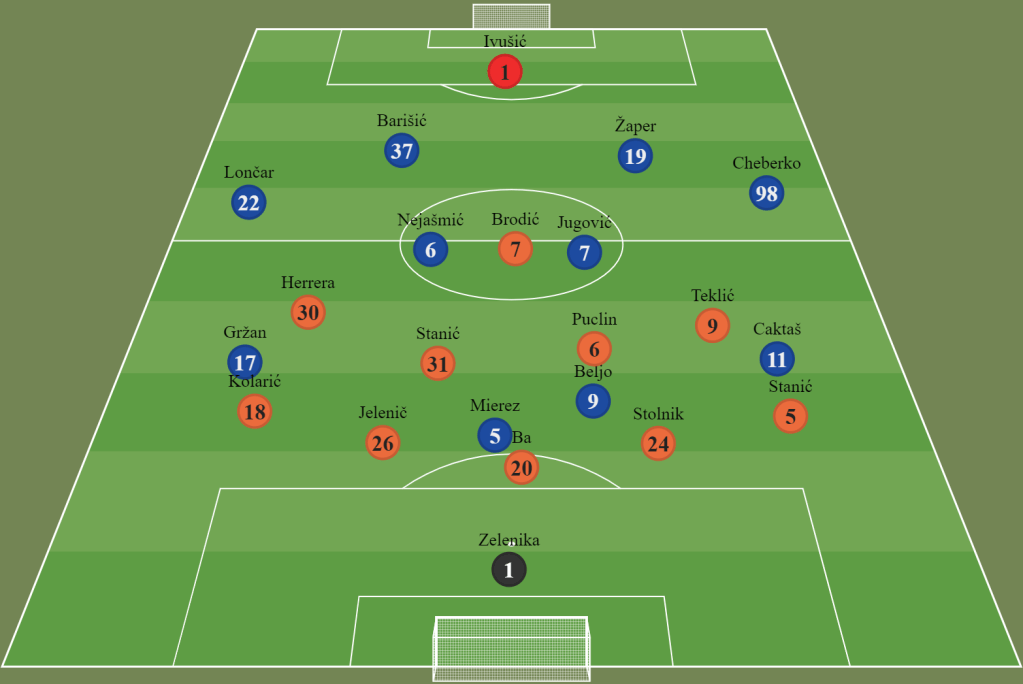
At the start of the second half, Poms changed the system in 442, putting Mierez on the pitch to play in attack with Beljo, But Varaždin continued to control the game with possession, scoring one more goal from a penalty kick.
In the final 15 minutes, Osijek was pushing upfront, trying primarily via flanks, but wasn’t effective at creating goal-scoring opportunities and often lost possession with bad passes or wrong crosses. Kovačić reacted by changing the system in 541, compensating flanks and putting in Herrera for counterattacks. Stolnik and Stanić did castling when there was an attack via Osijek’s right side, so Stolnik would attack opponent with ball, and Stanić would go behind his back, covering space. It looked excellent. In the end, Varaždin scored even on a counterattack for the final 4-1 result.
 Diamond Football Tactics