

Kovačević and Angelovski adapted shape and style after their teams received a red card. Cosmi introduced Rijeka’s offensive patterns, and Poms reacted at halftime by changing the system.

5. ŠIBENIK – SLAVEN BELUPO 0:2
Šibenik and Belupo played standard game model. Šibenik tried to gain an advantage through possession, but that’s precisely the game profile Belupo wanted and won on counterattacks.
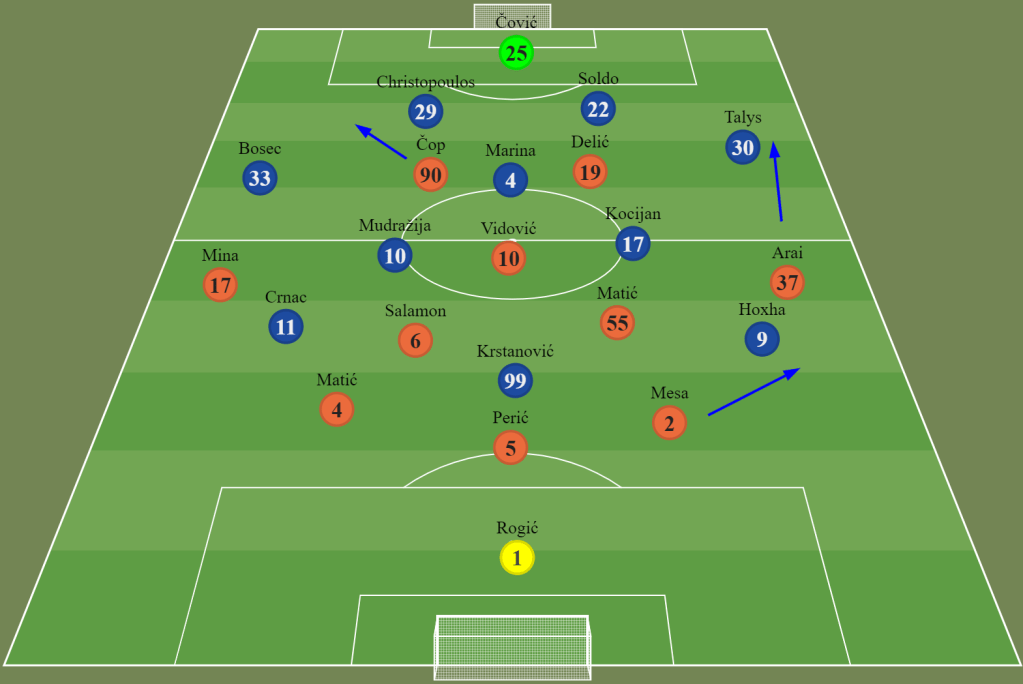
Cvitanović is still a searching system and style from which his team will gain the most. This time they tried something that looked most like 3412, which transformed into something of 4231, with Čop moving to the left side, and Arai going high up the pitch in possession.
That game profile is just what Zekić needed so he could profit with quick transitions. Šibenik’s possession, with a lot of corner kicks and quick counterattacks through Crnac, Krstanović and Hoxha, is exactly how the game model was.
In the end, Zekić players took advantage of this kind of game and materialized one corner kick and one counterattack through great heading and shooting Hoxhai skills.
4. RIJEKA – LOKOMOTIVA 3:0
Rijeka and Lokomotiva played a one-sided game, where Rijeka played attacking-minded football, and Lokomotiva played reactional football, trying to be dangerous from counterattacks.

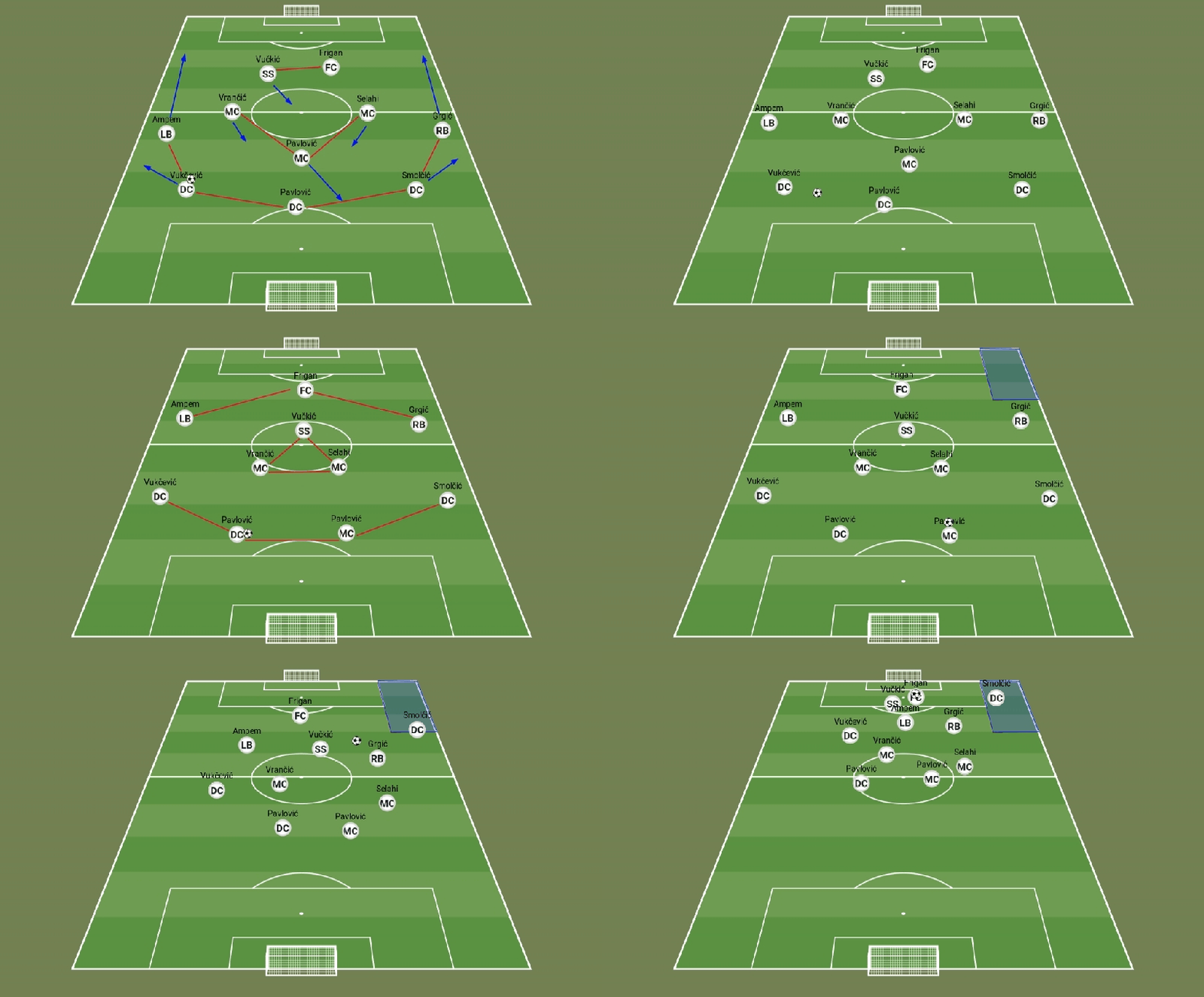
Cosmi decided on the same 352 system he introduced when arriving on Rijeka’s bench. His attacking patterns started to be clear on the field. In attack opening system, transformation is evident, DMC (Pavlović) is coming to build up the attack on the DC position, and two side central defenders (Vukčević and Smolčić – who otherwise are prone to play fullbacks) are transformed into left and right fullbacks, going in attacking third doing overlaps if it is necessary, and delivering crosses in the 16-yard box.
Čabraja decided to try a game plan via counter-attacks, but the team couldn’t impose themselves on the pitch.
3. OSIJEK – ISTRA 2:0
This is supposed to be a game of both attacking-minded coaches. Poms has a more direct approach but is also possession-oriented, and Garcia likes a lot of passing and triangular possession football.
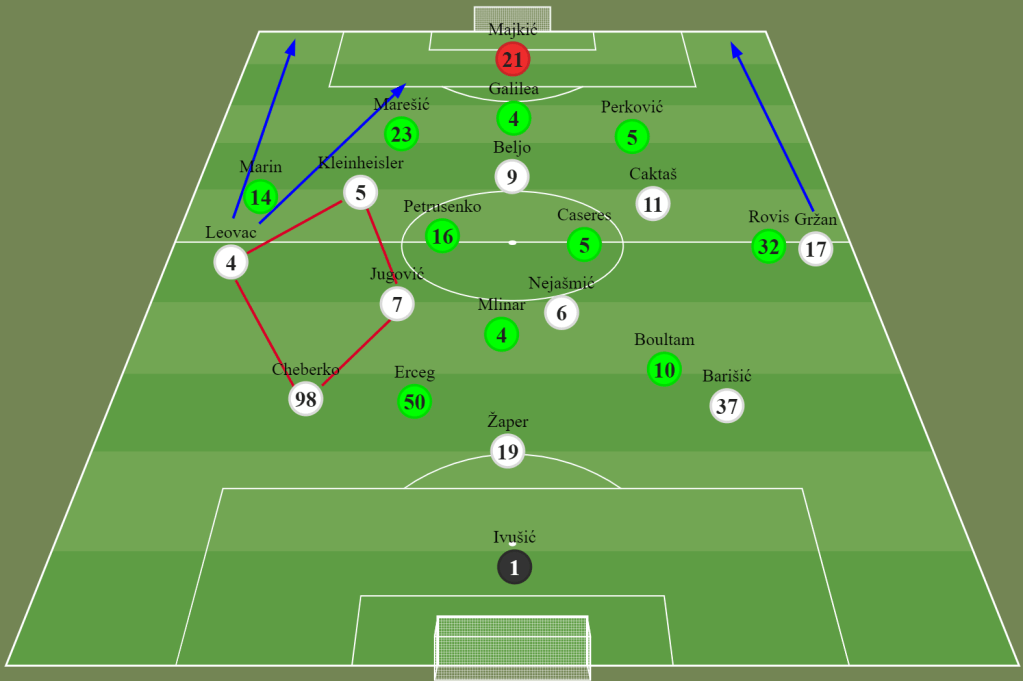
Osijek started the game in an already standardized 3421 formation, with a standardized line-up. Osijek came into the game very aggressively. Although Osijek has a tremendous offensive line that doesn’t need much space to go in the goalscoring opportunities, Beljo, Caktaš, and Mierez are not quick transitional players. Because of Garcia’s system and lineup adaptation, Osijek had problems in the final pas first half.
For this match, Garcia decided to change the play system and started in 3412 formation, with Mlinar in AMC position, going left a lot of times. The offensive trio (Erceg, Mlinar, and Boultam) created a few excellent chances, and Istra started to gain match control. Istra players made with two clear chances via trough balls and 1v1 opportunities missed.
Second Half, Poms changed the system in 442, putting in the second striker (Mierez), who likes to attack the space and pressure opponents’ defense in possession when opening attack and is excellent in heading crosses. So Mierez attacked depth, and Beljo was a bit behind him. With this formation change, Poms overturned match dynamics and won the game.
2. GORICA – HAJDUK 0:1
It was a tough match, with both sides playing strong defensively, Hajduk being very aggressive in midfield, and introducing more quality and idea in the offensive phase than Gorica. Gorica received a red card in the 51st minute, reorganizing their playing structure, in the end, looking like a 540 system and defending bravely after playing with 10 players on the field. Hajduk patiently tried to attack, mainly with many crosses, but without real goalscoring chances. In the end, when it looked like it was over, Livaja scored, putting the leg on a low solid cross/shot from Mlakar.

Karoglan decided to place Hajduk in something that looked like 4231. With Kalik in AMC position, Krovinović and Vuković behind him in central midfield positions., he was hoping to control midfield positions. Still, Hajduk is struggling to perform possession dynamics a lot of the time. Sahiti and Biuk played as wingers, with a lot of dribbling, but Gorica looked good defensively, taking care of many crosses with success.
Angelovski also put his team in 4231 but did not use midfield players to open the attack very often, they rather vent upfield by long passes. It could be that it resulted from Hajduk’s good and aggressive defensive play in midfield. Gorica’s players planned to exploit Fruk’s 1vs1 qualities in counterattacks, searching him more than a few times with diagonal balls, especially in counterattacks.
After receiving a red card, Angelovski imposed a 441/540 system, thinking only about how to protect his 16-yard box, directing Hajduk away from central positions.
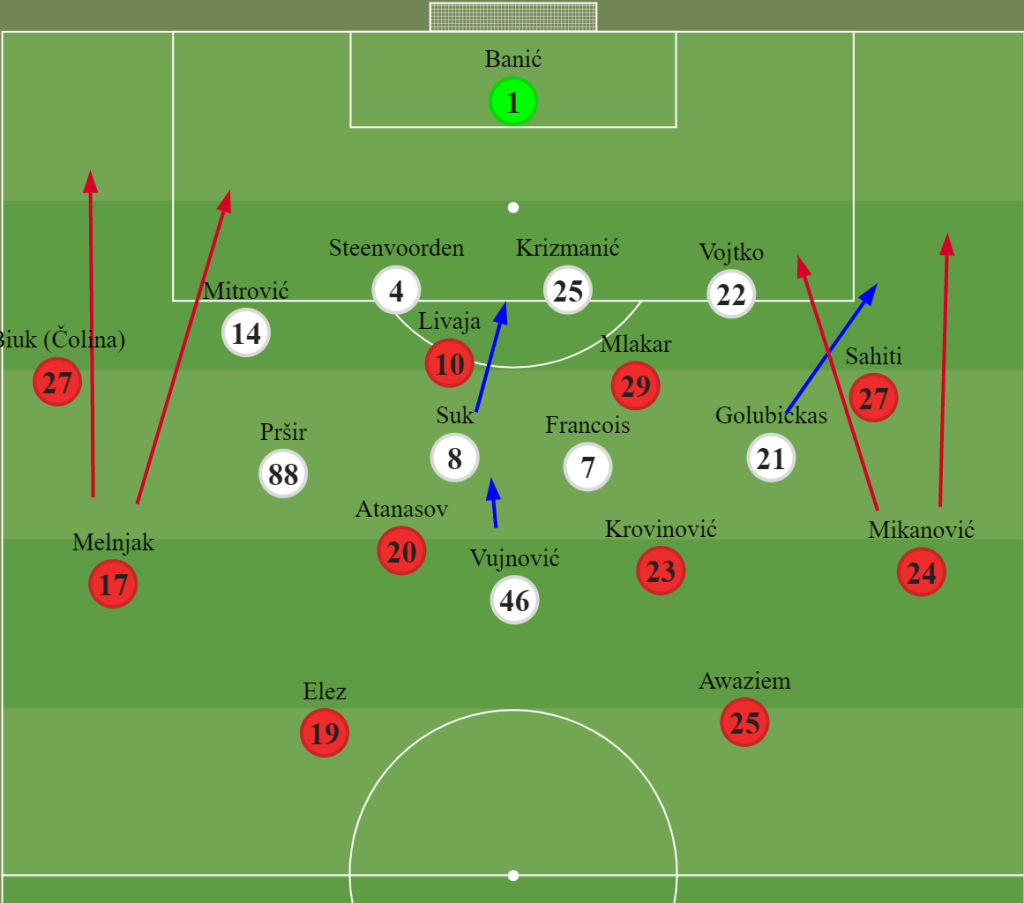
Karoglan placed Mlakar alongside Livaja, and Atanasov alongside Krovinović, Trying with many crosses. Both fullbacks, Melnjak and Mikanović, pushed upfield and tried to give a lot of crosses, even after a dribbling or 1vs1 situations. Both played an excellent game. Although Gorica defended well at the last minute lost concentration, receiving a goal when the game seemed over.
1. DINAMO – VARAŽDIN 3:1
This match was between two rivals playing the country’s most beautiful football. Kovačić, with necessary respect to all opponents that Varaždin encounters, has its style with a lot of ball possession that he represents in every game.
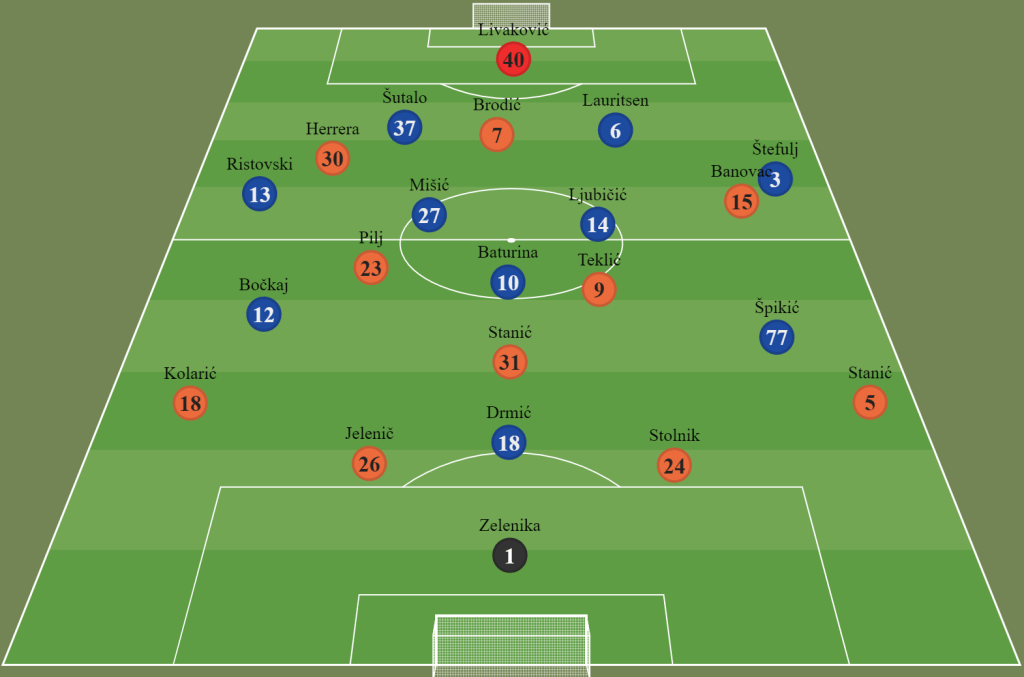
Dinamo decided to play with triangular 4231, Baturina taking place as more AMC, Mišić, and Ljubičić protecting his back a little more.
Varaždin took V midfield shape, with Stanić in the DMC position, Teklić on the semi-right, and Pilj on semi-left. Both Dinamo and Varaždin tried to exit pressure trough to pass, imposing triangular and diamond geometry on the field, Teklić being the leading architect of Varaždin’s game, and Mišić creating Dinamo’s game from deep.
Varaždin materialized their chance in the first half, but after receiving a red card, Varaždin was forced to take a more defensive approach. Kovačić changed shape, so they occasionally looked like they were playing the 621 system, especially when Dinamo penetrated flanks.
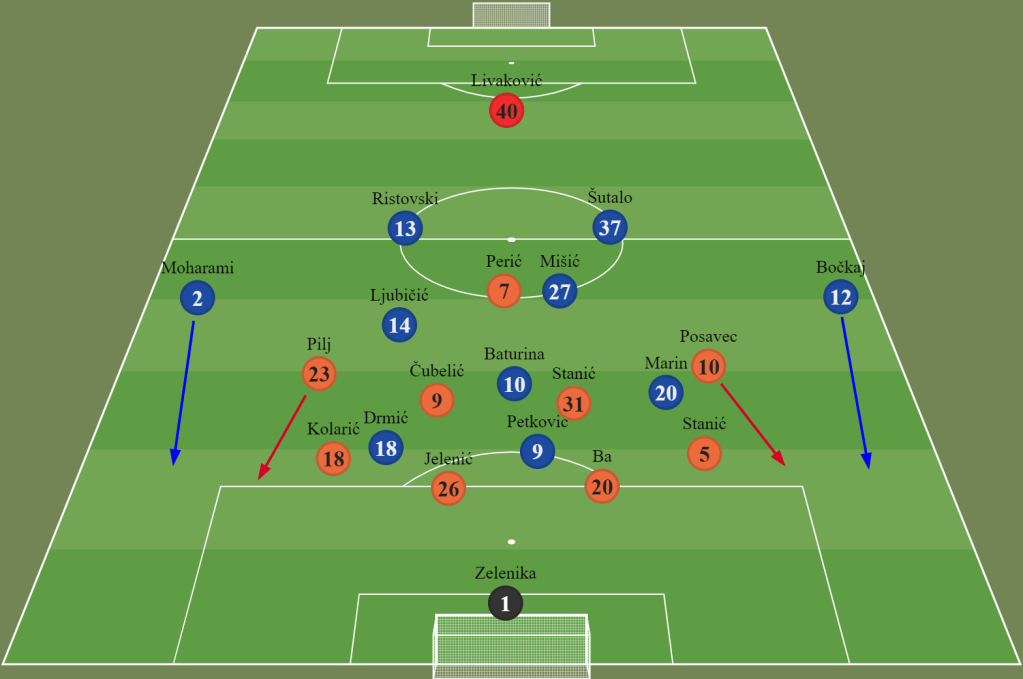
Dinamo took possession and dominated, creating clear goalscoring opportunities often.
Čačić changed the system in 442, imposing Petković alongside Drmić, putting Bočkaj in an LB position to gain from his great crosses. That gave his team a lot of presence in the 16-yard box. Petković scored two goals at the end, overturning the game entirely for Dinamo.
 Diamond Football Tactics