

Cosmi’s midfield diamond, Kovačević’s possession mindset, and Poms’s style and team standardization.

4. LOKOMOTIVA – ŠIBENIK 1:1
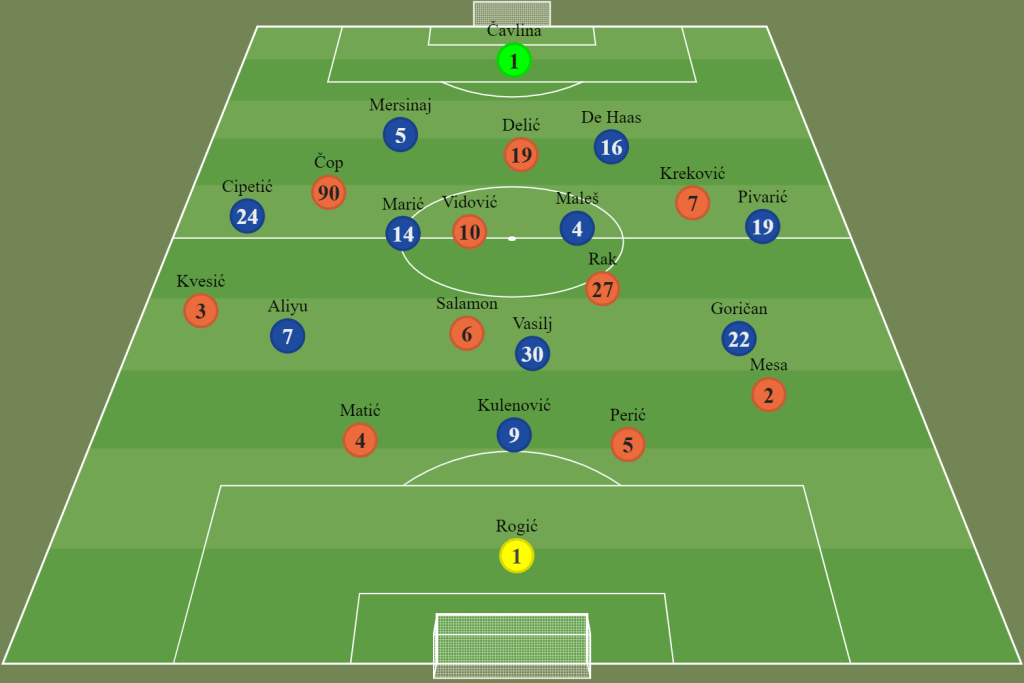
Both Čabraja (Lokomotiva) and Cvitanović (Šibenik) are still searching for a game plan to give the result.
Cvitanović is trying to implement the opening of the attack with 3 players from the back line (Mesa is staying more narrow), but it is not resulting in possession domination.
3. HAJDUK – VARAŽDIN 2:1
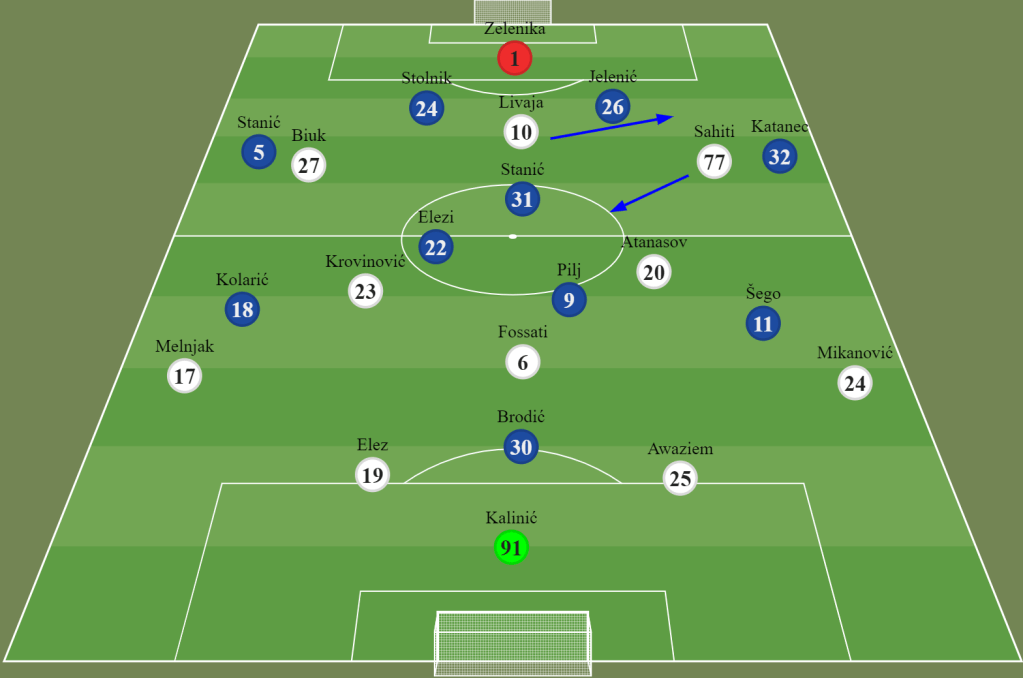
Varaždin’s coach Kovačević decided to stick to his ball possession style of play, although staying without a lot of players before this match, especially without his creative force Teklić. Playing his 433 system, transforming in 4231 in the defensive phase, with Pilj taking Teklić’s position. Varaždin played offensively, trying to bring the ball upfield even in the first 5 minutes when Hajduk pressed high up the pitch. Varaždin players made many passing mistakes, allowing Hajduk to be dangerous with its pressing. But after Hajduk’s pressing lost its intensity, although it was not as structured as it was energetic, Varaždin players started their triangular geometry and creative passing game that gave them a lot of chances, especially in the second half.
Varždin defended up the pitch whenever it was possible, trying to put Hajduk’s midfielders under pressure, playing men marking midfield when possible. Still, Hajduk took a bit of advantage in Sahiti’s and Livaja’s coming for the ball centrally in betwen the lines, making numerical superiorities in some parts of the game.
Kovačević made very interesting substitutions in the second half, allowing him to keep playing intensely without losing the playing idea. Čubelić, Hajduk’s midfield youngster on loan in Varaždin, came in for Stanić. Winger Posavec, for Šego, and winger Banovec, Varaždin’s homegrown youngster, came in for Katanec, Kolarić moving to the left fullback position, allowing space for Banovec on the right wing side.
Karoglan decided to enter the game with pressing and a lot of energy. Although Varaždin made many mistakes under pressure, Hajduk players failed to materialize them. Throughout the game, a lot of standardized tactical patterns were seen. In the opening of the attack, Hajduk sometimes played with three players at the back, meaning Melnjak stayed narrow, allowing the left side for Biuk and Krovinović to exploit. Playing against midfield man marking, Sahiti and Livaja would come to pick up the ball centrally, relieving Varaždin’s pressure a lot of times. Livaja roamed a lot, making him available centrally and on the flanks, often changing positions with Sahiti. In the first half, Sahiti made a lot of impact through individual actions, primarily through one-on-one situations. Hajduk players attacked the 16-yard box and were excellent in coming in goalscoring chances after taking the ball in the pressing, but missed a lot of them.
After pressing energy lowered, Varaždin players took the ball, making a lot of incredible passing opportunities. Karoglan didn’t find a solution for Varaždin’s playing style, and Varaždin controlled the game, making Hajduk suffer. Hajduk won, scoring a set peace, which is the most deficient part of Varaždin’s game. But it needs to be said that Kovačević’s Varaždin took complete tactical victory through the game plan and playing geometry. It looked as if Hajduk’s players lacked motivation throughout most of the second half. The game ended with Hajduk’s result win, but only because of individual players’ quality.
2. SLAVEN BELUPO – OSIJEK 0:4
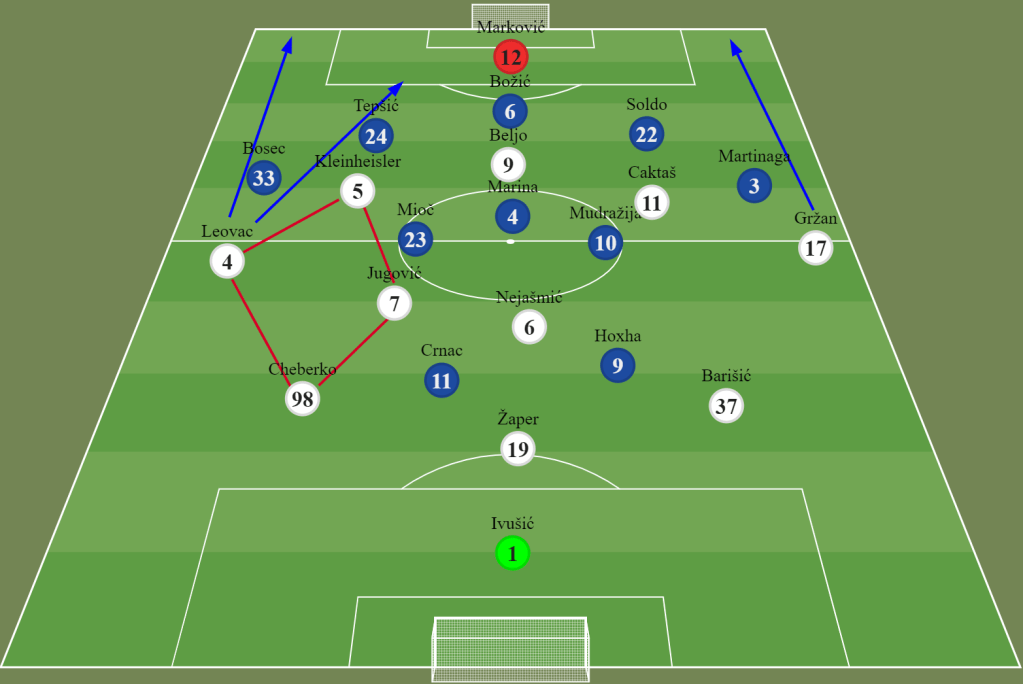
Osijek’s coach Poms standardized the style, team, and system (3421) of play. Osijek has a great mechanism on the left flank, where Jugović, Klenheisler, and Leovac create great chances through triangular and overlapping cooperation. The game paradigm of penetrating sides with back passes and crosses and attacking a 16-yard box is obviously something that gives Osijek results.
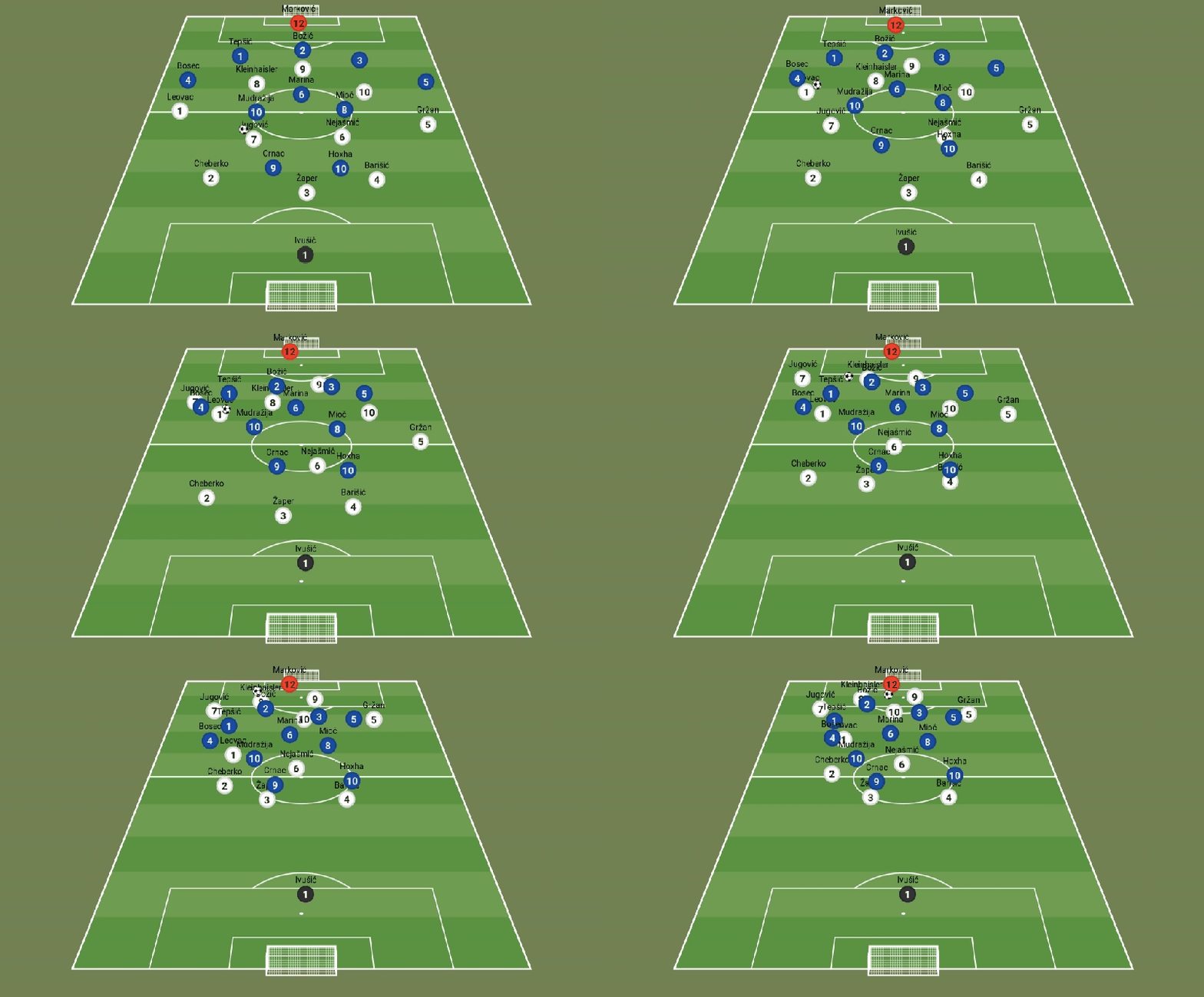
Caktaš and Kleinheisler are very technical and precise players taking advantage of Poms’s game system best of all players.
Zekić’s Belupo played defensive 532 and tried to attack mostly via counterattacks, especially at the end of the game, when Osijek players lovered their playing intensity and focus.
1 GORICA – RIJEKA 0:2

Rijeka’s coach Cosmi also started standardizing the game system and playing style. He introduced the 352 system of play and decided to stick with it. Last game versus Hajduk, he used a more defensive approach; in this game offensive plan was also presented. He chose to play in 3511 formations, this time in a midfield diamond shape that gave him ball possession control through numerical midfield superiority and a lot of triangular and rhombus geometry. Halilović played a free role and imposed himself on a ball. Frequently, giving tone and rhythm to Rijeka’s offensive play.
An interesting attacking approach was also seen on both flanks. Cosmi started the game with two fullbacks as central defenders on each side of middle central defender Pavlović. Smolčić, as a left-sided central defender, was overlapping left wing back Grgić when game dynamics allowed it and came to the left flank attacking third to make a cross. The same would happen when the ball arrived on the opposite side, where Vukčević overlapped wingback Ampem. If this situation occurred, the other two central backs positioned themselves more centrally to give defensive balance, and proper geometry in the case the ball was lost.
Gorica’s coach Angelovski has been imposing a traditional 4231 system since he arrived, but without much success.
 Diamond Football Tactics