

Zekić’s innovative defensive pressing geometry, Cosmi blocked Livaja with 532, and Poms’s great attacking dynamics with high wingbacks.

5. Rijeka – Hajduk 0:1
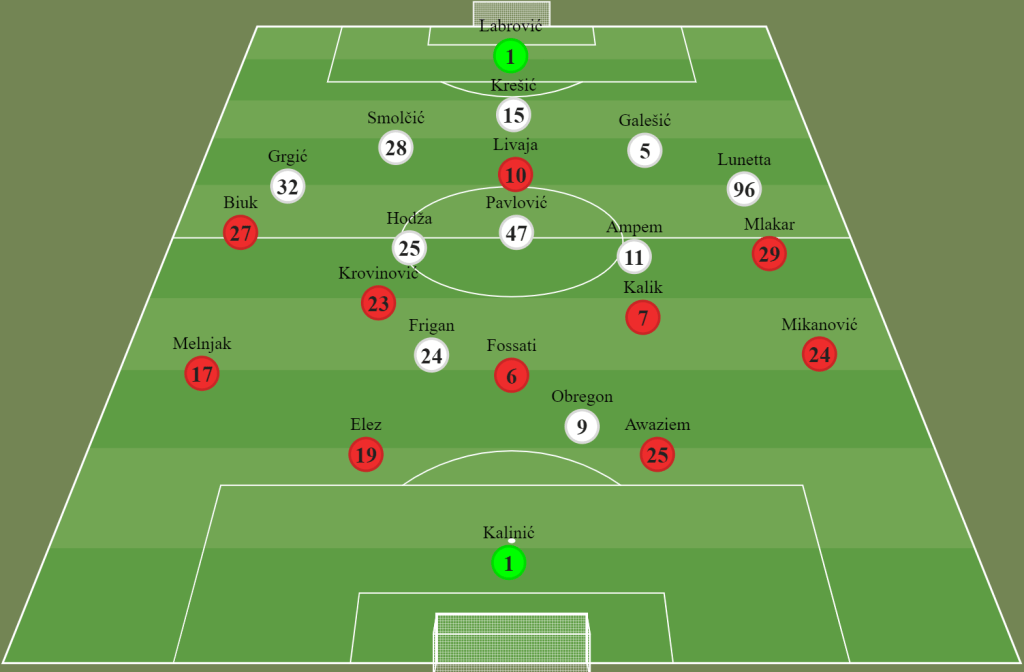
Cosmi decided to play in defensive guard, protecting space in front of a 16-yard box when defending low and trying to have a passive possession when attacking, spending match time with the ball. Because of numerical superiority in an opening third of the field (three DC against one FC), Rijeka could compete even with possession percentage but without depth progression. Putting six players (three central defenders and three midfielders) when defending in front of a 16-yard box meant that Livaja would have less maneuvering space. Cosmi invented Ampem (otherwise winger) in the LCM position to gain more motor skills in defending. Ampem still could participate in counterattacks from deeper positions, but Rijeka wasn’t dangerous in such situations. Cosmi’s plan worked defensively; if they didn’t receive an unlucky goal after the mistake, the plan would even give the result. The offensive plan didn’t show on the field. Frigan and Obregon were isolated and needed more balls from structured attacks or better transitions in counterattacks to be more dangerous on Hajduk’s goal.
Hajduk played in an almost standardized 433 with wide wingers but could not break Rijeka’s strong block. In the attack opening, Melnjak played more as third CB leaving the left side for Krovinović and Biuk to exploit. Hajduk’s attacks were well structured when players needed to transfer the ball in the attacking half, but whenever the ball entered in attacking third, Hajduk players would run out of an idea for how to create scoring chances.
At the end of the game, Hajduk’s coach, Karoglan, decided to protect the lead, changing the system in 541. In those times, Rijeka pushed up the field without any significant attacking paradigm or game impact.
Rijeka defended very well. If Cosmi had an idea of how to attack, the result would probably be much different.
4. Šibenik – Gorica 1:1
Šibenik changed coach the week before this match, looking for a more offensive style of play.
Šibenik with more possession 352/442, Gorica with more transition and counterattacking 4231. After red cards, the game took a bit of a wild and unorganized path, although Šibenik’s coach Cvitanović tried different systems during the match.
Both teams are still searching for their playing style and form to give them the result.
3. Varaždin – Istra 1961 1:1
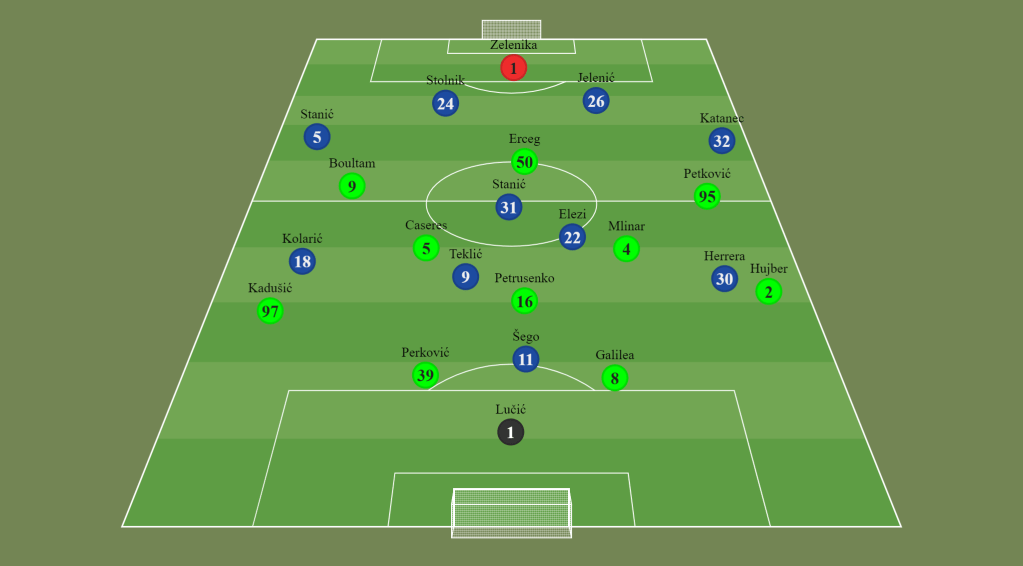
Vraždin and Istra played the expected match model. Both coaches (Kovačević and Garcia) have the same football philosophies, so both teams played possession-oriented games, with no press when defending or trying actively to take away the ball from the opposition. Both teams had phases when having ball dominance with long-time ball possession, not letting the other team take the ball.
As expected a lot of triangular geometry when attacking from both sides, with not much-changing rhythm (except when a ball would come to Teklić who played a very good free role) and occasionally man-marking in central midfield positions when defending, but very quickly dropping deep in the 4141 zonal marking system.
It was a mirror game in aspects of game geometry and philosophy.
2. Osijek – Lokomotiva 4:1
Lokomotiva played something that seemed 4231, but AMC Šotićek exploited the left side more when in attack and helped two holding midfielders when defending. Lokomotiva’s coach Čabraja used double pivot midfield, using Cipetić, otherwise LB, in one of two DMC positions, obviously trying to gain some physicality and aggression on second balls.

After Poms took over as Osijek’s team coach, Osijek changed their playing style completely, especially in the offensive phase. With more playing freedom triangular and rhombus geometry and not playing at full speed all the time, but changing rhythm depending on the result, game phase, and opponent, their game looks much more sophisticated now.
Because of injuries, Poms decided to put Žaper in the DC position alongside Barišić and Cheberko, playing in 3421 formations, with two DMC (Nejašmić and Jugović) that were giving stability and two AMC(Caktaš and Kleinheisler) that played more in halfspaces between the line, giving geometry and number superiority either in the middle of the field or on the flanks, depending the game flow. Both wing backs (Gržan and Leovac) were pushed upfield, making them play almost like wingers in the attacking phase, and allowing other players to go inside or around 16 meters box where they could be beneficial on crosses or bounced second balls.
Rhombus and triangular geometry and cooperation looked very well on the left side of the field, whereas through different forms of two or three players’ cooperation Kleinheisler and Leovac penetrated the left flank a lot. The right flank was also penetrated, but more thought individual skills of Gržan and Caktaš.
Osijek is a beautiful team to watch now, even in the offensive phase, and this game profile will allow their young attacker Beljo to develop more.
1. Dinamo – Slaven Belupo 4:1

Dinamo and Slaven Belupo played a tactically exciting match.
Dinamo played standardized Čačić’s 4123 formations for home league matches, trying ball circulation and possession domination through pass and patient attacking play.
Zoran Zekić introduced his team, playing aggressive 3421 with a midfield overload and adapting shape in pressing.
For 70 minutes, Dinamo had a big problem because Belupo was great at pressing and defending space by defending passing lanes and staying narrow. When the ball was passed a bit lightly between central defenders or toward the full-back, an attacking trio was triggered to lead the pressing, cutting one side of and covering Dinamo’s DMC Mišić, so Dinamo couldn’t change sides with the ball. The rest of Belupo’s team adjusted their positions depending on the side that was playing on, so Belupo’s midfield four changed shape a lot, covering space and then man-marking Dinamo’s midfield players.
When Dinamo penetrated through Belupo’s pressing, Belupo’s players came back in front of the 16-yard box, organized quickly in the zonal marking system, and covered space between the lines very well. In the first half, the central defending trio (Soldo, Tepšić, Božić) and goalkeeper (Matković) played very well and solved almost all crosses in the 16-yard box, with one exception that made the first-half result.

It was a great idea and shape, and it gave Zekić’s team a result 2/3rd of the game, especially in the first half when Dinamo couldn’t make quality chances. In the last third of the match, energy and concentration level dropped, so players started to be late in covering both space and Dinamo’s players, and individual errors occurred. Of course, Dinamo players knew how to punish those mistakes; after all, their quality for the domestic league is absolutely superior.

Ultimately, the result looks terrible, but Zekić’s idea and way of defending against such a quality opponent are creative and exciting.
 Diamond Football Tactics